Divorce and Separation in Vedic Astrology: What the Chart Can and Cannot Tell You
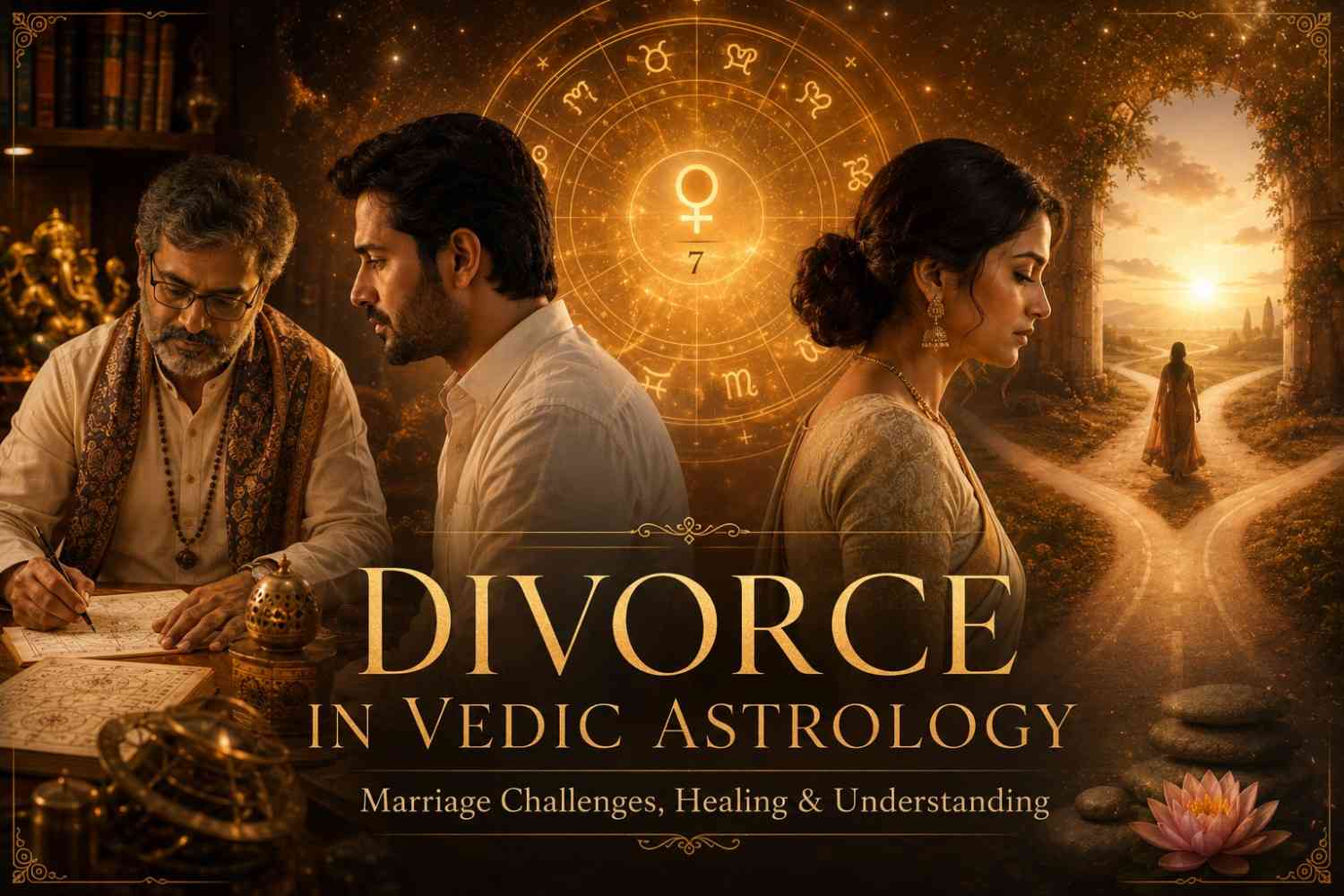
Vedic astrology examines marriage difficulty through the 7th house, Venus, Mars (Manglik), Saturn, and Rahu/Ketu afflictions—but these indicate tendencies, not fixed outcomes. A rigorous reading also checks mitigating factors and the Navamsha (D-9) chart. Difficult indicators don't predict divorce; human effort and choice matter equally.
- ◦A Framing Note Before the Technical Content
- ◦Marriage Difficulty Astrology — Quick Facts
- ◦The Houses Involved in Marriage Analysis
- ◦The Planets Involved
- ◦Classical Difficulty Indicators (Read as Tendencies, Not Verdicts)
- ◦The Mitigating Factors That Difficulty-Focused Readings Often Skip
- ◦The Navamsha (D-9) — A Note on Genuine Marriage Analysis
- ◦Common Scenarios — With Compassionate Framing
- ◦Honest and Compassionate Framing
- ◦Final Thought
Vedic astrology does have classical frameworks for looking at the marriage side of a chart — the houses tied to partnership, the planets linked to harmony or discord in marriage, and the combinations classically connected with separation.
But here's the thing that needs to be said up front, over and over: these are indicators of tendencies and challenge areas, not deterministic verdicts.
Marriages with "difficult" chart indicators often last and heal just fine.
Marriages without them sometimes still end.
This guide walks through the real analytical content, but keeps coming back to one point — human choice, effort, growth, and circumstance matter just as much as anything in the chart when it comes to a relationship.
A Framing Note Before the Technical Content
This topic really does deserve an honest note before we go further.
People asking about marriage difficulty are often in pain — dealing with a struggling marriage, worried about where their relationship is headed, or going through a separation already.
Some traditional interpretations of this material come from very different social contexts and can be pretty fatalistic.
So here's where this guide stands: chart indicators of marital difficulty are things to understand and work with consciously — they're not a sentence handed down in advance.
Astrology should never be used as a reason to walk away from a marriage that could be repaired, and it should never be used to make someone who's already struggling feel worse.
The real analytical content still has value, but only when it's held within a compassionate, non-deterministic frame.
That's the frame we're keeping throughout.
Marriage Difficulty Astrology — Quick Facts
| Factor | Details |
|---|---|
| Primary house | 7th house — marriage, spouse, partnership |
| Supporting houses | 8th (longevity of marriage, transformation), 2nd (family), 4th (domestic happiness), 12th (bed comforts, separation) |
| Relevant planets | Venus (relationships), Mars (conflict — Manglik factor), Saturn (distance, delay), Rahu/Ketu (disruption) |
| Difficulty indicators | Affliction to 7th house/lord/Venus by malefics without mitigation |
| Critical framing | Indicators are tendencies and challenge areas — never deterministic verdicts |
| What matters most | Conscious effort, communication, growth, and circumstance — alongside the chart |
The Houses Involved in Marriage Analysis
-
7th house — the main marriage house: the spouse, the partnership, and the relationship itself.
Its strength, how its lord is placed, and the influences on it form the core of any marriage analysis.
-
8th house — relates to how long a marriage lasts.
The 2nd from the 7th is about its sustenance, while the 8th concerns transformations and the rough patches a partnership goes through.
-
2nd house — family, the sustenance of the marriage, and the shared life built up over time.
-
4th house — domestic happiness and emotional grounding.
It is especially relevant to the home-life side of marriage.
-
12th house — bed comforts, intimacy, and in some classical frameworks, the separation dimension too.
-
The Lagna and Lagna lord — represent the self within the partnership and are central to the patterns a person tends to bring into relationships.
If you're unfamiliar with house meanings, planetary rulerships, and relationship analysis fundamentals, How to Read Your Vedic Birth Chart provides a useful foundation for understanding the chart factors discussed throughout this guide.
The Planets Involved
-
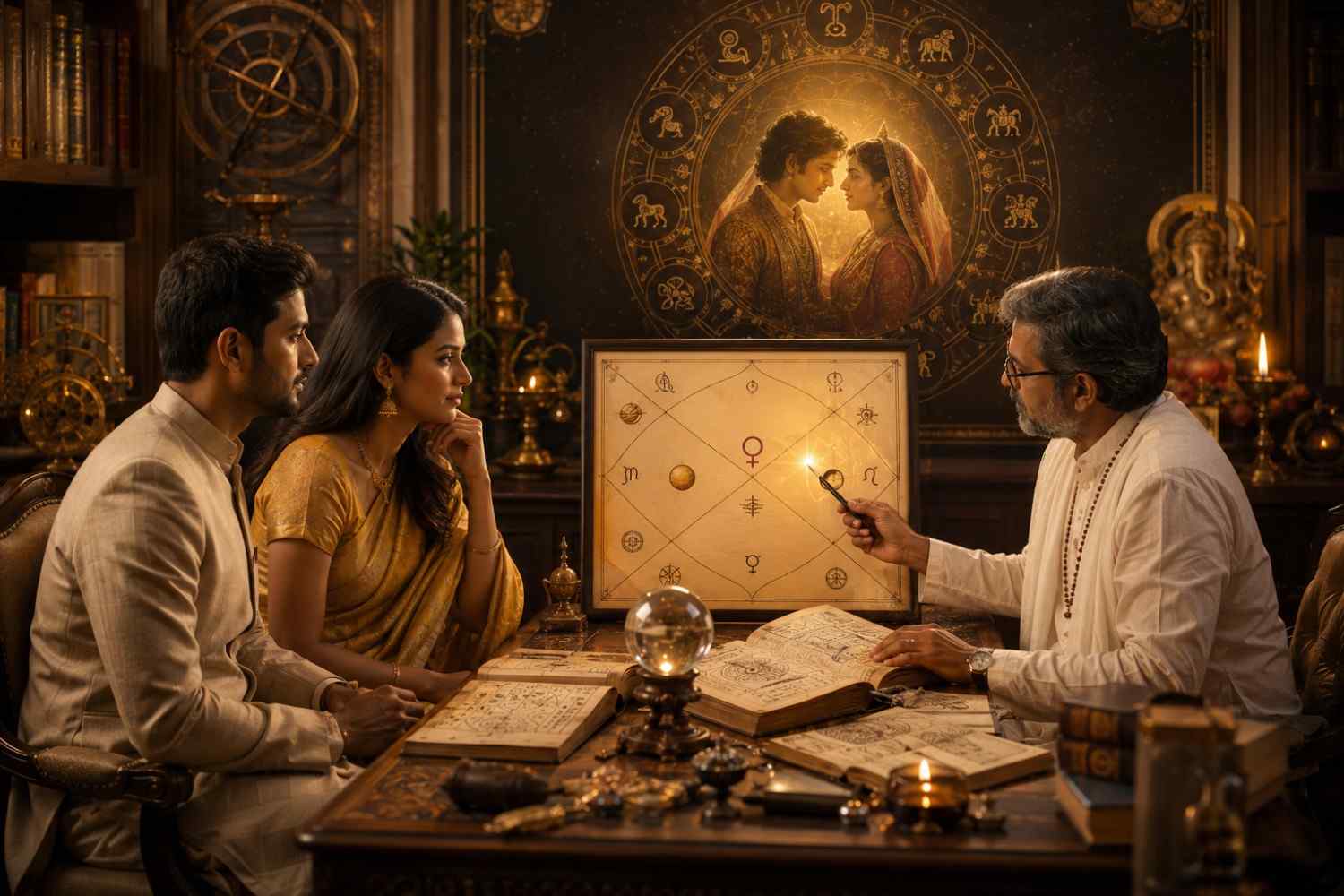
Venus — the natural significator of love, relationship, and marriage for everyone.
How strong or afflicted Venus is plays a central role in the overall marital-harmony picture.
-
Jupiter — the husband significator, especially in women's charts.
Jupiter's condition matters a lot when looking at marriage from this angle.
-
Mars — when it afflicts the 7th house or Venus, it's linked to conflict, intensity, and the Manglik factor.
This is one of the primary classical difficulty significators.
-
Saturn — when it afflicts the marriage houses, it's associated with distance, delay, coldness, or the kind of structural strain that can lead toward separation over time.
-
Rahu and Ketu — when they get involved with the marriage houses, they're linked to disruption, unconventional patterns, sudden change, or deeper karmic complexity in the relationship.
-
The Moon — represents the emotional side of things.
Its condition relates to how emotionally steady or volatile the relationship feels.
Classical Difficulty Indicators (Read as Tendencies, Not Verdicts)
Classical texts do connect certain combinations with marriage difficulty.
But the framing throughout stays the same — these point to tendencies and areas needing attention, not a marriage that's doomed to end.
-
Malefic affliction to the 7th house and/or its lord, without any mitigating benefic influence.
-
Venus heavily afflicted by Mars, Saturn, Rahu, or Ketu, without mitigation.
-
Mars afflicting the 7th house or Venus (the Manglik dimension) — especially when unmitigated and not matched between both partners.
-
The 7th lord sitting in a dusthana (6th, 8th, or 12th) without strength or benefic support.
-
Severe affliction hitting both the 7th house and the 8th house at the same time.
-
The 7th lord and a malefic planet caught in a difficult mutual relationship.
-
Certain challenging combinations involving the 6th house (which is the 12th from the 7th, relating to loss within partnership) together with the 7th.
And again — this is worth repeating — these combinations simply mean the marriage area of life is one that needs conscious attention and effort.
They don't mean divorce is fated.
Plenty of marriages with these exact indicators are sustained and healed through the genuine work the partners put in.
The chart points to where the work is needed.
It doesn't decide how that work turns out.
The Mitigating Factors That Difficulty-Focused Readings Often Skip
A genuinely careful reading doesn't just look at the difficulty indicators.
It also looks at the mitigating factors, which fatalistic readings tend to leave out entirely.
-
A benefic aspect on the 7th house or its lord — Jupiter's aspect in particular is a major mitigating factor.
-
A strong, well-placed Venus, even if there's some affliction to the 7th house.
-
A strong Lagna and Lagna lord — this reflects the person's own ability to navigate relationship challenges consciously.
-
Mutual Manglik status between both partners.
When the Manglik factor is matched on both sides, it's classically considered to soften the effect.
-
A strong Navamsha (D-9 divisional chart) — the main chart used for marriage analysis — even if the main chart shows some 7th-house affliction.
Readers interested in understanding how divisional charts work more broadly can explore Divisional Charts (Vargas) Explained.
-
The overall dasha sequence — whether the tough marriage indicators are active during a difficult period or a more supportive one.
-
The conscious effort, communication, and personal growth of the individuals involved.
None of these can be measured by the chart, and all of them usually shape the outcome more than any indicator does.
A reading that only talks about difficulty and skips these mitigating factors and the role of human effort isn't a thorough reading.
In a topic this sensitive, it's actually doing harm.
The Navamsha (D-9) — A Note on Genuine Marriage Analysis
A proper marriage analysis never relies on the main birth chart alone.
The Navamsha (D-9) is the main divisional chart used for marriage and partnership in Vedic astrology.
A serious look at someone's marriage prospects checks the D-9 Lagna and its lord, how the 7th house looks within the D-9, and where Venus and Jupiter sit in it.
The D-9 can change the picture quite a bit from what the main chart suggests.
Sometimes a main chart with 7th-house affliction is paired with a strong D-9 that softens that affliction considerably.
So any marriage-related claims based only on the main chart, without checking the D-9, aren't really following the proper classical method.
Marriage timing itself is a separate area of analysis.
Readers interested in understanding when supportive marriage periods are traditionally examined can also see Marriage Timing.
Questions involving remarriage may benefit from the dedicated guide on Second Marriage.
Common Scenarios — With Compassionate Framing

My marriage is struggling — does my chart show divorce?
Here's the honest, compassionate answer.
A chart can show whether the marriage area carries classical difficulty indicators, and whether the current period happens to be a tough one.
But it doesn't "show divorce" as some fixed outcome.
Plenty of marriages go through serious rough patches and come out the other side — often stronger than before.
If a chart shows difficulty indicators during a hard period, that's a sign this is a time that calls for conscious effort, and maybe some support too.
Counseling, better communication, and that kind of support can be valuable during challenging periods.
It's not a prediction that the marriage is going to end.
The most useful way to use astrology here is to understand the challenge — not to treat it like a forecast of doom.
Some readers also find it useful to revisit compatibility themes through Kundli Matching.
This can serve as another way of understanding areas of alignment, communication patterns, and challenge, rather than acting as a verdict on a relationship's future.
Is my difficult period in the marriage going to pass?
This is honestly a much more useful question, and one astrology can help with more directly.
The analysis can look at whether the current difficulty lines up with a challenging dasha or transit period.
Such periods often have a knowable end point, with a more supportive phase coming afterward.
Knowing a hard period has a horizon, and that the effort being put in now is building toward something better, can offer real and honest encouragement.
Should I leave my marriage? What does my chart say?
Astrology really shouldn't be answering this one.
Any astrologer who claims to give a definite answer here is overstepping.
Whether to leave a marriage is a deeply personal decision.
It involves safety, wellbeing, whether the relationship can realistically be repaired, and personal values that no chart can weigh in on.
At most, astrology can offer some context about which periods tend to be harder and which tend to be more supportive.
But the decision itself belongs to the person.
Ideally, it should be made with the help of counseling and trusted support systems, not a chart reading.
One thing overrides all of this without exception: if safety is at risk, that consideration comes before any astrological framing, full stop.
An astrologer said divorce is certain in my chart
Be really skeptical of this kind of statement.
"Certain divorce" just isn't something rigorous astrology can honestly claim.
It skips over mitigating factors, skips the D-9 analysis, ignores the huge role human effort and choice play, and can genuinely hurt someone who might be working hard to save their marriage.
Difficulty indicators are real and worth understanding.
But jumping from there to "certain divorce" is fatalistic overstatement and shouldn't be taken as authority on what will happen.
Honest and Compassionate Framing
-
Chart indicators of marital difficulty point to tendencies and challenge areas — never deterministic verdicts.
Marriages with difficult indicators often last and heal through the conscious effort of the people involved.
-
A genuinely rigorous analysis looks at mitigating factors and the Navamsha (D-9), not just the difficulty indicators in the main chart.
Readings that focus only on difficulty are incomplete — and in this area, that incompleteness can cause real harm.
-
Astrology should never be used as justification for leaving a marriage that could be repaired.
It should also never be used to add to the distress of someone who's already struggling.
-
Whether to leave a marriage is a deeply personal decision that belongs to the person involved.
Counseling and trusted support should guide that process, not a chart reading.
If safety is a concern, that overrides every other consideration entirely.
-
Be very wary of astrologers who declare divorce "certain," who use someone's marital anxiety to push expensive remedies, or who frame this whole area in fatalistic terms.
This is one of the cruelest forms of astrological exploitation out there.
-
The most humane way to use this kind of analysis is to understand which periods are harder and which are more supportive.
It can also help people find honest encouragement that tough phases do pass and identify where conscious effort is best directed.
It should never be treated as a verdict on a relationship's fate.
Get a Compassionate, Rigorous Marriage Analysis — Free on Vedaz
Vedaz looks at your 7th house, the marriage significators, the mitigating factors, and the Navamsha (D-9) divisional chart to give you an honest, non-fatalistic read on the marriage area of your chart.
This includes periods that are likely to be harder and periods that may feel more supportive.
Readers seeking relationship-focused chart discussions can explore Shubha AI.
Those navigating emotional strain, communication difficulties, or periods of separation may also find Mitra AI helpful.
Framed as understanding, never as a verdict.
Free at vedaz.io.
Final Thought
Marriage difficulty is one of the most sensitive questions Vedic astrology gets asked.
It's also an area where the gap between fatalistic and compassionate handling has real consequences for people going through real pain.
The genuine tradition does offer a way to look at this — the 7th house, the marriage significators, the classical difficulty combinations, and the Navamsha divisional chart.
But honest engagement holds onto one truth that fatalistic astrology tends to bury: these indicators describe tendencies and challenge areas, not verdicts.
Marriages with difficult indicators often last and heal through the conscious effort, communication, and growth of the people involved.
These are things the chart simply doesn't measure, and they usually matter more than any indicator does. The most a humane reading can offer is understanding.
It can point toward where the challenge lies, whether a difficult period has a known endpoint, and where conscious effort is best placed.
It should never offer a verdict on a relationship's fate. It should never become a reason to give up on a marriage that could be repaired. And it should never add to the distress of someone who is already struggling.
If safety is at risk, that overrides everything else, with no exceptions. The chart can shed light on the season and the work ahead.
But whether a marriage lasts, heals, or ends belongs to the people living it — to their effort, their choices, their circumstances, and where needed, to the support of counseling and people who genuinely care about them.
That's both the more honest and the more humane way to look at it.
Raghavendra Kulkarni
Predictive Astrology, Relationship Challenges & Horoscope Analysis | 18+ Years
Raghavendra Kulkarni specializes in analyzing relationship patterns, marital challenges, and significant life events through Vedic astrology. His work emphasizes balanced interpretations and encourages readers to view astrology as a tool for self-awareness and informed decision-making.
Frequently Asked Questions
1. Which house indicates divorce in Vedic astrology?
The 7th house is the main marriage house — its strength, how its lord is placed, and the influences on it are central to the picture. The 8th house (how long the marriage lasts and what transformations it goes through), the 2nd (family sustenance), the 4th (domestic happiness), and the 12th (intimacy and separation) all play a part too. But no single house "indicates divorce" as a fixed outcome — when these houses are afflicted, it points to areas of challenge and tendency, not a guaranteed result. A rigorous analysis also looks at the Navamsha (D-9), the main chart used for marriage.
2. What planetary combinations indicate marriage difficulty?
Classical indicators include malefic affliction to the 7th house or its lord without mitigation, a heavily afflicted Venus, Mars afflicting the 7th house or Venus (the Manglik dimension), the 7th lord placed in a dusthana without strength, and severe affliction hitting both the 7th and 8th houses at once. The key point, though, is that these are tendencies and areas of challenge the chart is highlighting — not proof that a marriage will end. A huge number of marriages with these exact indicators are sustained and healed through the conscious effort of the partners involved.
3. Does my chart having divorce indicators mean my marriage will end?
No. Chart indicators of marital difficulty are tendencies and challenge areas — not some predetermined sentence. Many marriages with difficult indicators go through tough times and come out the other side, often stronger. A thorough analysis also checks mitigating factors (benefic aspects, a strong Venus, the Navamsha D-9, the dasha sequence) and recognizes the huge role of human effort, communication, and growth — things the chart simply can't measure, and which usually shape the outcome more than any indicator does. The chart shows where the work is. It doesn't decide how that work turns out.
4. Why is the Navamsha (D-9) important for marriage analysis?
The Navamsha (D-9) is the main divisional chart for marriage and partnership in Vedic astrology. A proper analysis checks the D-9 Lagna and its lord, how the 7th house looks in the D-9, and where Venus and Jupiter sit there. The D-9 can shift the picture quite a bit from what the main chart suggests — sometimes a main chart showing 7th-house affliction pairs with a strong D-9 that softens it considerably. Marriage-related claims based only on the main chart, without checking the D-9, aren't really following the proper classical method.
5. Should I use astrology to decide whether to leave my marriage?
No. Whether to leave a marriage is a deeply personal decision involving safety, wellbeing, whether this specific relationship can realistically be repaired, and values that no chart can weigh in on. At most, astrology can offer some context about harder and more supportive periods — but the decision belongs to you, ideally with the support of counseling and people you trust, never a chart reading. And if safety is at risk, that consideration overrides all astrological framing entirely and should be acted on with proper support, regardless of what any chart says.
6. An astrologer told me divorce is certain in my chart — is that credible?
Be very skeptical. "Certain divorce" just isn't something rigorous astrology can honestly claim — it skips mitigating factors, skips the D-9 analysis, ignores the major role of human effort and choice, and it can genuinely hurt someone who might be working hard to save their marriage. Difficulty indicators are real and worth understanding, but jumping from "difficulty indicators" to "certain divorce" is fatalistic overstatement, not rigorous astrology — and it's actually one of the clearest signs of an astrologer worth avoiding.
Related Blogs

7 Secrets to a Happy Relationship Everyone Misses
Click to learn the top 7 secrets for a strong and happy relationship.

Boost Your Love Life with 5 Astrology Tips
Tap into cosmic wisdom to improve relationships, deepen emotional bonds, and attract real love with these 5 powerful astrology-backed love tips.

Unlock Love with VEDAZ’s Step by Step Romance Guide
Discover how to deepen your love life using astrology with this human, step-by-step guide that helps you align with cosmic timing and emotional insight.
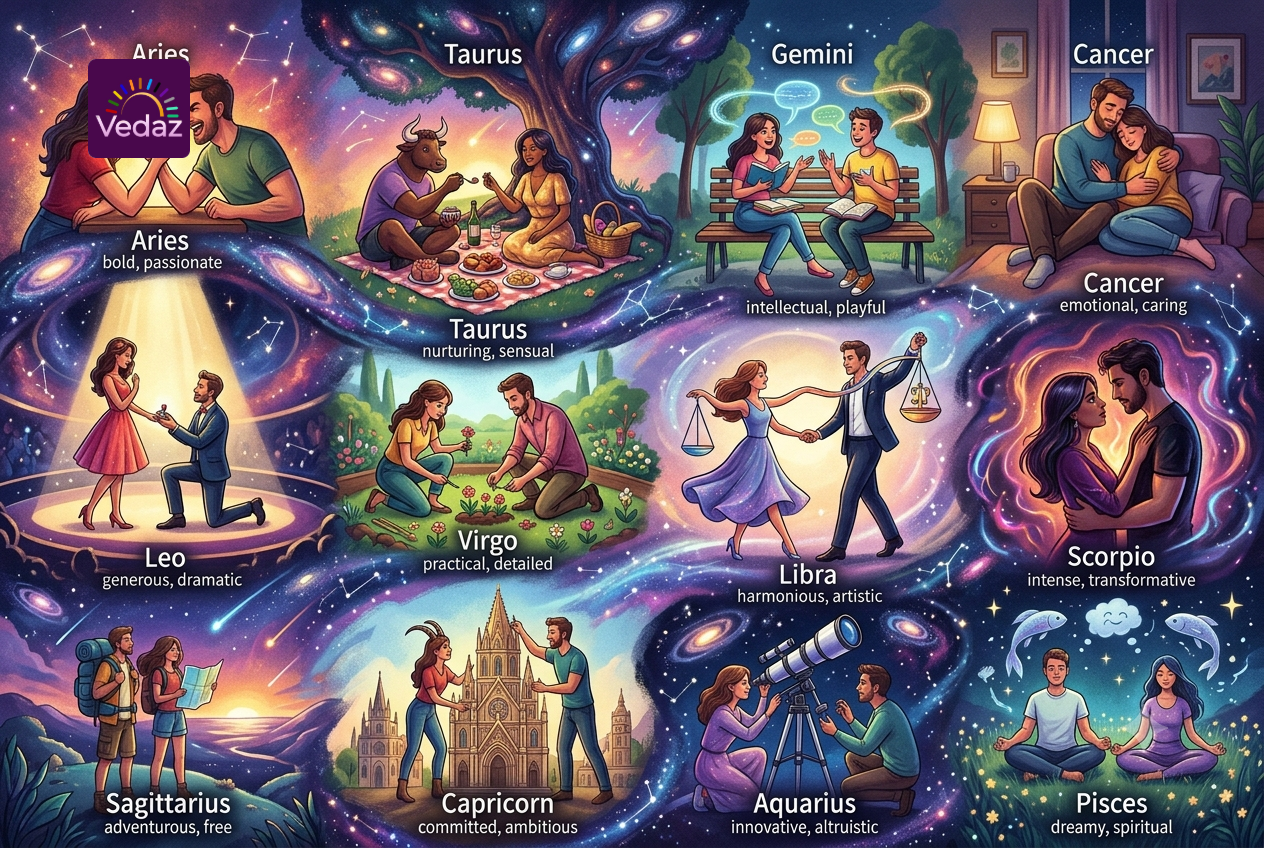
Ways of loving of each zodiac sign
Uncover the secrets behind each sign's way of loving and get inspired by their unique expressions of passion and care