Free Kundli Online: You Generated It — Now Here Is How to Actually Read It
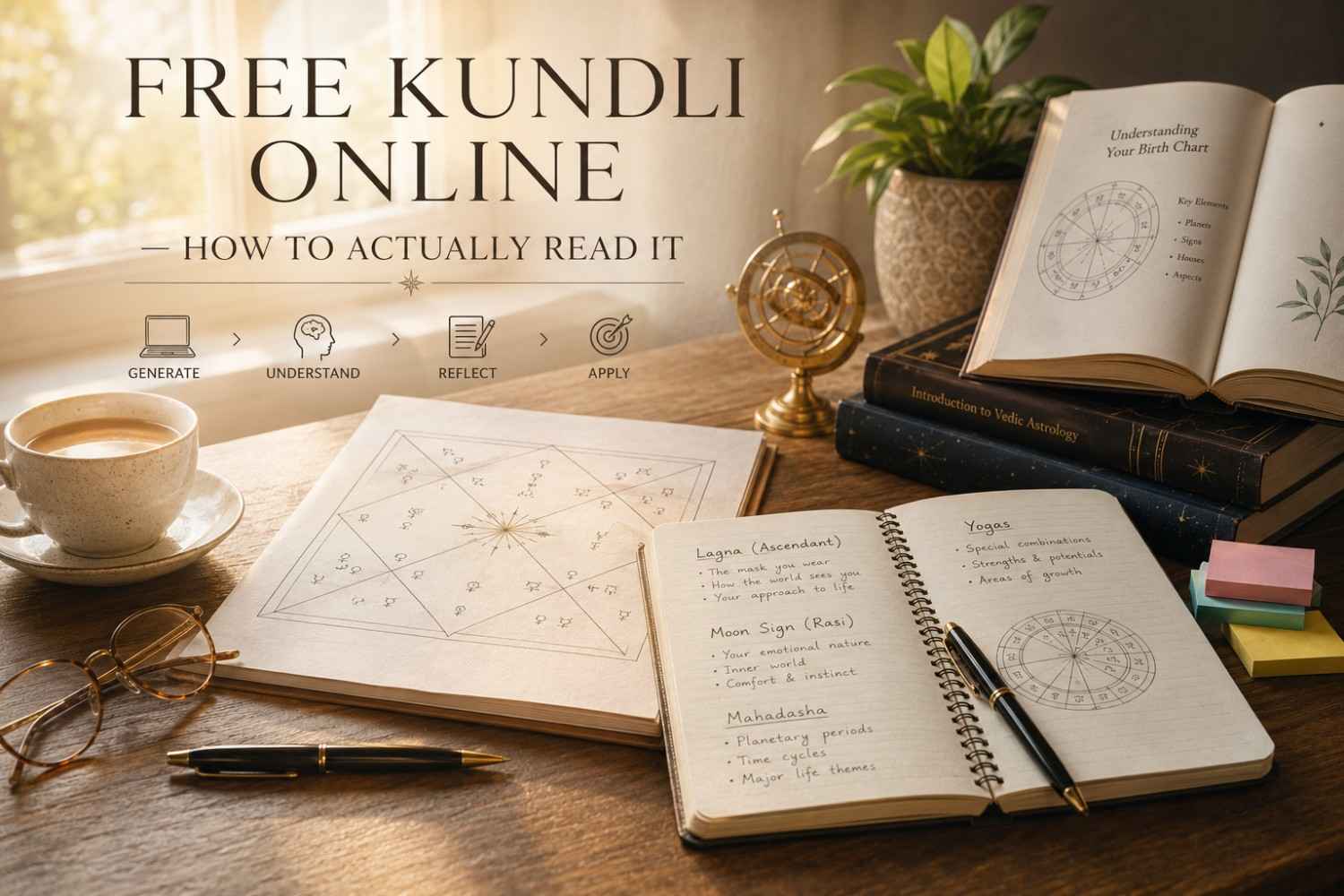
Generated a free kundli online but unsure what all the planets, houses, and symbols actually mean? This guide explains how to begin reading your chart honestly, including your Lagna, Moon sign, yogas, and Mahadasha, while avoiding fear-based interpretations and overly complicated astrology that creates confusion instead of understanding.
- ◦Quick Facts
- ◦Before You Read: Is Your Kundli Even Accurate?
- ◦Step 1 — Find Your Lagna (Ascendant)
- ◦Step 2 — Find Your Moon Sign (Rashi)
- ◦Step 3 — Locate the Sun, Moon, and Lagna Lord
- ◦Step 4 — Look for Major Yogas
- ◦Step 5 — Check Your Current Mahadasha
- ◦Step 6 — Go Deeper Without Getting Lost
- ◦Honest Framing
- ◦Generate and Understand Your Kundli Honestly — Vedaz
- ◦Final Thought
You generated your kundli, and now you're looking at a chart full of planets, houses, symbols, and unfamiliar terms without knowing what any of it means.
This is where most people get stuck.
Generating a kundli is easy. Understanding it is the hard part.
The good news is that you do not need to learn advanced astrology to start making sense of your chart. A few foundational concepts — your Lagna, Moon sign, key planetary placements, yogas, and current Mahadasha — can already tell you far more than most generic horoscope content online.
This guide walks through those basics step by step. The goal is simple: to help you understand your own chart with more clarity and confidence, without getting lost in technical jargon, fear-based interpretations, or unnecessary complexity.
Quick Facts
| Topic | Honest Answer |
|---|---|
| First thing to find | Your Lagna (Ascendant) |
| Second thing | Your Moon sign (Rashi) |
| Then | The Sun, Moon, and Lagna lord placements |
| Next layer | Yogas and your current Mahadasha |
| Most important requirement | Accurate birth time and sidereal calculation |
| Honest framing | A kundli is a reflective framework, not fixed fate |
Before You Read: Is Your Kundli Even Accurate?
Before interpreting anything, make sure the chart itself is accurate. This may sound obvious, but many beginners skip this step and immediately start reading meanings.
Two things matter most.
-
Use a Sidereal (Vedic) Chart
Vedic astrology uses the sidereal zodiac, while Western astrology usually uses the tropical zodiac. Because the two systems calculate planetary positions differently, the same birth details can produce noticeably different charts.
Many beginners accidentally generate a Western chart and then try to read it using Vedic astrology interpretations. This creates confusion almost immediately.
If your goal is Vedic astrology, make sure the chart was generated using a sidereal calculation.
-
Check Your Birth Time
Birth time matters more than many people realize.
Your Lagna changes roughly every two hours, and the entire house structure of the chart depends on it. If the birth time is significantly wrong, the chart may still look complete and professional, but many house placements and deeper interpretations can become unreliable.
Honest astrology should acknowledge this clearly. Accurate birth details create the strongest foundation for accurate interpretation.
Step 1 — Find Your Lagna (Ascendant)
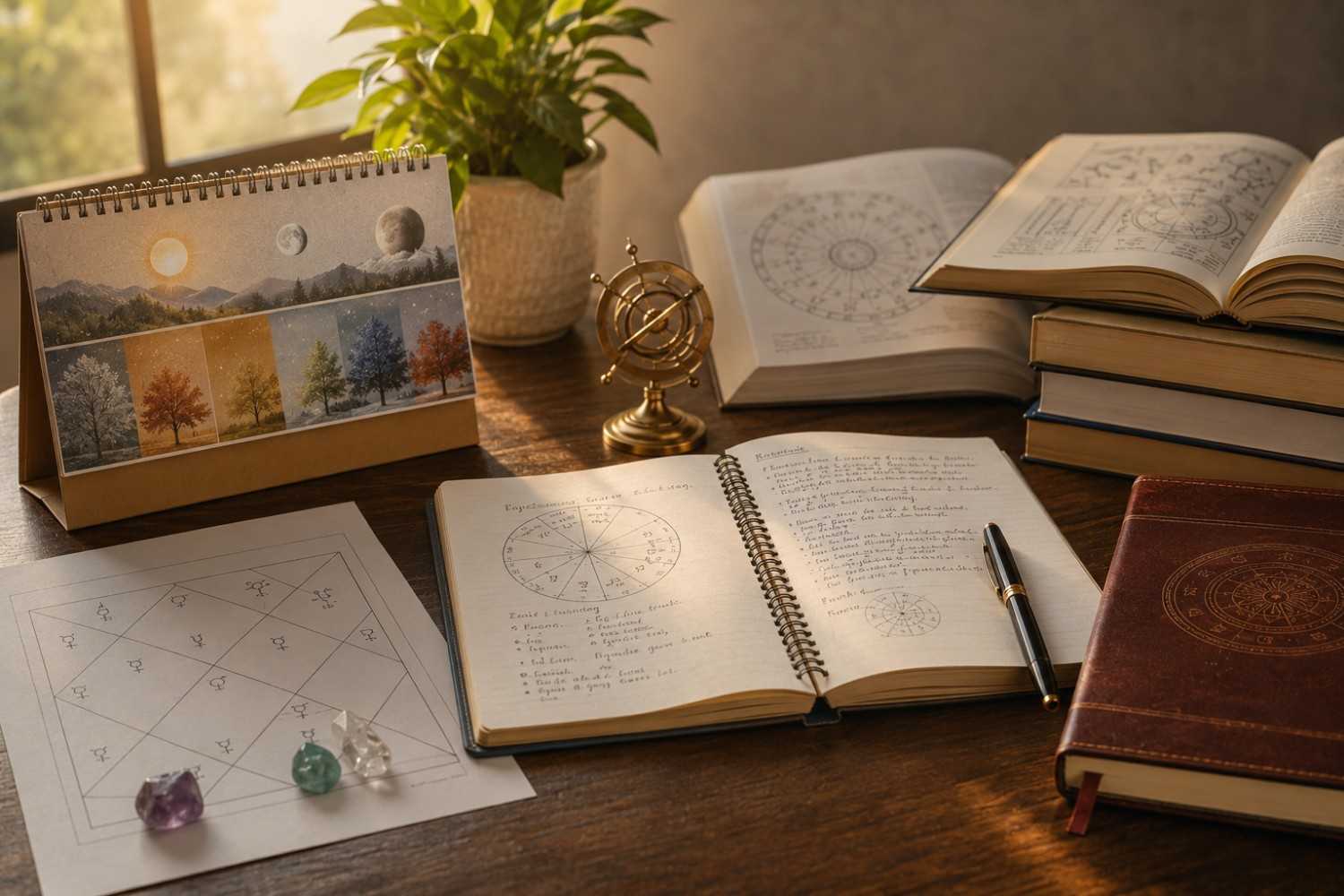
If you learn only one thing from your kundli today, make it your Lagna.
The Lagna, also called the Ascendant, is the zodiac sign rising on the eastern horizon at the exact moment you were born. On most charts it is marked as "Lagna," "Asc," or appears in the first house.
The reason astrologers pay so much attention to the Lagna is simple: it forms the foundation of the entire chart. Every house, planetary rulership, and life area is interpreted relative to it.
Broadly speaking, the Lagna reflects:
-
Your approach to life
-
How you engage with the world
-
Your natural style and instincts
-
The lens through which many experiences are filtered
This is one reason why reading about your Lagna sign often feels more personal than reading generic horoscope content online.
Understanding your Lagna first gives context to everything else that follows.
Step 2 — Find Your Moon Sign (Rashi)
Once you know your Lagna, the next thing to identify is your Moon sign.
In Vedic astrology, the Moon plays an extremely important role. While many people enter astrology through Sun-sign horoscopes, Vedic astrology traditionally places much greater emphasis on the Moon.
Your Moon sign, or Rashi, is simply the sign occupied by the Moon at birth.
The Moon is connected to:
-
Emotions
-
Mental patterns
-
Habits
-
Comfort and security
-
Inner experience
-
Emotional reactions
Much of Vedic predictive astrology, including dashas and kundli matching, uses the Moon sign as a major reference point.
Understanding your Rashi often gives valuable insight into how you experience life internally, even when it differs from how others see you.
Step 3 — Locate the Sun, Moon, and Lagna Lord
Once you know your Lagna and Moon sign, focus on three important placements.
-
The Sun
The Sun is broadly associated with:
-
Identity
-
Confidence
-
Vitality
-
Leadership
-
Self-expression
Its sign and house placement can show where these qualities naturally express themselves.
-
The Moon
The Moon reflects your emotional world.
It is associated with:
-
Feelings
-
Habits
-
Mental tendencies
-
Emotional comfort
-
Instinctive responses
The house placement often shows where emotional attention naturally concentrates.
-
The Lagna Lord
The Lagna lord is the ruling planet of your Ascendant sign.
For example:
-
Aries Lagna → Mars
-
Taurus Lagna → Venus
-
Gemini Lagna → Mercury
-
Cancer Lagna → Moon
-
Leo Lagna → Sun
The placement of the Lagna lord is often one of the most important parts of the chart because it shows where much of your energy, focus, and life development naturally flow.
Even a basic understanding of these three placements can provide more meaningful insight than most generic astrology content online.
Step 4 — Look for Major Yogas

This is usually the stage where people become excited.
They discover terms like Raja Yoga, Dhana Yoga, Gajakesari Yoga, or Panch Mahapurusha Yoga and immediately start searching for what they mean.
There is nothing wrong with that. Yogas can be important.
But there is one thing worth remembering:
A yoga being present is not the same thing as a yoga being powerful.
Many astrology websites highlight yogas because they sound impressive and positive. However, in serious astrology, a yoga's actual strength depends on many factors, including:
-
Planetary dignity
-
House placement
-
Planetary strength
-
Aspects
-
Combustion
-
Support from the rest of the chart
That is why two people can technically have the same yoga but experience very different outcomes.
Some common yogas beginners encounter include:
-
Raja Yoga
-
Dhana Yoga
-
Gajakesari Yoga
-
Panch Mahapurusha Yogas
Treat yoga announcements with curiosity rather than automatic belief. The existence of a yoga matters far less than its actual strength.
Step 5 — Check Your Current Mahadasha
If the birth chart shows the bigger picture, Mahadasha helps answer a different question:
What part of that picture is most active right now?
The your current Mahadasha is one of the most important timing tools in Vedic astrology.
Most kundli platforms automatically show:
-
Your current Mahadasha
-
Your current Antardasha
The planet ruling the Mahadasha often becomes especially important because its themes tend to receive greater emphasis during that period.
For example, someone running a Venus Mahadasha may experience stronger Venus-related themes than they would during a Saturn Mahadasha.
However, honesty matters here.
A Mahadasha is not:
-
A guaranteed marriage period
-
A guaranteed success period
-
A guaranteed disaster period
It is a timing framework. It highlights themes, tendencies, and areas of focus rather than guaranteeing specific events.
That distinction is important.
Step 6 — Go Deeper Without Getting Lost
Once you understand the basics, you can start exploring specific areas of life such as career, relationships, marriage, finances, education, or spirituality.
But two important cautions matter here.
-
Serious Analysis Uses Divisional Charts
The main birth chart is important, but it is not the only chart used in Vedic astrology.
Deeper analysis often involves the Varga charts, including:
-
Navamsha (D-9) — often used for marriage, relationships, and deeper life development
-
Dashamsha (D-10) — often used for career and professional matters
-
Saptamsha (D-7) — often used for children and lineage
If someone is making highly confident predictions about major life topics using only the main chart, it may be a sign that the analysis is incomplete.
-
Watch Out for the Fear Funnel
This is one of the most common patterns in online astrology.
A website identifies:
-
A dosha
-
A dangerous period
-
A curse
-
An affliction
-
A severe problem
And then immediately offers:
-
An expensive consultation
-
A costly remedy
-
A special puja
-
An urgent solution
That is not education.
That is a sales funnel.
A good astrology platform should leave you feeling:
-
More informed
-
More confident
-
More curious
-
More capable of understanding your chart
Not frightened.
Honest Framing
As you continue learning astrology, a few principles will help keep things grounded.
-
A kundli is a reflective framework, not a fixed-fate machine.
-
Accurate birth time matters more than most beginners realize.
-
Planetary placements describe tendencies and themes, not guaranteed outcomes.
-
Yogas vary enormously in strength and should not be sensationalized.
-
Deeper life topics often require divisional charts, not just the main birth chart.
-
Fear-plus-expensive-remedy patterns are usually sales tactics, not genuine education.
-
The healthiest relationship with astrology is understanding, not dependency.
Ultimately, learning astrology is less about memorizing meanings and more about reading your chart with enough confidence to ask better questions and avoid becoming dependent on dramatic interpretations.
Generate and Understand Your Kundli Honestly — Vedaz
Vedaz generates an accurate sidereal kundli and helps users understand the foundational layers clearly, including the Lagna, Moon sign, key placements, yogas, and current Mahadasha.
The goal is not to create fear or dependence. It is to help people understand their own charts with greater clarity and confidence.
People who are just beginning their astrology journey may also find Vidya AI helpful for exploring foundational concepts such as houses, planets, yogas, and dashas through a conversational learning experience.
Those who prefer asking chart-specific questions while learning may also enjoy exploring astrology concepts with Shubha AI, which is designed to discuss kundli basics, placements, and timing techniques in a non-fatalistic and beginner-friendly way.
Free at vedaz.io.
Final Thought
Many people generate a free kundli and immediately start searching for someone else to explain it.
But one of the most valuable things astrology can offer is understanding. The more you learn about your own chart, the less vulnerable you become to confusion, fear, and dependency.
You do not need to understand everything at once. Start with your Lagna, learn your Moon sign, understand your current Mahadasha, and build from there.
Astrology is a vast subject, but every experienced student started exactly where you are now: looking at a chart and trying to understand what they were seeing.
A good kundli should leave you more informed, more curious, and more grounded — not more confused or afraid. That is where meaningful learning begins.
Siddhant Vashishtha
Classical Jyotish, Birth Chart Interpretation & Foundational Astrology | 13+ Years
Siddhant Vashishtha is a Jyotish researcher specializing in birth chart interpretation, planetary analysis, and foundational Vedic astrology concepts. His work focuses on helping readers understand the building blocks of Vedic astrology, including houses, planets, signs, dashas, and divisional charts, making traditional teachings accessible to modern readers.
Frequently Asked Questions
1. I generated a free kundli. Where should I start reading it?
Start with the foundations in order. First find your Lagna (Ascendant), because it determines the entire structure of the chart. Then identify your Moon sign (Rashi), which is the primary emotional and predictive reference point in Vedic astrology. After that, look at the placements of the Sun, Moon, and Lagna lord by sign and house. Finally, check your current Mahadasha and any major yogas. This sequence gives a meaningful first understanding of the chart without getting lost in unnecessary complexity.
2. Why is birth time so important in a kundli?
Because the Lagna changes roughly every two hours, and the entire house structure depends on it. Even a moderately inaccurate birth time can shift planets into different houses and change interpretations significantly. It is also important that the chart uses sidereal (Vedic) calculation rather than tropical (Western) calculation, since the two systems place planets differently.
3. What is the difference between my Lagna and my Moon sign?
Your Lagna (Ascendant) is the sign rising on the eastern horizon at birth, and it forms the structural foundation of the entire chart. It broadly reflects your approach to life and how you engage with the world. Your Moon sign (Rashi) is the sign occupied by the Moon and relates more to emotions, mental patterns, and inner experience. In Vedic astrology, both are important, but the Moon sign is especially central to predictive techniques and kundli matching.
4. My chart says I have a Raja Yoga. Does that automatically mean success?
Not necessarily. Raja Yogas are among the most over-marketed concepts in astrology. A yoga being present in the chart does not automatically make it powerful or life-changing. Its actual influence depends on the condition, dignity, placement, and strength of the planets involved. A rigorous reading evaluates whether the yoga is genuinely strong instead of simply announcing its existence dramatically.
5. What is a Mahadasha and why does it matter?
The Mahadasha system is the timing framework in Vedic astrology. It indicates which planetary themes are currently more active in your life. Most kundli tools show your current Mahadasha and Antardasha automatically. The ruling planet of the period shapes the broader life themes being emphasized, but it should be understood as a timing tendency rather than a guarantee of specific events.
6. How do I go deeper into astrology without falling into fear-based content?
Look for educational guidance that explains houses, planets, dashas, and divisional charts honestly instead of immediately surfacing frightening doshas or “dangerous” predictions. Rigorous astrology uses divisional charts like the Navamsha (D-9) for marriage or Dashamsha (D-10) for career, rather than relying only on the main chart. Most importantly, avoid platforms that create fear and immediately push expensive remedies or urgent consultations as the solution.
Related Blogs
Dreaming of moving abroad? Check Foreign Travel Astrology
Is your destiny written in the stars? Discover if the universe is guiding you toward a life abroad!
The Best Places to Travel Abroad Foreign Travel Astrology
Is foreign travel written in your stars? Explore how astrology influences your journeys and uncover the best destinations for your zodiac sign!
Can Your Birth Chart Predict Depression Symptoms?
This article examines whether astrological birth charts can predict depression symptoms, contrasting astrological beliefs with psychological research on personality traits and mental health.
The Manifestation Secrets Hidden in Celebrity Birth Charts
Find out what makes fame unique and special. This guide lets you know how some of the biggest celebrities use planetary help to become successful—and how you can do the same.