Health in Vedic Astrology: How the Tradition Approaches Wellbeing, Why It Never Predicts Lifespan
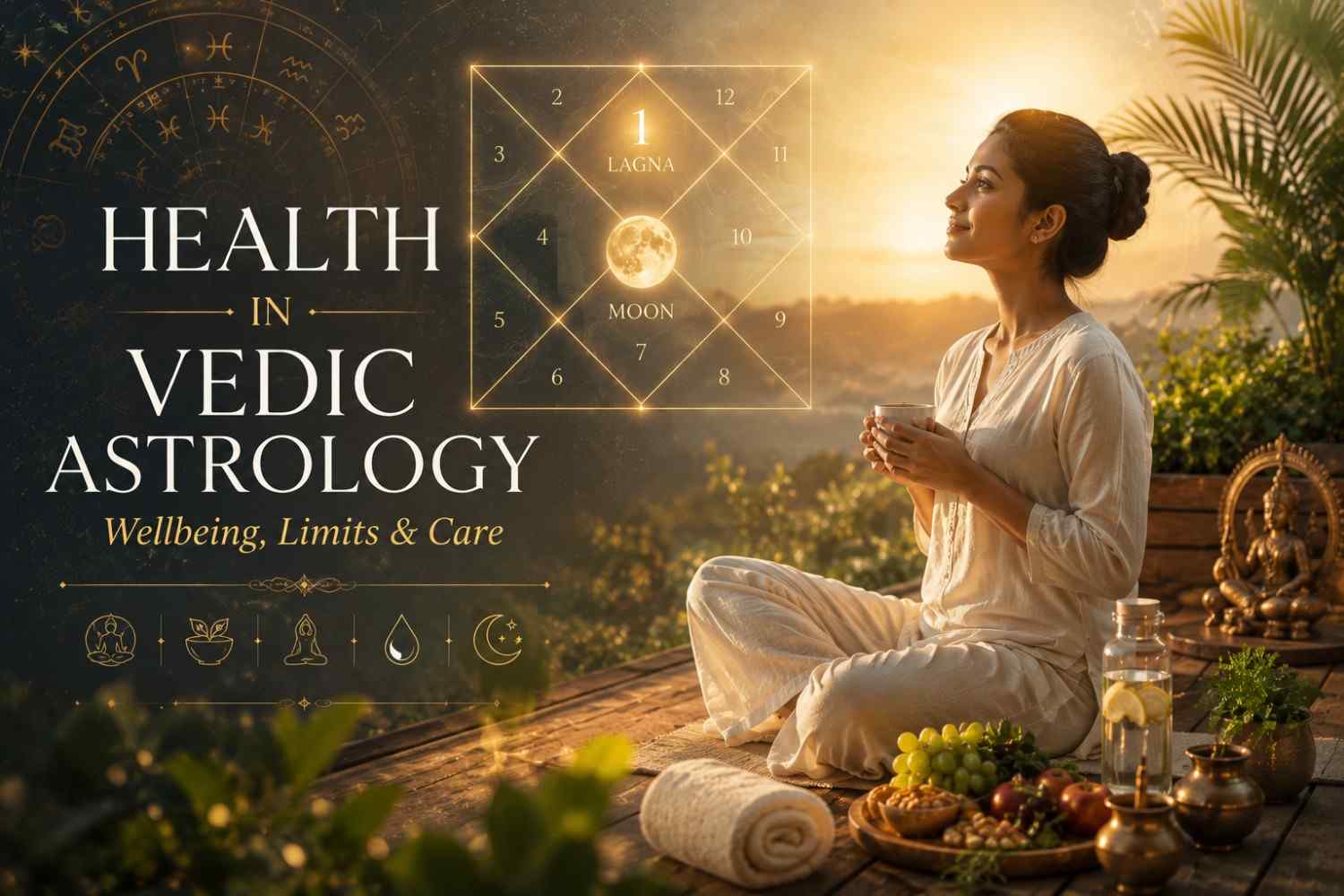
Health in Vedic astrology is traditionally viewed through the 1st house, Lagna lord, Moon, and general vitality indicators.
The framework offers broad wellbeing perspectives rather than medical diagnosis or lifespan prediction, emphasizing healthy living, emotional resilience, and the importance of qualified medical care for all health concerns.
- ◦The Essential Framing — Read This First
- ◦Health Astrology Quick Facts
- ◦How the Classical Tradition Relates to the Body — In Broad Terms Only
- ◦Why Health Astrology Requires the Firmest Framing of All
- ◦What Astrology Can Honestly and Constructively Offer Around Health
- ◦Common Scenarios — Each Answered With Medical Primacy
- ◦A Note on Distress
- ◦Honest Framing — The Whole Position in Brief
- ◦Final Thought
Questions about health are some of the most natural ones people bring to any reflective tradition, and Vedic astrology does have a classical way of looking at the body, vitality, and overall wellbeing.
But out of every topic in this library, health and longevity need the firmest and most careful framing.
This is the area where fatalistic astrology causes the most real harm, and where the gap between what the tradition can honestly say and what exploitative practitioners claim is at its widest and most dangerous.
This guide explains how the classical tradition looks at the health side of a chart, says clearly and repeatedly what astrology cannot and must not do here, and keeps coming back to one central point: qualified medical care is the foundation of health.
Nothing in astrology replaces it, delays it, or overrides it.
The Essential Framing — Read This First
Before we get into any classical material, here are the points that govern everything in this guide.
First, Vedic astrology does not predict lifespan, and no responsible use of it tries to.
Classical texts do contain longevity (ayur) frameworks, but even within the tradition, their interpretation is seen as one of the most uncertain and contested areas.
Using them to tell someone how long they'll live is both unsupportable and harmful.
This guide doesn't offer longevity prediction methods, and it rejects their use outright.
Second, astrology does not diagnose illness.
A chart can't tell you what disease you have or will get.
Third, qualified medical professionals are the only appropriate source for diagnosis, treatment, and health guidance.
Astrology isn't a supplement to medicine, a second opinion, or a reason to put off care.
If you have a health concern, the right move is to see a doctor — not to consult a chart.
These aren't small caveats tacked on for safety.
They're the foundation, and they hold true everywhere in this guide.
Health Astrology Quick Facts
| Aspect | What's True |
|---|---|
| What the tradition addresses | General vitality themes, the 1st house and its lord, broad wellbeing perspective |
| What it does NOT do | Predict lifespan, diagnose illness, identify diseases, substitute for medical care |
| Primary house (general vitality) | 1st house — the body and constitutional vitality, in broad terms only |
| The only appropriate health authority | Qualified medical professionals — without exception |
| Longevity prediction | Explicitly rejected as unsupportable and harmful |
| Genuine constructive role | Encouraging general wellbeing practices; supporting calm during illness |
How the Classical Tradition Relates to the Body — In Broad Terms Only

The classical tradition links the 1st house (the Lagna) and its lord to the physical body and general constitutional vitality, and connects the Moon to general wellbeing and the mind-body link.
In very broad terms, a strong, well-supported Lagna is treated as relating to robust general vitality — offering the kind of broad constitutional perspective that traditional wellbeing systems, like Ayurveda (which shares roots with Vedic astrology), have long offered.
But here's where the honest framing has to be explicit about scope.
This general constitutional perspective is exactly that: general and constitutional, the way a traditional wellbeing system might talk about broad tendencies — say, needing more rest, or benefiting from a particular kind of lifestyle balance.
It is not, and should never be treated as, information about specific illnesses, medical conditions, or health events.
The jump from "the tradition links the Lagna to general vitality" to "your chart shows you'll develop a specific disease" is exactly the kind of dangerous overreach this guide exists to push back on.
The classical material can support broad lifestyle reflection at most — never a medical conclusion.
If you're unfamiliar with the houses, planetary rulerships, and chart structure referenced throughout this guide, How to Read Your Vedic Birth Chart provides a useful introduction to understanding the foundations of Vedic chart interpretation.
Some branches of Vedic astrology also use specialized divisional charts to examine particular areas of life in greater detail.
Readers interested in understanding how these supplementary charts are traditionally used can explore Saptamsha (D-7) chart, alongside the broader divisional-chart framework.
However, no divisional chart is considered a tool for medical diagnosis or lifespan prediction.
Why Health Astrology Requires the Firmest Framing of All
Health is the area where fatalistic astrology does the most concrete damage.
Here's why, stated plainly:
-
Predictions of illness or a short lifespan can cause serious psychological harm — health anxiety, despair, and in the worst cases, a real crisis.
No astrological claim is worth that risk, and the tradition's genuine content doesn't support such claims to begin with.
-
Astrological health claims can lead people to delay or avoid medical care, believing a remedy will fix what is actually a medical condition that needs treatment.
That delay can cause serious, sometimes irreversible harm.
-
Exploitative practitioners use health fear to sell expensive remedies — one of the cruelest forms of astrological exploitation, since it preys on people at their most vulnerable.
-
Self-fulfilling distress is real too: being told your chart points to a health catastrophe can itself wear down your wellbeing through the stress it creates, regardless of whether there's any medical truth behind it.
Because of all this, the only responsible position is that astrology does not make health predictions or diagnoses — full stop.
Any practitioner who does should be avoided.
If you take just one thing away from this guide, take this: a chart is not a medical document.
No astrologer can tell you what illness you have or how long you'll live, and anyone who claims otherwise is both wrong and potentially dangerous to your wellbeing.
The right response to any health question or concern is medical, not astrological.
What Astrology Can Honestly and Constructively Offer Around Health
Having said firmly what astrology can't do, there is a small, genuine role it can play — but only within a wellbeing-support frame, never a predictive or diagnostic one.
-
Encouraging general wellbeing practices.
Many of the lifestyle habits the broader tradition recommends — a steady routine, enough rest, moderation, time in nature, contemplative practice, community — are simply sound general wellbeing practices that line up with what modern health guidance also recommends.
Used this way, astrology is a cultural vehicle for encouraging healthy living, not a predictive tool.
-
Supporting psychological calm during illness.
For someone already under medical care, spiritual and contemplative practices — prayer, mantra, meditation — can offer real psychological comfort and resilience during a hard time.
This is support for the person's inner state, completely separate from any claim about the medical condition itself, and it sits alongside medical treatment, never in place of it.
-
Encouraging timely medical attention.
A responsible astrologer, when asked a health question, points the person toward medical care.
The most ethical thing astrology can do with a health question is decline to answer it astrologically and point firmly toward a doctor.
-
General lifestyle reflection.
At most, the broad constitutional perspective the tradition offers can prompt some reflection on lifestyle balance — rest, stress, routine — the kind of reflection any wellbeing framework might prompt, with no diagnostic content involved.
Major health challenges and wellbeing priorities can sometimes prompt broader reassessments of work, purpose, and lifestyle.
Readers navigating significant professional transitions alongside wellbeing concerns may also find Career Change Timing useful for understanding how astrology traditionally approaches periods of change and redirection.
Common Scenarios — Each Answered With Medical Primacy

"What does my chart say about my health?"
At most, the tradition offers the kind of broad general-vitality perspective a traditional wellbeing system might offer — nothing specific, diagnostic, or predictive.
If you have any health concern, the meaningful step is a medical consultation.
A chart can't tell you anything actionable about your health; a doctor can.
Some people also become more interested in stability, predictable routines, and long-term security following periods of health-related stress.
In those situations, Government Job Astrology may provide additional context on career paths traditionally associated with structure and continuity.
"An astrologer said my chart shows a serious health problem — what should I do?"
First and most important: see a qualified doctor for any real health concern, and don't carry the astrological claim around as if it were a medical fact — because it isn't one.
An astrologer can't diagnose illness, and a claim like this is an overreach that shouldn't be taken as authoritative or treated as a medical finding.
If the claim itself is causing you anxiety, that anxiety is worth taking seriously too — talking to a doctor about the actual health question, and to a mental health professional or trusted person if the distress is significant, is the right path.
The astrological claim carries no medical weight.
"How long will I live?"
This guide doesn't answer this question, and rejects the idea that astrology can.
Classical longevity frameworks exist, but even within the tradition their interpretation is seen as one of the most uncertain areas — and using them to tell someone their lifespan is unsupportable and harmful.
No responsible practitioner answers this question.
If it comes up because of health anxiety or fear about mortality, that's a deeply human concern best supported by people who can genuinely help: doctors for health questions, and trusted people or mental health professionals for the anxiety itself.
A chart has nothing real to offer here, and the kindest thing is to say so plainly.
"Can a remedy cure my illness?"
No.
Spiritual and contemplative practices can offer genuine psychological comfort to someone who is also receiving proper medical treatment, but they aren't a cure for medical conditions and should never replace or delay medical care.
Any practitioner offering a remedy as a substitute for real medical treatment is putting that person at risk.
Medical conditions need medical treatment; spiritual practice's role is supporting the person's inner state alongside that treatment — never instead of it.
A Note on Distress
Sometimes a question about health or longevity doesn't come from idle curiosity — it comes from real distress: health anxiety, fear about mortality, or a hard period emotionally.
If that's where you're coming from, please know this is a deeply human thing to feel, and the most caring response isn't an astrological answer — it's real support.
For health concerns, a doctor can address the actual question and is the right place to start.
If the distress itself feels heavy — persistent anxiety, hopelessness, or thoughts of self-harm — please reach out to a mental health professional, a trusted person in your life, or a helpline in your area.
These feelings deserve real care and support, and you don't have to carry them alone.
A chart can't help with this, but people can, and reaching out to them is the strong and right thing to do.
For some individuals, ongoing wellbeing concerns can also influence decisions about workload, flexibility, and professional direction.
Our guide on Business vs Job explores another dimension of balancing career choices with broader quality-of-life considerations.
Honest Framing — The Whole Position in Brief
-
Vedic astrology does not predict lifespan and does not diagnose illness. This guide rejects both outright and provides no methods for either.
-
Qualified medical care is the irreplaceable foundation of health.
Astrology is not a supplement, a second opinion, or a reason to delay care.
Any health concern calls for a doctor, not a chart.
-
The tradition's genuine content is, at most, a broad general-vitality perspective — the kind any traditional wellbeing system offers — never specific, diagnostic, or predictive.
-
Astrology's only constructive role here is encouraging sound general wellbeing practices and offering psychological comfort to someone already under medical care — alongside treatment, never instead of it.
-
Be deeply skeptical of any astrologer who predicts illness or lifespan, who uses health fear to sell remedies, or who offers astrological remedies as substitutes for medical care.
This is among the most harmful exploitation in the field, and steering clear of it protects your wellbeing.
-
If a health question comes from distress, the caring response is real support — medical care for the health concern, and trusted people or mental health professionals for the distress itself.
A chart can't help here; people can.
-
A note on how Vedaz approaches health questions
Vedaz does not provide health predictions, longevity readings, or diagnostic claims, and will direct any health concern toward qualified medical care.
Where spiritual practice can offer genuine comfort alongside — never instead of — medical treatment, Vedaz frames it honestly as wellbeing support.
For any health concern, please consult a qualified doctor.
Final Thought
Of every topic in this library, health and longevity is the one where the gap between honest astrology and harmful astrology is widest — and where getting the framing right matters most.
The genuine position is simple and firm: Vedic astrology does not predict lifespan, does not diagnose illness, and is not a substitute for medical care.
At most, the tradition offers the kind of broad wellbeing perspective any traditional system might offer, and its only constructive role around health is encouraging sound general living and offering psychological comfort to someone already under proper medical care.
Everything beyond that — illness prediction, longevity reading, remedies offered instead of treatment — is overreach that causes real harm, and the responsible thing is to reject it plainly rather than soften it.
If you came to this guide with a health concern, the meaningful next step is a doctor, not a chart.
And if you came carrying fear or distress about health or mortality, please know this is deeply human, that a chart can't help with it, but that people can — and reaching toward medical care for the health question, and toward trusted people or professionals for the distress, is the strong and right thing to do.
That is the most honest and the most caring thing this guide can say, and it is the whole of its position.
Devaditya Narayanan
Medical Astrology, Longevity Studies & Classical Jyotish | 14+ Years
Devaditya Narayanan researches classical Jyotish texts with a particular interest in health-related planetary combinations, longevity studies, and karmic influences. His articles provide readers with a nuanced understanding of traditional astrological perspectives on well-being.
Frequently Asked Questions
1. Can Vedic astrology predict how long I will live?
No. This guide rejects the idea that astrology can predict lifespan and offers no methods for doing so. Classical longevity (ayur) frameworks exist in the texts, but even within the tradition their interpretation is seen as one of the most uncertain and contested areas, and using them to tell someone their lifespan is unsupportable and harmful. No responsible practitioner answers this question. If it comes from anxiety about mortality, that deeply human concern is best supported by trusted people or mental health professionals — not a chart.
2. Can a chart tell me what illness I have or will have?
No. Astrology doesn't diagnose illness, and a chart can't identify a disease you have or will develop. The classical tradition offers, at most, a broad general-vitality perspective — the kind a traditional wellbeing system offers — not specific or diagnostic content. Any health concern needs a qualified medical professional, who is the only appropriate source for diagnosis and treatment. The jump from general constitutional perspective to a specific medical claim is a dangerous overreach with no support in the genuine tradition.
3. An astrologer told me my chart shows a serious health problem — should I worry?
See a qualified doctor for any real health concern, and don't carry the astrological claim around as a medical fact, because it isn't one. An astrologer can't diagnose illness, and a claim like this is an overreach that carries no medical weight and shouldn't be taken as authoritative. If the claim is causing you anxiety, that's worth addressing in its own right — a doctor can handle the actual health question, and a mental health professional or trusted person can help if the distress is significant. The astrological claim itself has no medical validity.
4. Can astrological remedies cure illness?
No. Spiritual and contemplative practices can offer genuine psychological comfort to someone who is also receiving proper medical treatment, but they aren't a cure for medical conditions and must never replace or delay medical care. Any practitioner offering a remedy as a substitute for real treatment is putting that person at risk. Medical conditions need medical treatment; spiritual practice's role is supporting the inner state alongside that treatment — never instead of it.
5. Is there anything astrology can honestly offer regarding health?
A small, genuine role, entirely within a wellbeing-support frame: encouraging sound general lifestyle practices — regular routine, rest, moderation, contemplative practice — which line up with general health guidance, and offering psychological comfort and resilience to someone already under medical care during a hard time. Both of these support the person's inner state and healthy living — never prediction, diagnosis, or a substitute for medical treatment. The most ethical thing astrology can do with a health question is decline to answer it astrologically and point firmly toward a doctor.
6. Why does this guide refuse to give health predictions when other sites do?
Because health is the area where fatalistic astrology does the most concrete harm — psychological distress, delayed medical care, and exploitation of vulnerable people through fear-based remedy selling. The genuine tradition doesn't support specific health prediction or diagnosis in the first place, and the responsible thing is to say so plainly. Sites that offer health or longevity predictions are offering something the tradition can't honestly support, and that can genuinely put someone's wellbeing at risk. Declining to do so is both more honest and more caring.
Related Blogs
Boost Your Health with Astrology
Boost your health with astrology using zodiac-based habits, wellness tips, and simple routines for better physical and mental balance.
The Socking Truth Behind Wearing A Black Thread
Uncover the mystery behind the black thread. From protection to spiritual energy—here’s why everyone’s suddenly wearing one.
Hidden Messages In Your Moles
What if that little mole on your cheek is more than just a mark? Explore the fascinating meanings behind mole placements and what they reveal about your future.
Who Is Your Ishta Devata?
Explore the concept of your personal God in Hinduism. Learn how to discover, connect with, and build a relationship with your Ishta Devata for inner peace and spiritual growth.