How Accurate Is Vedic Astrology? An Honest Answer to the Question Everyone Actually Has
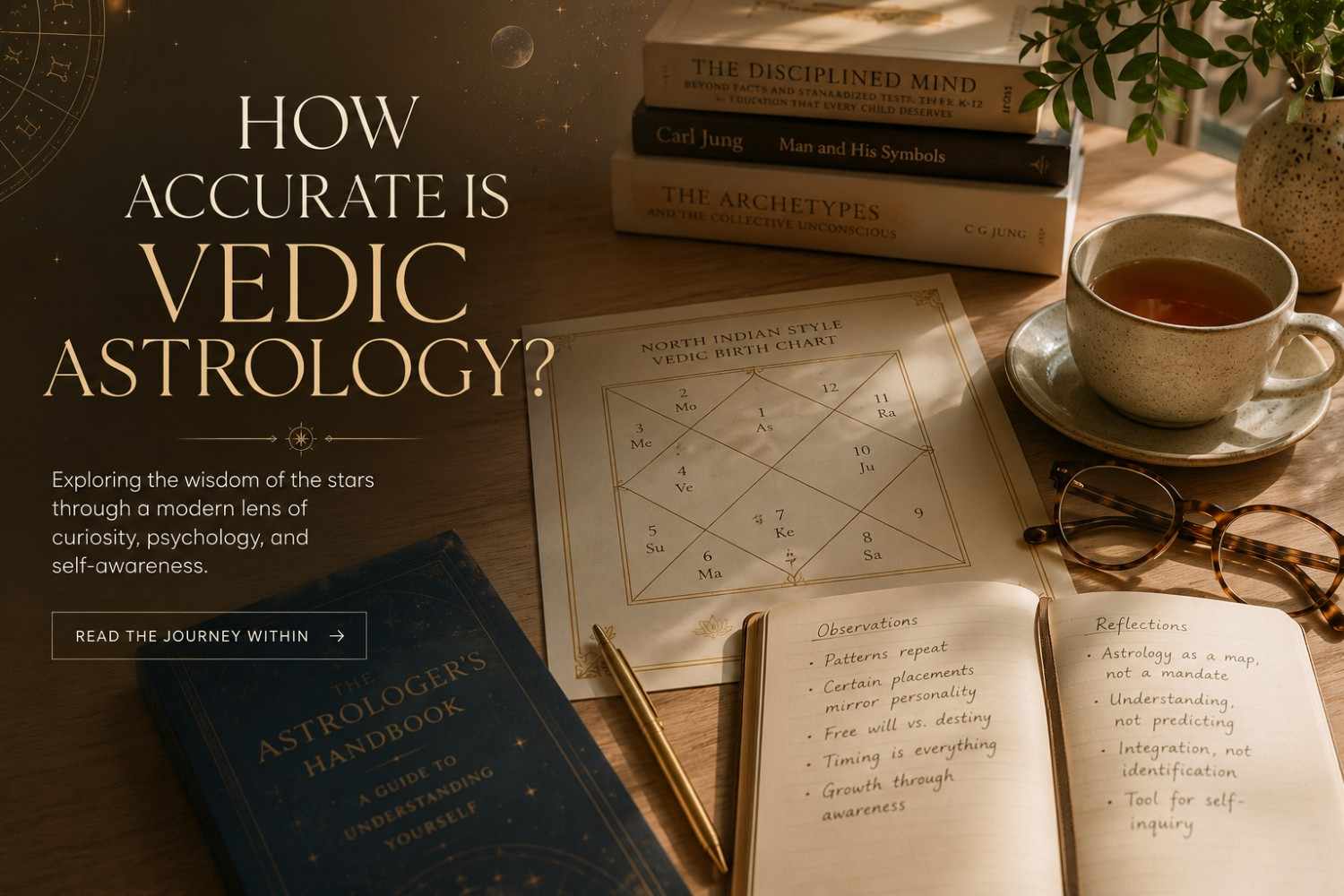
How accurate is Vedic astrology, really? It is one of the most common questions people ask, yet few answers are completely honest. This guide explores what astrology can and cannot reliably do, why it often feels surprisingly accurate, and how to engage with it thoughtfully without falling into either blind belief or complete dismissal.
- ◦Introduction
- ◦Quick Facts
- ◦Why "Accuracy" Is Partly the Wrong Question
- ◦What Vedic Astrology Cannot Reliably Do
- ◦Why Astrology Can Still Feel Strikingly Accurate
- ◦Where Vedic Astrology Has Genuine Value
- ◦Why the Honest Answer Is Actually Liberating
- ◦How to Engage With Astrology Given Its Real Limits
- ◦Engage With Your Chart Honestly — Vedaz
- ◦Final Thought
Introduction
Almost everyone who spends enough time around astrology eventually asks the same question.
Not whether astrology is interesting. Not whether astrology is ancient. Not whether astrology is popular.
But whether it is actually accurate.
Maybe you have had a chart reading that felt uncannily personal. Maybe an astrologer described a life pattern you had never told anyone about. Or maybe you followed a prediction closely, waited for it to happen, and watched the date come and go without anything changing at all.
Those experiences create a natural question: what exactly should we trust?
Unfortunately, most answers tend to fall into two extremes. Some people claim astrology is astonishingly accurate and capable of predicting almost anything. Others dismiss it entirely and act as though there is no value in it whatsoever.
The honest answer sits somewhere in the middle.
And while it may sound less dramatic, it is actually far more useful. Because once you understand what Vedic astrology is genuinely trying to do, what it can realistically offer, and where its limits begin, the entire conversation about accuracy starts to make a lot more sense.
Quick Facts
| Topic | Honest Reality |
|---|---|
| Short honest answer | "Accuracy" is partly the wrong frame; astrology is not deterministic prediction |
| What it cannot do | Reliably predict specific events, dates, or fixed outcomes |
| Why it can feel accurate | Genuine reflection combined with known psychological effects |
| Where it has value | Self-understanding, perspective, and meaning-making |
| The dishonest answers | "Guaranteed accurate" and "complete nonsense" |
| Honest framing | Use astrology as perspective, not prophecy |
Why "Accuracy" Is Partly the Wrong Question
When most people ask whether Vedic astrology is accurate, they are usually thinking about prediction.
Can it tell me when I will get married?
Can it predict whether I will get a job?
Can it forecast what will happen next year?
These are understandable questions, but they quietly assume that astrology functions like a forecasting system.
Traditionally, that is not really what astrology was built to do.
Vedic astrology is generally much better at describing tendencies rather than certainties, themes rather than guarantees, and broader life patterns rather than fixed outcomes. It often points toward areas of life that may become more important, periods that may feel more supportive or challenging, and recurring patterns that deserve attention.
That is very different from claiming that a specific event will happen on a specific date.
A weather forecast can be evaluated by checking whether it rained. Astrology is usually dealing with something much more complex: personality, meaning, timing, relationships, choices, and the unpredictable realities of human life.
That is why the most useful question is often not:
"How accurate is astrology?"
But rather:
"What kind of insight does astrology offer, and where do its limits begin?"
People interested in exploring this question further may also appreciate a deeper discussion of astrology's real limits, especially when evaluating strong predictive claims.
Once you approach the subject that way, the conversation becomes much more productive.
What Vedic Astrology Cannot Reliably Do

Being honest about astrology means being honest about its limitations too.
There are several things that astrology is commonly expected to do that it simply cannot support reliably.
-
Predict specific events with consistent accuracy.
-
Guarantee that a particular outcome will happen.
-
Replace medical, legal, financial, or mental health expertise.
-
Function like a scientific forecasting system.
-
Remove uncertainty from important life decisions.
This is where many people become disappointed, because popular astrology often promises more certainty than the framework itself can honestly deliver.
A chart may suggest that career themes become more active during a certain period, particularly when viewed through the Mahadasha sequence. It may indicate that relationships become a major focus. It may point toward opportunities, challenges, or transitions.
But that is very different from saying:
"You will definitely get married in October."
"You will certainly receive a promotion next March."
"This exact event will happen on this exact date."
The more specific and guaranteed a prediction becomes, the more carefully it deserves to be treated.
Because real life contains factors that no birth chart fully captures: personal choices, changing circumstances, other people, unexpected opportunities, setbacks, effort, luck, and timing.
Even within traditional astrology, serious analysis often goes beyond the main birth chart and incorporates Varga charts, which is one reason highly specific guarantees should be treated cautiously.
Any honest discussion about astrology has to make room for that reality.
Why Astrology Can Still Feel Strikingly Accurate
At this point, many people naturally ask another question.
If astrology cannot reliably predict exact outcomes, why does it sometimes feel so accurate?
The answer is actually quite interesting, because several different things may be happening at the same time.
First, there is genuine reflective value. A well-structured astrological framework often encourages people to think deeply about themselves. It can help organize experiences, identify recurring patterns, and bring attention to parts of life that might otherwise go unnoticed. When that happens, the insight can feel genuinely meaningful.
There are also psychological effects that researchers have studied for decades.
-
The Barnum Effect describes how people often accept broad descriptions as uniquely personal.
-
Confirmation bias causes people to remember accurate-feeling statements more strongly than inaccurate ones.
-
Selective memory naturally highlights the hits while quietly forgetting many of the misses.
-
Self-fulfilling dynamics can occur when expectations subtly influence behavior and decisions.
An honest explanation makes room for all of these factors.
What makes astrology interesting is that the experience is rarely explained by just one thing. The sense of accuracy often comes from a combination of genuine self-reflection, psychological pattern recognition, personal interpretation, and sometimes a surprisingly meaningful resonance with broad life themes.
Part of the experience also depends on whether someone is working with a skilled astrologer who communicates uncertainty honestly, rather than someone presenting broad tendencies as guaranteed outcomes.
That is why reducing the entire conversation to either "it is all psychology" or "it proves astrology is true" usually misses something important.
Reality is often more nuanced than either side wants to admit.
Where Vedic Astrology Has Genuine Value

One of the biggest mistakes people make is assuming that astrology's value depends entirely on prediction.
In many cases, its strongest value may lie somewhere else.
For many people, astrology provides a structured way of reflecting on life. It creates a language for discussing personality, recurring patterns, motivations, strengths, challenges, and major transitions. It offers a framework that encourages self-examination and helps people think about their lives from a different perspective.
For many people, one of the most empowering ways to engage with astrology is simply to read your own chart rather than relying entirely on predictions from someone else.
That value does not disappear simply because astrology cannot guarantee future events.
In fact, some of the most thoughtful people who engage with astrology do so without expecting precise predictions at all.
They use it as a tool for reflection.
They use it as a way to think about timing and life cycles.
They use it as a philosophical framework for understanding change, uncertainty, growth, and meaning.
And honestly, that may be a much healthier relationship with astrology than treating it like a crystal ball.
Because the deepest insights often come from understanding yourself better, not from trying to eliminate uncertainty completely.
Why the Honest Answer Is Actually Liberating
At first glance, some people find this answer disappointing.
If astrology cannot guarantee outcomes, does that not make it less valuable?
In many ways, it does the opposite.
Imagine for a moment that astrology really could predict every major event with perfect certainty.
A difficult chart would become a sentence.
A favorable chart would become a guarantee.
Your choices would matter less.
Your effort would matter less.
Your ability to influence your own future would matter less.
The honest answer leaves room for something much more empowering.
A difficult indication becomes something to navigate rather than something to fear. A supportive period becomes an opportunity rather than a promise. Challenges become areas requiring awareness, while strengths become resources that still need to be developed.
The uncertainty that remains is not necessarily a weakness.
It is the same uncertainty that leaves room for growth, adaptation, effort, and human agency.
And honestly, that may be one of the most valuable insights the entire discussion has to offer.
How to Engage With Astrology Given Its Real Limits
A balanced approach usually works best.
-
Treat astrology as a source of perspective rather than prophecy.
-
Be aware of psychological effects without becoming cynical.
-
Look for insight and reflection rather than guarantees.
-
Be cautious around claims of absolute certainty.
-
Reject both blind belief and blanket dismissal.
-
Keep your own choices and actions at the center of your life.
-
Route serious health, legal, financial, and mental health matters to qualified professionals.
Approached this way, astrology becomes much harder to misuse.
It remains interesting without becoming controlling.
It remains meaningful without becoming dogmatic.
And it can provide perspective without demanding unquestioning belief.
Engage With Your Chart Honestly — Vedaz
Vedaz presents astrology as a reflective framework rather than a system of guarantees. The focus is on helping people understand life themes, patterns, strengths, and challenges honestly, while keeping serious matters where they belong — with qualified professionals. People who enjoy exploring astrology from a more curious and analytical perspective may also find Buddhi AI useful for asking questions about astrological concepts, symbolism, and interpretation while keeping realistic expectations about certainty and prediction.
People who resonate with astrology primarily as a tool for self-reflection and personal growth may also appreciate conversations with Gargi AI, which approaches astrology through the lens of introspection, emotional awareness, and understanding recurring life patterns.
Free at vedaz.io.
Final Thought
The question of accuracy is probably the question most people secretly bring to astrology.
And the honest answer is not the one usually promoted by either side.
Vedic astrology cannot reliably predict specific events, guarantee outcomes, or function as a substitute for professional expertise. Any source claiming otherwise is promising a level of certainty that simply does not exist.
At the same time, dismissing astrology entirely overlooks why so many thoughtful people continue finding value in it.
Its deepest strengths may have very little to do with prediction at all.
They lie in reflection.
They lie in perspective.
They lie in helping people think more carefully about themselves, their choices, their patterns, and the different seasons of their lives.
Yes, astrology can sometimes feel remarkably accurate. Part of that experience comes from genuine insight. Part comes from well-understood psychological effects. And often the experience is a mixture of both.
Understanding that does not weaken astrology.
If anything, it places it on more honest ground.
Perhaps the healthiest way to engage with astrology is not to ask whether it can tell you exactly what will happen next.
Perhaps it is to ask whether it helps you understand yourself a little more clearly while life unfolds.
Because that is where its most defensible value has always lived.
And unlike a prediction, that value does not disappear when a date passes quietly.
Dr. Tanvi Deshpande
Astrology Education, Jyotish Philosophy & Consultation Ethics | 11+ Years
Dr. Tanvi Deshpande is an astrology educator and researcher specializing in the philosophical foundations of Jyotish, astrology literacy, and responsible consultation practices. Her work focuses on helping readers understand the scope, limitations, and practical applications of Vedic astrology, encouraging informed engagement and thoughtful interpretation of traditional astrological concepts.
Frequently Asked Questions
1. How accurate is Vedic astrology, honestly?
The honest answer is that Vedic astrology is generally better at describing tendencies, themes, and life patterns than predicting specific events or dates. Its strongest value lies in reflection and perspective rather than guaranteed forecasts.
2. Why does astrology often feel accurate?
The feeling of accuracy often comes from a combination of genuine self-reflection, pattern recognition, confirmation bias, selective memory, and occasionally meaningful resonance with broader life themes.
3. Can Vedic astrology predict specific events?
Not reliably. Exact predictions about specific dates, events, or guaranteed outcomes usually involve more certainty than astrology can honestly support.
4. If astrology cannot predict everything, does it still have value?
Yes. Many people find value in astrology as a framework for self-understanding, personal reflection, meaning-making, and thinking about recurring patterns in life.
5. Is the honest answer about astrology disappointing?
For many people, it is actually liberating. The fact that astrology does not determine everything leaves room for choice, effort, growth, and personal agency.
6. How should I approach astrology responsibly?
Treat it as a reflective framework rather than a source of certainty. Stay aware of psychological influences, avoid guaranteed claims, keep your own judgment central, and rely on qualified professionals for serious health, legal, financial, and mental health matters.
Related Blogs
Boost Your Health with Astrology
Boost your health with astrology using zodiac-based habits, wellness tips, and simple routines for better physical and mental balance.
The Socking Truth Behind Wearing A Black Thread
Uncover the mystery behind the black thread. From protection to spiritual energy—here’s why everyone’s suddenly wearing one.

Hidden Messages In Your Moles
What if that little mole on your cheek is more than just a mark? Explore the fascinating meanings behind mole placements and what they reveal about your future.
Who Is Your Ishta Devata?
Explore the concept of your personal God in Hinduism. Learn how to discover, connect with, and build a relationship with your Ishta Devata for inner peace and spiritual growth.