Your Kundli Matching Score Is Low: What That Actually Means and What to Do Next
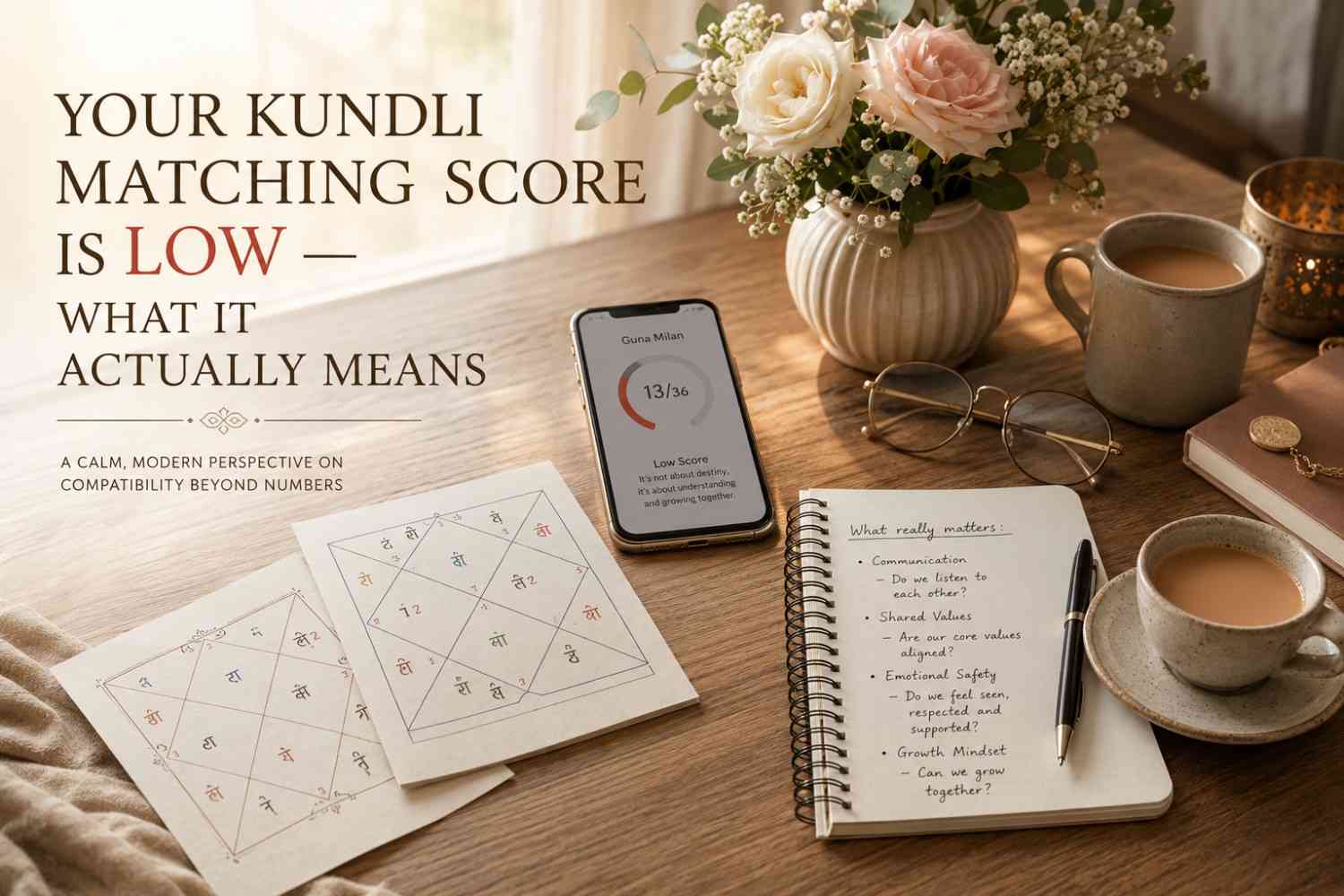
A low kundli matching score can create enormous anxiety, but the Guna Milan score was never meant to act as a final verdict on marriage. This guide explains what low scores actually mean, when deeper analysis genuinely matters, how dosha cancellations work, and why compatibility always goes beyond one number alone.
A low kundli matching score has a way of making people nervous very quickly.
Families become concerned. Conversations suddenly feel heavier. Questions that seemed settled a few days ago now feel uncertain. In many cases, the score starts carrying more emotional weight than the relationship itself.
This is understandable. Marriage is one of the biggest decisions most families make, and nobody wants to overlook something important. But this is also the moment when misunderstandings about kundli matching often create unnecessary fear.
The problem is that many discussions around low scores become extreme. Some people immediately treat the match as unsuitable. Others begin recommending urgent remedies, expensive rituals, or quick fixes before a proper analysis has even happened.
The reality is usually much more nuanced.
A low Guna Milan score is not a prediction that a marriage will fail. It is not proof that two people are fundamentally incompatible. And it was never meant to function as a final verdict on a relationship.
In traditional astrology, a low score is supposed to be the beginning of a deeper conversation, not the end of one.
This guide explains what a low score actually means, which questions should be asked before drawing conclusions, when a low score genuinely deserves attention, and why compatibility always involves much more than a single number.
Quick Facts
| Topic | Honest Reality |
|---|---|
| Total score system | Ashtakoota Guna Milan (36 points) |
| Traditional acceptable range | Usually 18 and above |
| What the score compares | Mainly Moon signs and nakshatras |
| What it does not include | Full chart compatibility and real-life relationship dynamics |
| Biggest risk after a low score | Fear-based decisions and expensive remedies |
| Most important honest point | A low score is a prompt for deeper analysis, not a final verdict |
First: What a Low Score Actually Means
One of the biggest misconceptions in kundli matching is that the final score somehow predicts the success or failure of a marriage.
It does not.
The Guna Milan system compares two people across eight traditional compatibility factors using primarily their Moon signs and nakshatras. A lower score simply means that some of those factors show more friction than others.
That is the honest definition.
It does not automatically mean the marriage will be unhappy. It does not mean the couple cannot build a healthy relationship. And it certainly does not mean two people are destined to fail together.
This distinction matters because many families unknowingly treat the score as if it measures the entire relationship. In reality, it measures only one specific framework of compatibility.
Marriage is influenced by many things that a Guna score cannot fully capture, including:
-
Communication
-
Emotional maturity
-
Trust
-
Shared values
-
Conflict resolution
-
Family expectations
-
Long-term goals
-
Mutual respect
That is why some couples with lower scores build strong and lasting marriages, while some high-scoring matches still struggle.
The score is information.
It is not destiny.
The Questions to Ask Before Anyone Concludes Anything

A low score should lead to better questions, not immediate conclusions.
Before treating the score as a serious concern, it is worth slowing down and examining the details.
Important questions include:
-
Which specific kootas are lowering the score? The breakdown often matters more than the total itself.
-
- Were cancellation conditions checked properly? a Manglik mismatch, Nadi Dosha, and Bhakoot Dosha considerations all have classical exceptions and cancellation rules.
-
Was a full-chart analysis performed? Guna Milan alone does not examine the complete horoscope.
-
Were the 7th house, Venus, Jupiter, and Navamsha studied? These often provide important relationship information that the score cannot capture.
-
Does the concern actually appear elsewhere in the charts? A genuine issue usually shows up in multiple places rather than relying on one number alone.
-
What does the real relationship look like? Communication, emotional safety, shared values, and mutual respect matter enormously.
Interestingly, many low-score situations look very different once these questions are answered properly.
People who want to better understand compatibility frameworks may also find it helpful to explore how Gana Dosha works, or even learn to read the charts yourself before treating a single number as a final judgment.
When a Low Score Is a Real Signal — and When It Is Being Overstated
Not every low score deserves the same level of concern.
Sometimes the score points toward an area that genuinely deserves closer examination. Other times the concern becomes much larger than the actual chart supports.
More Worth Taking Seriously
A low score may deserve additional attention when:
-
Significant compatibility concerns remain even after cancellation checks.
-
Nadi or Bhakoot concerns remain genuinely strong.
-
Full-chart analysis also points toward relationship challenges.
-
Multiple careful assessments identify the same issue.
-
The relationship itself already shows serious incompatibility or instability.
More Likely Being Overstated
A low score is more likely being exaggerated when:
-
Nobody checked cancellation conditions.
-
The astrologer stopped at the score without studying the full charts.
-
The score is only moderately low rather than extremely low.
-
The concern is driven primarily by fear.
-
The couple demonstrates strong communication, trust, and emotional compatibility.
The difference is usually straightforward.
A genuine concern tends to remain after deeper analysis.
An exaggerated concern often becomes much smaller once the charts are examined properly.
The "Remedy to Fix the Score" Trap

This is one of the most vulnerable moments in the entire kundli matching process.
Families are emotionally invested. Decisions feel important. Uncertainty is uncomfortable.
Unfortunately, that also makes this one of the most common situations where fear-based selling appears.
A low score is often followed by recommendations for expensive rituals, special pujas, gemstones, or urgent remedies designed to "fix" compatibility.
This is where caution becomes important.
A ritual cannot change two people's birth charts. It cannot recalculate the original Guna score. And it cannot magically rewrite the compatibility factors that created the score in the first place.
The honest response to a low score is deeper analysis.
Not panic.
Not urgency.
And certainly not emotional pressure to spend money immediately.
If the conversation suddenly sounds like this:
-
The marriage cannot happen unless this remedy is done.
-
You must act quickly.
-
This ritual is the only solution.
-
Things will become worse if you wait.
Then it is usually wise to slow the entire process down.
Fear plus urgency plus expensive remedies remains one of the clearest warning signs in astrology.
A Practical Decision Path
For families trying to navigate a low score calmly, a practical approach often works best.
-
Do not let the score alone decide anything immediately.
-
Get the detailed koota breakdown.
-
Check cancellation conditions carefully.
-
Request a full-chart compatibility assessment.
-
Study the 7th house, Venus, Jupiter, and Navamsha.
-
Consider the actual relationship, not just the charts.
-
Avoid fear-driven spending.
-
Take time before making major decisions.
-
Make the final decision thoughtfully rather than emotionally.
The healthiest decisions usually come from context, patience, and perspective—not from reacting to a headline number.
Get an Honest Kundli Matching Analysis — Vedaz
Vedaz approaches kundli matching through full-chart analysis rather than fear-based conclusions. The platform includes detailed koota breakdowns, dosha cancellation checks, and broader compatibility analysis explained in clear and practical language.
The goal is not to create anxiety around a score. It is to help people understand what the score actually means and where it fits within the larger picture of compatibility.
People who want to discuss compatibility concerns in a more conversational and reflective way may also find Mitra AI useful as a companion for thinking through relationship expectations, communication, and emotional compatibility alongside chart analysis.
Families trying to understand what a low score actually means, how dosha cancellations work, or what deeper chart analysis involves may also find Shubha AI helpful for exploring kundli matching concepts through a traditional but non-fatalistic conversation.
Free at vedaz.io.
Final Thought
A low kundli matching score can feel frightening because marriage decisions naturally carry emotional weight.
But the score itself was never meant to carry all of that weight alone.
It is one compatibility tool within a much larger framework. It can highlight areas that deserve attention, but it cannot fully measure trust, emotional safety, communication, maturity, shared values, or the quality of a relationship.
Those things matter too.
Sometimes more than people realize.
The healthiest approach is neither to ignore kundli matching nor to become trapped by it.
Instead, slow the process down. Ask better questions. Look beyond the headline number. Understand the full context before drawing conclusions.
Because the purpose of kundli matching was never to frighten families into decisions.
At its best, it was meant to help them make those decisions more thoughtfully.
Vaishnavi Bhardwaj
Marriage Astrology, Kundli Matching & Relationship Analysis | 12+ Years
Vaishnavi Bhardwaj is a Vedic astrology writer specializing in marriage astrology, compatibility assessment, and relationship analysis. Her work focuses on helping readers understand classical Jyotish principles related to partnerships, kundli matching, and significant relationship milestones.
Frequently Asked Questions
1. My kundli matching score is low. Does that mean we should not marry?
Not usually, and definitely not based on the number alone. A low Guna Milan score simply means some traditional compatibility factors based on Moon signs and nakshatras show more friction. It is not a direct prediction that the marriage will fail or that the couple cannot be happy together. Many successful marriages have lower scores, and many high-scoring matches still struggle. A low score should lead to deeper analysis, not immediate rejection.
2. What should we check before treating a low score as serious?
The most important things are the koota breakdown, dosha cancellation conditions, and full-chart analysis. Families should ask which specific kootas are low, whether Manglik, Nadi, or Bhakoot cancellations were properly checked, and whether the astrologer studied the full charts including the 7th house, Venus, Jupiter, and Navamsha chart. The actual relationship between the couple also matters far more than many people realize.
3. When is a low kundli matching score genuinely concerning?
A low score deserves more attention when heavily weighted factors remain problematic even after proper cancellation checks and when the full-chart analysis also consistently shows relationship difficulties. It becomes more meaningful if multiple careful analyses point toward the same concern and if the couple themselves are already facing major compatibility issues in real life. A real concern usually survives deeper analysis instead of disappearing once the charts are studied properly.
4. Can a puja or remedy fix a low kundli matching score?
No, not in the literal sense. A ritual cannot change two people’s nakshatras or recalculate the original Guna Milan score. This is one of the most common moments where fear-based remedy selling happens because families are emotionally vulnerable. The genuine response to a low score is deeper chart analysis and thoughtful discussion, not urgent expensive spending framed as “fixing” compatibility.
5. Does the koota breakdown matter more than the total score?
Yes, very much. Two people can have a lower total score because of one or two specific kootas while many other compatibility areas remain strong. That is why looking only at the final number often creates unnecessary fear. Understanding which kootas are low and whether cancellation conditions apply gives a much more accurate picture than the total score alone.
6. How should the final marriage decision actually be made?
The healthiest decision comes from looking at the full picture together. That includes the detailed chart analysis, cancellation conditions, the actual relationship between the couple, communication, emotional maturity, family values, mutual respect, and long-term compatibility. Kundli matching should guide thoughtful discussion, not replace human judgment or create panic around one number.
Related Blogs

Dreaming of moving abroad? Check Foreign Travel Astrology
Is your destiny written in the stars? Discover if the universe is guiding you toward a life abroad!

The Best Places to Travel Abroad Foreign Travel Astrology
Is foreign travel written in your stars? Explore how astrology influences your journeys and uncover the best destinations for your zodiac sign!

Can Your Birth Chart Predict Depression Symptoms?
This article examines whether astrological birth charts can predict depression symptoms, contrasting astrological beliefs with psychological research on personality traits and mental health.
The Manifestation Secrets Hidden in Celebrity Birth Charts
Find out what makes fame unique and special. This guide lets you know how some of the biggest celebrities use planetary help to become successful—and how you can do the same.