Navratri 2026: Dates, Nine Forms of Durga, Rituals and Complete Guide
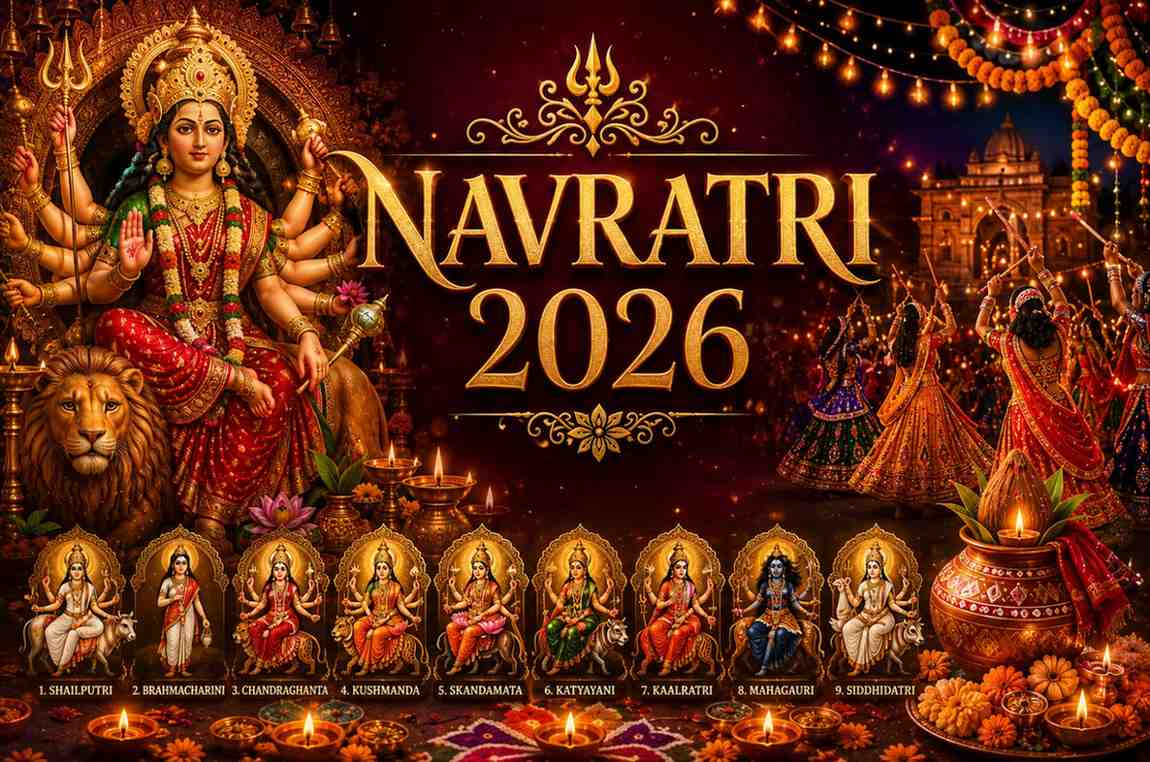
Navratri means "nine nights" — nine consecutive nights of worshipping the Goddess in nine distinct forms. Sharad Navratri 2026 falls October 11–19, followed by Vijayadashami on October 20. The festival is one of the most powerful annual windows in Vedic tradition for sustained spiritual practice, mantra anushthana, and planetary remedies.
Nine nights. Nine forms of the Goddess. One of the most spiritually charged festivals in the entire Hindu calendar.
If you've grown up around Navratri, you know the feeling — the continuous lamp burning, the smell of incense, Garba nights, the fasting, the daily worship.
But beyond the cultural celebration, Navratri carries something deeper. Each of the nine days has a specific form of the Goddess, a specific energy, and in many traditions, a specific planetary connection. It's not just a festival — it's a structured nine-day arc of inner and outer practice.
This guide covers everything you need: the dates, the nine forms of the Goddess and what they actually mean, the planetary connections, the traditional practices, and how to approach this window for astrological remedies.
Navratri 2026 Quick Facts
| Sharad Navratri 2026 | October 11–19, 2026 (most widely observed) |
| Chaitra Navratri 2026 | March 19–27, 2026 (has occurred) |
| Sanskrit meaning | Nava (nine) + Ratri (nights) — "nine nights" |
| Primary worship | The nine forms of the Goddess (Navadurga) |
| Vijayadashami / Dussehra | Tenth day after Sharad Navratri — victory of good over evil |
| Climate significance | Sharad = autumn transition; Chaitra = spring transition |
| Core practices | Worship, fasting, mantra recitation, mantra anushthana, scripture reading |
Who Are the Nine Forms of the Goddess in Navratri?
This is the heart of Navratri — and it's worth actually understanding each form, not just their names. Each one represents a real stage of spiritual development, not just a different deity to rotate through.
Day 1 — Shailaputri (Daughter of the Mountain)
Shailaputri is the Goddess as the daughter of Himavan, the mountain. She represents pure consciousness and the very foundation of spiritual life — the moment you decide to begin. Worshipping her on Day 1 is about setting your sankalpa (your intention) for the entire nine days.
If you don't get the foundation right, everything built on top of it shakes. Traditional color: red.
Day 2 — Brahmacharini (The Ascetic)
Brahmacharini is the Goddess in her form as the devoted ascetic — the one who undergoes tapas (sustained spiritual discipline) with complete focus.
She represents what it actually takes to grow spiritually: sustained effort, willingness to sit with difficulty, and not giving up. Worshipped for the development of focus and real discipline. Traditional color: royal blue.
Day 3 — Chandraghanta (Crescent Moon Bell)
Chandraghanta wears a crescent moon on her forehead shaped like a bell. She is the warrior aspect of the divine feminine — fierce, courageous, and protective.
She is worshipped to cultivate courage and remove fear — not just external fear, but the inner kind that stops people from moving forward. Traditional color: yellow.
Day 4 — Kushmanda (The Cosmic Egg)
Kushmanda is held to have created the universe with her smile — radiating light and creative energy outward in all directions.
She represents vitality, creative power, and the source of all creation. Worshipped for health, energy, and creative strength. If you've been feeling depleted, Day 4 is worth particular attention. Traditional color: green.
Day 5 — Skandamata (Mother of Skanda)
Skandamata is the Goddess as mother of Lord Skanda (Kartikeya). She carries him in her arms while seated on a lion — fierce and tender at once.
She represents nurturing power, maternal protection, and family harmony. Worshipped for the wellbeing of children and family. Traditional color: grey.
Day 6 — Katyayani (The Warrior Goddess)
Katyayani is the one who slew Mahishasura — the demon no other force could destroy. She is one of the fiercest and most powerful forms of the Goddess.
She represents righteous action, the destruction of evil, and decisive movement in service of dharma. Traditionally, unmarried women worship Katyayani specifically for the grace of a good marriage. Traditional color: orange.
Day 7 — Kalaratri (The Dark Night)
Kalaratri is the most intense form — dark-complexioned, fierce, the destroyer of ignorance and inner obstacles. Don't let the fearsome appearance throw you.
She represents the darkness that must be faced before spiritual dawn — the clearing out of deep-rooted negative patterns. This is one of the most powerful days for protection and inner transformation. Traditional color: white (some traditions: black).
Day 8 — Mahagauri (The Radiant One)
Mahagauri is luminous white — the Goddess after she has undergone intense tapas and emerged purified.
She represents what sustained practice actually produces: inner clarity, peace, and the fulfillment of sincere wishes. Day 8 is widely considered one of the most auspicious days of the entire Navratri arc. Traditional color: pink.
Day 9 — Siddhidatri (Bestower of Spiritual Powers)
Siddhidatri is the culmination — the Goddess who bestows the eight siddhis (genuine spiritual accomplishments) to devoted practitioners.
She represents the fruition of everything the nine days have been building toward. Worshipped for the completion of the Navratri arc and for real spiritual capacities that carry beyond the festival. Traditional color: light blue.
Day 10 — Vijayadashami / Dussehra
Not technically Navratri, but the culminating day. Lord Rama's victory over Ravana is celebrated — the symbolic triumph of dharma over adharma, good over evil, light over darkness. It closes the nine-day arc on a note of victory.
Why Is Navratri Astrologically Significant?
Navratri is primarily a goddess-worship festival — but classical tradition connects it to planetary energies in ways worth understanding.
- Nine days, nine grahas — In some traditions, the nine days correspond to the nine planets, making Navratri one of the most complete annual windows for planetary remedy work
- Seasonal transitions — Chaitra Navratri marks the spring transition; Sharad Navratri marks the autumn transition. Both align with significant Sun-position shifts in the Vedic calendar
- Sharad Navratri and the autumnal energy — Many traditions emphasize that Sharad Navratri falls near the autumnal equinox, when the divine feminine energy is particularly accessible for worship and inner work
- The Mahishasura Mardini narrative — Durga's slaying of Mahishasura maps symbolically onto the destruction of egoic and karmic obstacles — which is why Navratri is so strongly recommended for those in difficult planetary periods
- Sharad Navratri 2026 specifically — Falls during a significant period of Saturn's stabilization in Pisces, making it a particularly strong spiritual window for those undergoing Saturn transitions
Like Diwali 2026 astrology — where Kartika Amavasya creates a concentrated window for Lakshmi worship and planetary remedies — Navratri creates its own nine-day concentrated window for Durga worship and sustained practice. The Diwali 2026 Astrology Guide goes deeper on how that window compares.
What Are the Traditional Practices During Navratri?
Worship
- Daily Durga worship at home altar or temple — the non-negotiable core of the nine days
- Durga Saptashati recitation — 700 verses dedicated to Durga; one of the most powerful Navratri practices you can undertake
- Devi Mahatmyam reading — scripture that recounts the Goddess's victories
- Daily mantra recitation — Durga Beej Mantra, Lalita Sahasranama, or the specific mantra of each day's Goddess form
- Akhand jyot — keeping a continuous lamp burning for all nine days; a practice that requires commitment but carries deep significance
For personalized mantra guidance during Navratri, Apala - apala at Vedaz specializes in mantra and meditation — worth consulting before the nine days begin if you want a targeted practice.
Fasting (Vrat)
Fasting during Navratri is deeply traditional — but it's also one area where honest guidance matters. The full breakdown of how to approach fasting & vrat correctly is worth reading before you commit to a nine-day practice.
- Many devotees observe vrat for all nine days — typically phalahar (fruits and milk, no grains)
- Some fast only on Day 1 and Day 8 or 9
- Some maintain a sattvic diet (no onion, garlic, meat) without strict fasting
- Kanya Pujan on Ashtami or Navami involves worshipping young girls as embodiments of the Goddess — a deeply meaningful practice that often marks the end of the vrat
Important: Multi-day fasting is not appropriate for everyone. People with diabetes, low blood pressure, pregnancy, eating disorders, or those who are elderly should consult a doctor before any extended fast. Match the practice to what your body can actually sustain.
Cultural Traditions
- Garba and Dandiya — particularly in Gujarat and increasingly across India; the nine nights of communal dance as devotional practice
- Golu / Bommai Kolu — elaborate tiered displays of dolls, primarily in Tamil Nadu, Karnataka, and Andhra Pradesh
- Durga Puja in Bengal — some of the most elaborate pandal worship anywhere in India, particularly on the final four days
- Kanya Pujan / Kumari Puja — worshipping young girls as living embodiments of the Goddess, typically on Ashtami or Navami
Navratri Practices for Specific Astrological Situations
Different charts call for different approaches during these nine days:
- Difficult planetary periods (Sade Sati, Rahu-Ketu, Mars afflictions) — committed Durga worship and Durga Saptashati recitation are among the strongest classical remedies for these periods; Navratri is the ideal time to begin
- Sustained mantra anushthana — the nine days are perfect for committing to a fixed daily mantra count (108, 1,008, or higher per day); the arc of nine days creates momentum that carries forward
- Kalaratri (Day 7) — particularly powerful for those processing deep negative patterns or stuck karmic themes; don't skip this day
- Health concerns — Mahagauri (Day 8) combined with Mahamrityunjaya Mantra is a strong traditional practice
- Beginning a new spiritual practice — Navratri's opening sankalpa is the traditional launch point; start here and let it continue beyond the nine days
- Ancestral matters — Navratri immediately follows Pitru Paksha; the transition from ancestral observance into goddess worship is a powerful and intentional sequence in the Vedic calendar
For guidance on which specific practices suit your chart during this window, Moksha - moksha at Vedaz specializes in spiritual astrology — particularly useful if you're looking to use Navratri for deep inner work.
Navratri sits within a broader pattern of major Vedic festival windows. The Akshaya Tritiya Guide, Mahashivaratri Guide, and Ganesh Chaturthi Guide each cover their own powerful annual windows — understanding all of them together gives you a complete picture of the Vedic calendar's most auspicious periods.
Honest Guidance on Navratri Practice
A few things worth saying clearly before you plan your nine days:
Multi-day fasting isn't for everyone. If you have diabetes, low blood pressure, are pregnant or nursing, have a history of eating disorders, or are elderly — please consult a doctor before committing to extended fasting. A sattvic diet is a valid and meaningful alternative.
Depth matters more than elaborateness. A simple daily worship with sincere mantra practice and a sustainable vrat is more meaningful than an elaborate performance without real engagement. The Goddess doesn't need a grand production. She needs sincerity.
Navratri's deepest purpose is internal. The nine forms of the Goddess are also understood as nine stages of inner development. The nine days are an invitation to sustained inward work — not just outward ritual.
You don't have to rotate through all nine forms. Many traditions focus on one form throughout — often whatever your family or personal tradition emphasizes. That's completely valid.
For unmarried women observing Katyayani worship for marriage — the practice has genuine classical roots. But it should come from devotion, not anxiety. Pressure-driven ritual is not the tradition.
Final Thought
Nine nights. That's what you have.
And the tradition says that if you use them well — with daily worship that has real engagement, with a vrat your body can sustain, with mantra practice that builds actual focus — something shifts. Not just during the nine days, but after them too.
Because Navratri's real gift isn't the festival itself. It's the discipline and depth that sustained practice builds — and that carries forward long after the lamps are put away.
The nine forms of the Goddess aren't just nine deities to rotate through. They're a map — from Shailaputri's foundational awakening all the way to Siddhidatri's fruition. The nine nights are an arc, not a series of isolated observances. Show up for all of it, and let it mean something.
Whatever your chart looks like this year, Navratri is one of the most genuine invitations the Vedic calendar offers. Don't let it pass as just nine days of fasting and Garba. Go deeper. That's what it's for.
Ritoban Mukherjee
Specialization: Mythology, Festival Legends & Hindu Traditions | 10+ Years
Ritoban Mukherjee specializes in Hindu mythology, festival stories, and devotional traditions. His articles bring ancient legends and sacred narratives to life while explaining their relevance to modern celebrations and spiritual practices.
Frequently Asked Questions
1. What is Navratri?
Navratri means "nine nights" — nine consecutive nights of worshipping the Goddess in nine distinct forms, each representing a different stage of spiritual development. There are technically four Navratris in the lunar year, but Chaitra Navratri (spring) and Sharad Navratri (autumn) are the two widely observed. Sharad Navratri is the most celebrated.
2. When is Navratri 2026?
Sharad Navratri 2026 falls October 11–19, 2026, followed by Vijayadashami (Dussehra) on October 20. Chaitra Navratri 2026 occurred March 19–27, 2026. Dates vary each year because Navratri follows the lunar calendar.
3. Who are the nine forms of the Goddess?
Day 1 — Shailaputri, Day 2 — Brahmacharini, Day 3 — Chandraghanta, Day 4 — Kushmanda, Day 5 — Skandamata, Day 6 — Katyayani, Day 7 — Kalaratri, Day 8 — Mahagauri, Day 9 — Siddhidatri. Day 10 — Vijayadashami / Dussehra closes the arc.
4. Do I have to fast for all nine days?
No. Fasting practices vary widely — phalahar (fruits and milk) for all nine days, fasting only on specific days, or simply maintaining a sattvic diet. Multi-day fasting is not appropriate for those with diabetes, low blood pressure, pregnancy, or eating disorders. Match the practice to what your body can genuinely sustain.
5. What is the best Navratri practice for astrological remedy?
For difficult planetary periods — Sade Sati, Rahu-Ketu afflictions, Mars difficulties — committed Durga worship and Durga Saptashati recitation are the classical go-to. A sustained mantra anushthana (fixed daily mantra count for all nine days) is the traditional intensive practice. Beginning a practice during Navratri that continues beyond the nine days uses the festival as the strongest possible launch point.
6. What is Kanya Pujan?
Kanya Pujan (also Kumari Puja) is the worship of young girls as living embodiments of the Goddess — typically performed on Ashtami (Day 8) or Navami (Day 9). Nine young girls are traditionally invited, their feet washed, fed special food (halwa, puri, chana), and given gifts. It is one of the most meaningful practices of the entire Navratri arc.
Related Blogs
Saraswati Puja: Science Behind Yellow Sweets
Yellow sweets on Saraswati Puja aren't just tradition—they're science, emotion, and energy in one. Find out how colour, food, and devotion come together in this surprising story of wisdom and wellness
Are You Doing Shiv Puja In The Right Way?
Shiv Pooja isn’t about perfection—it’s about presence. Discover the small yet powerful steps you might be skipping, and how they can transform your prayer into a deeper, more personal experience.
Easy Lakshmi Pooja Steps For Inner Peace
You don’t need perfection to feel divine peace. Just a diya, a flower, and a moment of stillness. This gentle Lakshmi Pooja is a soft reminder that grace begins within.
Navgraha Pooja: A Powerful Spiritual Start
Struggling with delays, confusion, or emotional heaviness? Navgraha Pooja might be the spiritual shift you need. Learn how this ancient practice helps you align with cosmic energy and reclaim inner peace.