Akshaya Tritiya 2027: Date, Significance, Gold Buying, Donations and Complete Guide
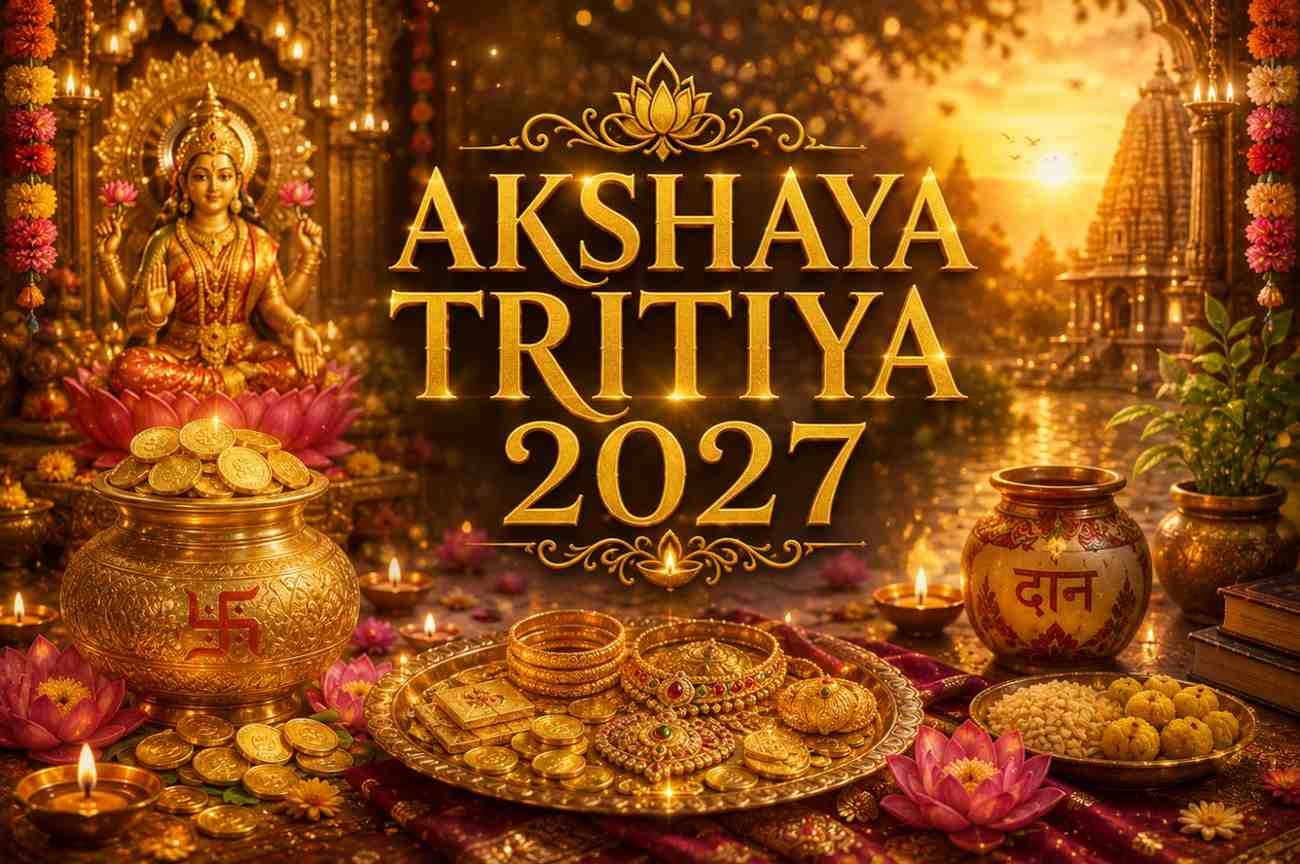
Akshaya Tritiya falls on the third lunar day of the bright half of Vaishakha month. In 2027, it falls on Friday, May 7. Classical tradition holds that any auspicious action — donation, investment, new beginning, or worship — done on this day produces results that never diminish. No muhurat calculation is needed; the day itself is universally auspicious.
- ◦Akshaya Tritiya Quick Facts
- ◦Why Is Akshaya Tritiya Astrologically Significant?
- ◦The Gold Buying Tradition — What's Real and What's Marketing?
- ◦What Are the Most Auspicious Actions on Akshaya Tritiya?
- ◦Akshaya Tritiya Practices for Specific Astrological Situations
- ◦Honest Notes on Akshaya Tritiya
- ◦Final Thought
You've probably seen the gold ads. Every year around April or May, jewelry stores go all out — "Buy gold on Akshaya Tritiya, it's the luckiest day of the year." And while that's not entirely wrong, it's also not the whole picture.
Akshaya Tritiya is genuinely one of the most powerful days in the Vedic calendar. But the reason isn't the gold. It's the astrology — and once you understand what's actually happening in the sky on this day, the tradition starts making a lot more sense.
This guide covers everything: what Akshaya Tritiya actually is, why it's astrologically significant, what the gold tradition really means, and what practices actually matter on this day.
Akshaya Tritiya Quick Facts
| Date in 2026 | Monday, April 20, 2026 (has occurred) |
| Date in 2027 | Friday, May 7, 2027 (next occurrence) |
| Sanskrit meaning | Akshaya = never-diminishing; Tritiya = the third lunar day |
| Lunar position | Shukla Paksha Tritiya of Vaishakha month |
| Classical claim | Auspicious actions on this day produce eternally undiminishing results |
| Astrological associations | Sun exalted in Aries, Moon exalted in Taurus — both luminaries at maximum strength |
| Primary deities | Lord Vishnu, Goddess Lakshmi, Lord Parashurama |
Why Is Akshaya Tritiya Astrologically Significant?
This is the part most people don't know — and it's what actually explains why this day carries such weight in classical tradition.
Akshaya Tritiya isn't auspicious because someone decided it was. There's a real astronomical reason:
- Sun in exaltation — Akshaya Tritiya consistently falls when the Sun is in or near Aries, its exaltation sign. The Sun is at maximum strength in the zodiac at this point of the year
- Moon in exaltation — The Moon is in Taurus on or very close to Akshaya Tritiya. The Moon is exalted in Taurus (specifically at 3° Taurus), making it also at peak strength
- Both luminaries at peak strength simultaneously — This is the key. The Sun and Moon being exalted on the same day is genuinely rare — and this convergence is the actual technical basis for the day's status in classical Vedic astrology
- Beginning of Satya Yuga — Classical tradition associates Akshaya Tritiya with the start of Satya Yuga, the first and most virtuous of the four cosmic ages
- Parashurama Jayanti — Lord Parashurama, the sixth avatar of Vishnu, is traditionally said to have been born on this day, adding devotional significance
Understanding how planetary exaltations interact with your own chart is something worth exploring — knowing your birth chart helps you see exactly why certain dates and transits land differently for you than for others.
The Gold Buying Tradition — What's Real and What's Marketing?
Let's be honest about this, because there's a lot of noise around it.
The classical logic is straightforward: auspicious actions on Akshaya Tritiya produce never-diminishing results. Gold itself is a form of value that doesn't diminish through time.
So buying gold on this day combines two "never-diminishing" energies. That logic is genuinely classical — it predates the modern jewelry industry by centuries.
But here's what's also true: the gold tradition has been massively commercialized. Jewelry retailers run some of their biggest campaigns of the year around this date. And somewhere along the way, "buy gold on Akshaya Tritiya" became the headline, while the actual tradition got buried underneath it.
A few things worth knowing clearly:
- You are not required to buy gold. The deeper tradition is about any auspicious action — donation, worship, beginning a venture, investment. Gold is one expression of that, not the only one
- Buying gold you can't afford defeats the purpose. Taking on debt or bowing to social pressure is not what the tradition had in mind. Overextension is not auspicious
- The day's power is not contingent on commercial activity. Sincere worship and donation carry exactly the same classical weight
- If you do buy gold — physical gold (coins or jewelry), within your means, paired with worship or donation rather than treated purely as a shopping trip, is the traditional approach
- Silver, copper coins, and other precious metals also carry the never-diminishing symbolism if gold isn't your preference or budget
What Are the Most Auspicious Actions on Akshaya Tritiya?
Important Beginnings
One of the most practical things about Akshaya Tritiya is this: no muhurat calculation is needed. The day itself is universally auspicious for any important beginning.
This is actually one of the strongest classical reasons for its popularity — you don't need a pundit to tell you the right hour. The whole day works.
Traditional beginnings for this day include:
- Starting a new business or venture
- Buying a home or major property
- Purchasing a vehicle
- Beginning a major construction project
- Marriage — Akshaya Tritiya is one of the most popular wedding dates precisely because no separate muhurat is needed
- Investments — gold, silver, financial instruments, real estate
- Beginning a sustained spiritual practice — a vrat, mantra anushthana, or study program
- Opening new account books or beginning the financial year (in many business traditions)
For business-specific guidance on making the most of this auspicious window, Vyapar - vyapar at Vedaz specializes in business astrology and can help you align your new venture with your chart.
Donations (Daan)
This is actually the part of Akshaya Tritiya that the gold ads never mention — and in the classical tradition, daan is at least as important as any purchase.
Daan performed on Akshaya Tritiya is held to produce never-diminishing karmic results:
- Anna daan (food donation) — feeding the hungry; one of the most emphasized practices for this specific day
- Water donation — giving cool water during the hot Vaishakha month, often through public water stations
- Clothing donation to those in need
- Donations to genuine educational, religious, or charitable causes
- Donations during pilgrimage to genuine temples
Worship
- Lord Vishnu worship — particularly Vishnu Sahasranama recitation
- Goddess Lakshmi worship — for prosperity, jointly with Vishnu in many traditions
- Lord Parashurama worship — on his Jayanti
- Vedic mantra recitation and scriptural study
- Visit to a Vishnu or Lakshmi temple
Akshaya Tritiya Practices for Specific Astrological Situations
Different charts call for slightly different approaches. Here's how traditional practice adjusts:
- Seeking prosperity — Combine Lakshmi worship with sincere donation; this is the traditional formula, not just worship or purchase alone
- Beginning a new venture — The day removes the need for separate muhurat calculation; combine the beginning with Lakshmi Puja and a donation for the strongest approach
- Difficult financial period — Donate within your means rather than spend; the karmic logic of the day favors giving over receiving
- Planetary difficulty (Sun or Moon related) — The day's strength of both luminaries makes it favorable for Sun and Moon remedies: Surya Namaskar, Aditya Hridaya Stotram for the Sun; Lord Shiva worship for the Moon
- Beginning dharmic study or practice — Akshaya Tritiya strongly favors beginning a sustained mantra anushthana or scriptural study program
- Ancestral honoring — The day carries weight for Pitra Tarpan and ancestral remembrance
For personalized guidance on which practices suit your specific chart during this window, Bhagya - bhagya at Vedaz can help you identify the luck and prosperity practices most aligned with your planetary configuration.
Akshaya Tritiya sits within a broader pattern of major Vedic festival windows across the year. The Navratri Guide, Mahashivaratri Guide, and Ganesh Chaturthi Guide each cover their own powerful annual windows — worth reading alongside this one to understand how the full Vedic calendar works together. And if you're looking at the Diwali 2026 astrology angle specifically, the Diwali 2026 Astrology Guide goes deep on the Kartika Amavasya window and how it compares to Akshaya Tritiya's energy.
Honest Notes on Akshaya Tritiya
A few things worth saying directly:
The astrological significance is real. The convergence of Sun-exalted in Aries with Moon-exalted in Taurus is a genuine and rare configuration — not invented for marketing purposes.
The commercial amplification has gone too far. The tradition is about any auspicious action. Gold purchase is one expression of that, not the point of the day.
Not buying gold is not failing the tradition. Sincere donation, worship, and conscious beginnings carry the exact same classical weight.
The day favors giving at least as much as receiving. Anna daan and charity carry deep karmic weight on this day — the deepest practice often includes both donation and beginning.
No muhurat needed. This is one of only a handful of days in the Vedic calendar where the day itself is universally auspicious — a practical advantage worth actually using.
Auspicious timing still requires real action. Beginning a business on Akshaya Tritiya is meaningful; doing the actual work that makes the business succeed is still essential.
Final Thought
Akshaya Tritiya is a genuine astrological window — not a jewelry sale with a spiritual backstory.
The convergence of Sun and Moon at their respective exaltations on a single day is real and rare, and classical tradition has always treated it as one of the year's most powerful moments for conscious beginnings and sincere donations.
The gold ads have made people associate this day with shopping. But the tradition was always pointing at something deeper — a beginning made with real intention, a donation given to someone who genuinely needs it, worship performed with actual devotion.
Those are the actions the tradition says never diminish. And if you think about it, that makes sense — a business started with real purpose, a habit of giving built on a meaningful day, a practice begun sincerely. These things do tend to grow.
That's what Akshaya Tritiya was always about.
Devansh Trivedi
Hindu Festivals, Rituals & Sacred Traditions | 12 years
Devansh Trivedi is a cultural researcher and spiritual writer specializing in Hindu festivals, traditional observances, and devotional customs. His work explores the origins, symbolism, and evolving practices of India's major religious celebrations, helping readers understand both their spiritual and cultural significance.
Frequently Asked Questions
1. What is Akshaya Tritiya?
Akshaya Tritiya (also spelled Akha Teej) is one of the most auspicious days in the Hindu calendar, falling on the third lunar day of the bright half of Vaishakha month. The name means "never-diminishing third day." Classical tradition holds that any auspicious action — donation, investment, beginning a venture, or worship — performed on this day produces eternally undiminishing results.
2. When is Akshaya Tritiya 2027?
Akshaya Tritiya 2027 falls on Friday, May 7, 2027. Akshaya Tritiya 2026 was Monday, April 20, 2026 (already passed). The exact date varies each year because it is calculated by the lunar calendar — specifically the third day of the bright half of Vaishakha month.
3. Why is Akshaya Tritiya considered so auspicious?
The astrological foundation is genuine: Akshaya Tritiya consistently falls when the Sun is exalted in Aries and the Moon is exalted in Taurus — both luminaries at maximum strength on the same day, which is rare. Classical tradition also connects the day to the beginning of Satya Yuga and to Lord Parashurama's birth, adding mythological significance.
4. Do I have to buy gold on Akshaya Tritiya?
No. The gold-buying tradition has genuine classical roots but has been heavily commercialized. The deeper tradition is about any auspicious action — donation, investment, beginning a venture, worship — not gold specifically. Buying gold you cannot afford or going into debt for it undermines the auspiciousness rather than enhancing it.
5. What are the best practices for Akshaya Tritiya?
Important beginnings (business, home purchase, marriage, spiritual practice — no muhurat needed), donations especially of food (anna daan) and water, worship of Lord Vishnu and Goddess Lakshmi, mantra recitation, dharmic study, and temple visits. The deepest practice includes both giving (donation) and beginning (auspicious undertakings).
6. Can I start a new business on Akshaya Tritiya?
Yes — Akshaya Tritiya is one of the most traditionally recommended days for major beginnings including new businesses. No separate muhurat calculation is required — the day itself is universally auspicious. Combine the beginning with Lakshmi Puja and donation for the strongest traditional approach. The practice must still combine with the actual work that makes the venture succeed.
Related Blogs
Saraswati Puja: Science Behind Yellow Sweets
Yellow sweets on Saraswati Puja aren't just tradition—they're science, emotion, and energy in one. Find out how colour, food, and devotion come together in this surprising story of wisdom and wellness

Are You Doing Shiv Puja In The Right Way?
Shiv Pooja isn’t about perfection—it’s about presence. Discover the small yet powerful steps you might be skipping, and how they can transform your prayer into a deeper, more personal experience.

Easy Lakshmi Pooja Steps For Inner Peace
You don’t need perfection to feel divine peace. Just a diya, a flower, and a moment of stillness. This gentle Lakshmi Pooja is a soft reminder that grace begins within.
Navgraha Pooja: A Powerful Spiritual Start
Struggling with delays, confusion, or emotional heaviness? Navgraha Pooja might be the spiritual shift you need. Learn how this ancient practice helps you align with cosmic energy and reclaim inner peace.