Mahashivaratri 2027 Complete Guide: Shiva Worship, Fasting, Jagaran and Remedies
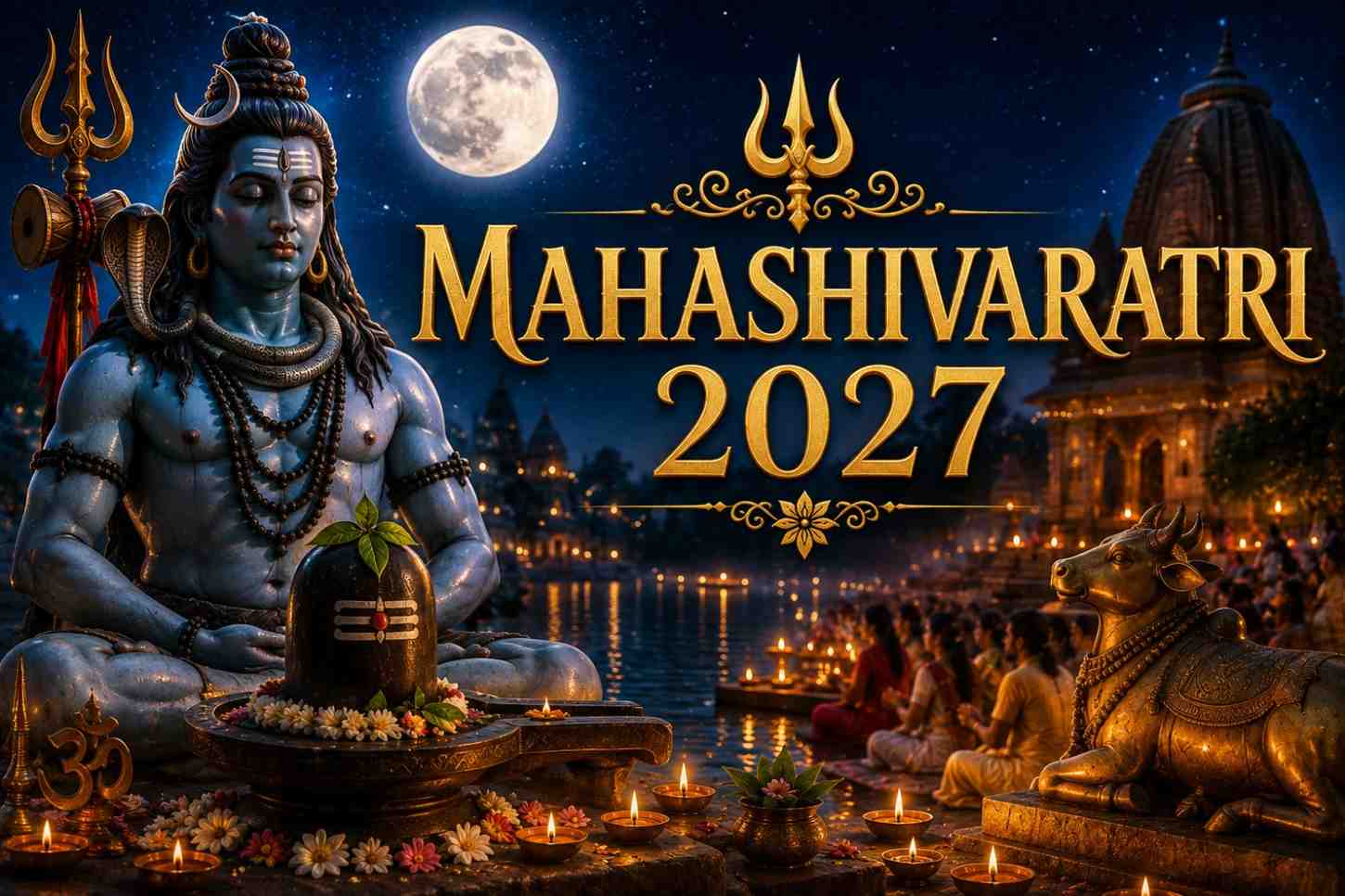
Mahashivaratri falls on the 14th lunar day of the dark half of Phalguna month — the annual climax of Lord Shiva worship. Mahashivaratri 2027 falls on Saturday, March 6 — a Saturday occurrence, which carries particularly strong Saturn-Shiva significance. The night is observed with conscious wakefulness, abhishekam, and sustained mantra practice through four prahar (watches).
- ◦Mahashivaratri Quick Facts
- ◦What Is Mahashivaratri and Why Is It Observed at Night?
- ◦Why Is Mahashivaratri Astrologically Significant?
- ◦The Four Prahar — How the Night Is Structured
- ◦Traditional Practices for Mahashivaratri
- ◦Mahashivaratri Practices for Specific Astrological Situations
- ◦Honest Guidance on Mahashivaratri Practice
- ◦Final Thought
Of all the nights in the Hindu calendar, Mahashivaratri is the one that asks the most of you. It doesn't just ask you to worship — it asks you to stay awake the entire night, move through four rounds of ritual, keep your mantra going in the deep hours when everything in you wants to sleep, and meet Shiva in the silence that's left when the mental noise finally settles.
That's not a coincidence. That's the whole design.
Mahashivaratri is genuinely different from most Hindu festivals — not a daytime celebration but a night-long inward practice. And once you understand what's actually happening astrologically on this night, and why Shiva and Saturn are more connected than most people realize, the tradition starts making a lot more sense.
Mahashivaratri Quick Facts
| Date in 2026 | Sunday, February 15, 2026 (has occurred) |
| Date in 2027 | Saturday, March 6, 2027 — Saturday carries special Saturn significance |
| Sanskrit meaning | Maha (great) + Shiva + Ratri (night) — "the great night of Shiva" |
| Lunar position | Krishna Paksha Chaturdashi of Phalguna/Magha month |
| Primary deity | Lord Shiva (Mahadeva) |
| Distinctive practice | Conscious wakefulness through the night in four prahar, with worship at each |
| Saturn connection | Saturday Mahashivaratris carry particularly strong Shani-Shiva combined significance |
What Is Mahashivaratri and Why Is It Observed at Night?
Most Hindu festivals are daytime celebrations — color, light, community, food. Mahashivaratri is the opposite. It is a night observance, by design.
Several mythological narratives converge on this night. Classical tradition holds it as the night Shiva performed the Tandava (the cosmic dance of creation and destruction), the night of Shiva and Parvati's marriage, the night Shiva drank the halahala poison that emerged from the churning of the cosmic ocean — saving the universe by holding the poison in his throat — and in some traditions, the night Shiva first manifested as the Jyotirlinga of infinite light.
Each of these stories points at something essential about Shiva: transformation, protection, the power of consciousness over destruction.
The classical practice doesn't involve a brief puja and sleep. It involves staying awake the entire night, divided into four prahar (watches of approximately three hours each), with specific worship performed at each transition. The whole night becomes one extended act of devotion and meditation — which is exactly what Shiva, as the deity of consciousness and dissolution, calls for.
Why Is Mahashivaratri Astrologically Significant?
Why the 14th Lunar Day?
Mahashivaratri falls on Krishna Paksha Chaturdashi — the 14th day of the dark, waning half of the lunar month. This is the day immediately before the new moon (Amavasya), when the Moon is at its smallest and the night sky is approaching maximum darkness.
In Vedic understanding, the receding Moon corresponds to the withdrawal of mental activity — the quieting of the mind's usual noise.
And Shiva is specifically the deity of what lies beneath that noise: pure consciousness, dissolution, the awareness that remains when everything else falls away.
The 14th lunar day is therefore a natural fit — it's the night when the external conditions most support the inward turning that Shiva worship invites.
The Pradosh-Shivaratri Connection
Every 13th lunar day (Trayodashi) is called Pradosh — classically associated with Shiva worship, especially during Pradosh Kaal (the period around dusk).
Every 14th lunar day of the dark half is called Shivaratri — a monthly Shiva-night observance. Mahashivaratri is the annual maximum of this monthly rhythm — the single most powerful Shivaratri of the year, the one where all the monthly Shiva energy concentrates into one night.
The Saturn Connection — More Important Than Most People Realize
This is the part of Mahashivaratri that doesn't get nearly enough attention.
Lord Shiva has a deep classical association with Saturn. In tradition, Saturn (Shani) is held to be one of Shiva's most devoted worshippers. Certain forms of Shiva — notably in the Mahamrityunjaya context — are directly connected to the Saturn-death-dissolution relationship.
Both Shiva and Saturn govern themes of discipline, letting go, karmic reckoning, and transformation through difficulty. They are not identical, but they are deeply linked.
What this means practically: for anyone undergoing Sade Sati, Shani Dosha, Saturn Mahadasha, or Ashtama Shani, Mahashivaratri is one of the most powerful annual remedy windows available.
The night already carries Shiva's energy at its annual peak — and for Saturn-afflicted charts, that Shiva energy is directly relevant.
Mahashivaratri 2027 falls on a Saturday — when the Saturn-Shiva connection is at its strongest. If you or someone you know is in a difficult Saturn period, March 6, 2027 is a date worth marking.
Understanding how Saturn is placed in your birth chart will tell you exactly how significant this window is for your specific situation.
Just as Diwali 2026 astrology creates a concentrated window for Lakshmi worship and planetary renewal on Kartika Amavasya, Mahashivaratri creates its own concentrated window — specifically for Shiva-Shani work. The Diwali 2026 Astrology Guide covers that comparison in detail.
The Four Prahar — How the Night Is Structured
This is what makes Mahashivaratri genuinely different. The night isn't one long unstructured vigil — it's divided into four prahar (watches of approximately three hours each), each with specific worship:
First Prahar — Sunset to approximately 9 PM
Milk abhishekam over the Shiva Lingam. This is when you establish your sankalpa — your intention for the entire night. Don't rush through this. The first prahar sets the tone for everything that follows.
Second Prahar — Approximately 9 PM to midnight
Curd (dahi) abhishekam. The practice deepens as the night progresses and the world quiets around you. This is when the sustained mantra recitation starts to build real momentum.
Third Prahar — Approximately midnight to 3 AM
Ghee abhishekam. This is widely considered the most powerful prahar — the deep middle of the night, when consciousness can turn most fully inward and the external world is at its most silent. If you can observe only part of the night, prioritize being awake for this one.
Fourth Prahar — Approximately 3 AM to dawn
Honey abhishekam. The final prahar carries the practice through to sunrise, completing the all-night observance. Breaking the fast after dawn closes the night formally.
Throughout all four prahar: Om Namah Shivaya or Mahamrityunjaya Mantra recitation, Rudrabhishek if your tradition includes it, and recitation of Shiva stotrams — Shiva Tandava Stotram, Rudra Ashtakam, Lingashtakam.
Traditional Practices for Mahashivaratri
- Visit a Shiva temple — particularly one of the twelve Jyotirlingas if accessible: Kashi Vishwanath, Somnath, Mahakaleshwar, Omkareshwar, Kedarnath, Bhimashankar, Trimbakeshwar, Vaidyanath, Nageshwar, Rameshwaram, Grishneshwar, Mallikarjuna
- Perform abhishekam — milk, curd, ghee, honey, and water poured over the Shiva Lingam through the four prahar
- Offer Bilva (bel) leaves — Shiva's most beloved offering; even a simple home practice with bilva leaves carries deep significance
- Recite Mahamrityunjaya Mantra in sustained practice throughout the night — one of the most powerful uses of this night
- Recite Shiva stotrams — Shiva Tandava Stotram, Rudra Ashtakam, or Lingashtakam
- Observe a fast — phalahar (fruits and milk) through the night, or water-only depending on your capacity
- Stay awake (jagaran) — conscious wakefulness is central, not optional
- Meditate on Shiva as the pure consciousness beneath all phenomena — not just as a deity to petition, but as the awareness you're trying to recognize
Mahashivaratri Practices for Specific Astrological Situations
Different charts call for different approaches to this night:
- Sade Sati or Saturn afflictions — Mahashivaratri is one of the most powerful annual windows for combined Shiva-Shani worship; prioritize this night during any Saturn period, especially when it falls on a Saturday
- Health and longevity concerns — sustained Mahamrityunjaya Mantra recitation through the night is one of the strongest classical remedy practices available; this night amplifies it significantly
- Ashtama Shani — combine full Mahashivaratri observance with committed Mahamrityunjaya practice for maximum effect
- Manglik Dosha or Mars afflictions — Mars has a classical connection to Shiva's Tandava energy; Mahashivaratri is relevant for Mars-related remedies as well
- Beginning sustained spiritual practice — Mahashivaratri is the traditional launch point for committed Shiva-related anushthana practices that continue beyond the festival
- Ancestral matters — the Shiva-Yama (death/ancestors) connection makes the night relevant for Pitra-related practices in some traditions
For personalized guidance on which practices your chart needs during this window, Atri - atri at Vedaz specializes in astrological remedies — particularly useful if you're navigating a Saturn period and want to plan your Mahashivaratri practice specifically.
Mahashivaratri sits within the broader pattern of major Vedic festival windows. The Navratri Guide, Akshaya Tritiya Guide, and Ganesh Chaturthi Guide each cover their own powerful annual windows — and understanding how they connect gives you a complete picture of the Vedic calendar's most significant spiritual opportunities.
Honest Guidance on Mahashivaratri Practice
A few things worth saying clearly:
The all-night observance is genuinely demanding. If you cannot maintain wakefulness through the full night, observing at least the first three prahar (sunset to approximately 3 AM) with sincere practice is widely considered substantial. Something is always better than nothing.
Prepare your mantra in advance. Sustained mantra recitation through the deep hours of the night requires that the mantra is already familiar — you can't be learning it at midnight. Practice it beforehand so the recitation flows naturally.
Match fasting to your health. Phalahar (fruits and milk) through the night is widely manageable. Complete water-only fasting is not appropriate for everyone — particularly in regions where the night is warm. Don't make the fast the point; the wakefulness and practice are the point.
A home practice is entirely valid. A Shiva Lingam at the altar, abhishekam, bilva leaves, Mahamrityunjaya recitation, conscious wakefulness — this is complete practice. You don't need to travel to a Jyotirlinga for the night to be meaningful.
Don't make it transactional. Especially for those in Saturn difficulty — the deepest Mahashivaratri practice doesn't approach Shiva with "I will observe this night so Saturn will ease up." It approaches Shiva as the consciousness beneath all conditions, Saturn included. That shift in orientation is itself the remedy.
Final Thought
Mahashivaratri asks something of you that most festivals don't — your whole night.
And that's intentional. Shiva is the deity of what remains when everything else dissolves — the consciousness beneath the mental noise, the awareness that doesn't sleep even when the body does.
The all-night practice is designed to bring you to the edge of that recognition. The sustained mantra, the prahar structure, the fasting, the wakefulness — none of it is arbitrary. It's all pointing at the same thing.
If you observe Mahashivaratri, observe it with that in mind. Stay awake as long as your health genuinely permits. Keep the mantra going through the difficult hours.
Do the abhishekam simply and sincerely. And in whatever silence opens up between the recitations — that's where the festival is actually happening.
For those carrying Saturn difficulty this year: the night is a real invitation. Saturn's lessons don't disappear on Mahashivaratri — but Shiva is the consciousness in which even Saturn's weight can be held differently. That shift is what the night is for.
Vaidehi Gokhale
Spiritual Practices, Fasting & Festival Observances | 11+ Years
Vaidehi Gokhale is a spirituality writer with expertise in fasting traditions, festival rituals, and devotional practices. She focuses on creating practical and well-researched content that helps readers understand the deeper purpose behind religious observances.
Frequently Asked Questions
1. What is Mahashivaratri?
Mahashivaratri — "the great night of Shiva" — is one of the most spiritually significant nights of the Hindu calendar, falling on the 14th lunar day of the dark half of Phalguna/Magha month. It is the annual climax of Lord Shiva worship, observed with conscious wakefulness through the night, abhishekam of the Shiva Lingam, and sustained mantra practice. Multiple mythological narratives — Shiva's Tandava, the marriage of Shiva-Parvati, the drinking of halahala poison — all converge on this one night.
2. When is Mahashivaratri 2027?
Mahashivaratri 2027 falls on Saturday, March 6, 2027 — and a Saturday Mahashivaratri carries particularly strong Saturn-Shiva combined significance, making it especially powerful for those in Sade Sati, Shani Dosha, or Saturn Mahadasha. Mahashivaratri 2026 was Sunday, February 15, 2026 (already occurred).
3. Why is Mahashivaratri observed at night?
Because Shiva is the deity of dissolution, inward turning, and the consciousness beneath all mental activity. The 14th lunar day of the dark half is when the Moon is at its smallest and the night sky is at its darkest — the external conditions that most naturally support the deep inward focus Shiva worship invites. The all-night conscious wakefulness (jagaran) is central to the practice, not optional.
4. What is the connection between Mahashivaratri and Saturn?
Lord Shiva has a deep classical association with Saturn — Shani is held in tradition to be one of Shiva's most devoted worshippers. Both govern themes of discipline, karmic reckoning, letting go, and transformation through difficulty. Mahashivaratri is therefore one of the most powerful annual windows for combined Shiva-Shani worship — particularly for those undergoing Sade Sati, Shani Dosha, or Saturn Mahadasha. When Mahashivaratri falls on a Saturday (as in 2027), the connection is at its absolute strongest.
5. What are the four prahar of Mahashivaratri?
The night is divided into four watches of approximately three hours each. First prahar (sunset to 9 PM) — milk abhishekam. Second prahar (9 PM to midnight) — curd abhishekam. Third prahar (midnight to 3 AM) — ghee abhishekam, widely considered the most powerful. Fourth prahar (3 AM to dawn) — honey abhishekam. Each prahar deepens the practice as the night progresses.
6. What are the best practices for Mahashivaratri?
Visit a Shiva temple if possible, perform abhishekam, offer bilva leaves, recite the Mahamrityunjaya Mantra in sustained practice through the night, recite Shiva stotrams, observe a fast, stay awake (jagaran) through the four prahar, and meditate on Shiva as pure consciousness. A sincere home practice is entirely valid — elaborateness is not the point, sustained inward engagement is.
Related Blogs
Saraswati Puja: Science Behind Yellow Sweets
Yellow sweets on Saraswati Puja aren't just tradition—they're science, emotion, and energy in one. Find out how colour, food, and devotion come together in this surprising story of wisdom and wellness
Are You Doing Shiv Puja In The Right Way?
Shiv Pooja isn’t about perfection—it’s about presence. Discover the small yet powerful steps you might be skipping, and how they can transform your prayer into a deeper, more personal experience.
Easy Lakshmi Pooja Steps For Inner Peace
You don’t need perfection to feel divine peace. Just a diya, a flower, and a moment of stillness. This gentle Lakshmi Pooja is a soft reminder that grace begins within.
Navgraha Pooja: A Powerful Spiritual Start
Struggling with delays, confusion, or emotional heaviness? Navgraha Pooja might be the spiritual shift you need. Learn how this ancient practice helps you align with cosmic energy and reclaim inner peace.