Ganesh Chaturthi 2026: Date, Puja, Visarjan and Significance
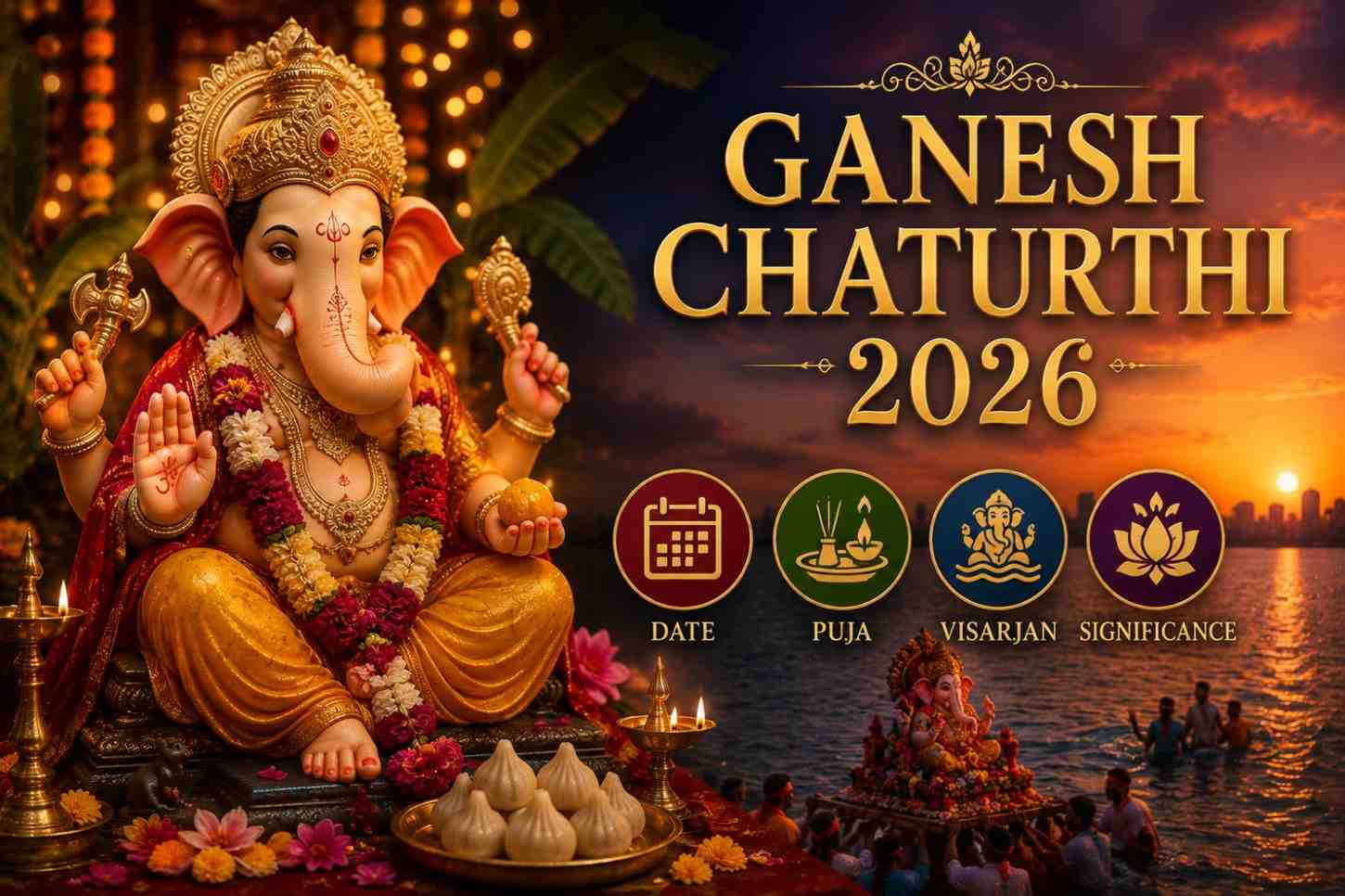
Ganesh Chaturthi 2026 falls on Monday, September 14 — the fourth lunar day of the bright half of Bhadrapada month. The 10-day festival culminates in Visarjan on Thursday, September 24 (Anant Chaturdashi). Lord Ganesha is classically connected to Mercury (Budha) — making this the most powerful annual window for Mercury-related remedies and obstacle removal.
- ◦What Does Ganesh Chaturthi Actually Celebrate?
- ◦Why Is Ganesh Chaturthi Astrologically Significant?
- ◦The 10-Day Festival Sequence
- ◦Traditional Practices for Ganesh Chaturthi
- ◦Ganesh Chaturthi Practices for Specific Astrological Situations
- ◦Honest Guidance on Ganesh Chaturthi Practice
- ◦How Ganesh Chaturthi Fits Into the Vedic Festival Calendar
- ◦Final Thought
There's a reason Ganesha is the first deity invoked in every Hindu prayer, every wedding, every new business, every exam. Before anything else begins — Ganesha comes first. Not as a formality, but as a principle: pause at the threshold, invoke wisdom, then cross.
Ganesh Chaturthi is ten days of celebrating exactly that principle. And while the festival is famous for its massive community pandals, elaborate idol processions, and the energy of Visarjan — there's a lot more happening underneath the celebration.
The Mercury connection alone changes how you think about what Ganesha worship actually does astrologically.
This guide covers it all — the dates, the mythology and what it actually means, the Mercury and Ketu connections, the 10-day sequence, the practices, and how to use this window for astrological remedies.
Quick Answers
- Ganesh Chaturthi 2026: Monday, September 14, 2026
- Visarjan 2026: Thursday, September 24, 2026 (Anant Chaturdashi)
- Festival duration: 10 days (traditions vary — 1, 3, 5, 7, or 11 days also observed)
- Primary deity: Lord Ganesha (Ganapati, Vinayaka, Vighneshvara)
- Astrological connection: Mercury (Budha) — intelligence, communication, learning, commerce
- Also connected to: Ketu — obstacle removal, spiritual breakthrough, Kaal Sarp Dosha
- Lunar position: Shukla Paksha Chaturthi of Bhadrapada month
What Does Ganesh Chaturthi Actually Celebrate?
Most people know the story. But it's worth understanding what it's actually saying.
Parvati created Ganesha from sandalwood paste and life-breath while she bathed, instructing him to guard the entrance. When Shiva returned and the young Ganesha refused him entry — not recognizing his own father — Shiva severed Ganesha's head in anger.
Upon realizing what had happened, Shiva restored Ganesha by replacing his head with that of an elephant and gave him a gift that no other deity received: he would be the first to be worshipped in every undertaking, every prayer, every important beginning.
That last part is the key. Ganesha isn't just a deity among many — he is the principle of conscious beginning itself.
And the symbolism runs deep:
- The elephant head represents wisdom and discrimination — the ability to see clearly before acting
- The broken tusk represents the willingness to sacrifice for higher purpose
- The large belly represents the capacity to digest all of life's experiences — good and bad
- The mouse he rides represents desire — subdued and made to serve rather than run wild
- The modak sweet he holds represents the reward of inner knowledge
Ganesh Chaturthi celebrates his birth — but more deeply, it celebrates what he represents: the moment of pausing at any threshold to invoke wisdom before crossing it.
Why Is Ganesh Chaturthi Astrologically Significant?
The Mercury-Ganesha Connection
This is the part that changes how you approach Ganesha worship if you're thinking about it astrologically.
Classical Vedic tradition connects Lord Ganesha directly to Mercury (Budha). Both govern the same fundamental domain: intelligence, learning, communication, the arts, and commerce.
Mercury is the planet of the intellect; Ganesha is the deity of wisdom. Mercury rules Wednesday — and Ganesha is widely worshipped on Wednesdays. That parallel is not accidental.
What this means practically: if your chart has a weak or afflicted Mercury — showing up as communication difficulties, struggles in education, problems with commerce or trade, or challenges in clear thinking — Ganesha worship is the primary classical remedy.
Not as a supplement to Mercury mantra, but as a central practice.
And Ganesh Chaturthi is the most powerful annual window for exactly that. Understanding how Mercury sits in your birth chart tells you how significant this window is for your specific situation.
The Ketu-Ganesha Connection
Some traditions also connect Ganesha to Ketu — both are associated with spiritual insight, transcendence of obstacles, and the capacity to break through conditioned patterns. For Ketu-related afflictions, including Kaal Sarp Dosha, Ganesha worship is a classical remedy, and Ganesh Chaturthi amplifies its effect significantly.
Why the 4th Lunar Day?
The 4th lunar day (Chaturthi) of every fortnight is classically dedicated to Lord Ganesha — specifically Sankashti Chaturthi (4th day after the full moon) and Vinayaka Chaturthi (4th day after the new moon).
Ganesh Chaturthi is the most powerful annual Vinayaka Chaturthi — falling in Bhadrapada when the festival's broader cultural and devotional intensity converges with the lunar timing to create the year's strongest Ganesha window.
The 10-Day Festival Sequence
Day 1: Ganesh Chaturthi — September 14, 2026
The main day — and the most important ritual of the entire festival happens on this day: Pranapratishtha, the formal invocation of life-energy into the Ganesha idol. After Pranapratishtha, the idol is no longer treated as a sculpture — it is treated as the actual living presence of the deity for the duration of the festival.
Day 1 involves elaborate worship, the offering of 21 modaks (the sweet considered Ganesha's most beloved food), durva grass offerings, mantra recitation, and the beginning of the sustained devotional period. If you observe only one day, this is the one.
Days 2–9: Daily Worship
Throughout the festival — however many days your tradition observes — the installed Ganesha receives daily morning and evening worship. Aartis, mantra recitation, Atharvashirsha recitation, scripture reading, and food and flower offerings are maintained.
Many families host extended family and community for shared worship and meals during this period. The sustained daily practice is what builds real momentum.
Final Day: Visarjan — September 24, 2026
The festival culminates with Visarjan — the immersion of the Ganesha idol in water (river, lake, sea, or specially designated immersion tank). The sequence: a final aarti, the formal request for Ganesha to depart with the prayer for his return next year, and the procession to the immersion site.
The symbolic meaning is worth sitting with: the form Ganesha took for the festival's duration is released back into the formless — while the devotion and benefit of the days remain with the devotees. The idol dissolves; the practice doesn't.
For those observing shorter durations (1, 3, 5, or 7 days), Visarjan simply occurs at the end of your chosen period.
Traditional Practices for Ganesh Chaturthi
- Pranapratishtha — the formal invocation of the deity into the idol on Day 1; don't skip this
- Daily morning and evening aartis throughout the festival duration
- Ganesha mantra recitation — Om Gam Ganapataye Namah or longer Vinayaka mantras; 108 daily is the foundational count
- Atharvashirsha Upanishad recitation — the classical Vedic text dedicated to Ganesha; one of the most powerful Ganesh Chaturthi practices
- Ganesh Stotram and Sankashtanashana Stotram recitation
- Modak offering — 21 modaks is the traditional offering; Ganesha's most beloved food
- Durva grass offering — the specific grass classically associated with Ganesha worship
- Visarjan — the concluding immersion ceremony performed with reverence, not just celebration
- Sankashti Chaturthi — using Ganesh Chaturthi as the launch for committed monthly Ganesha worship throughout the year
For personalized mantra guidance during Ganesh Chaturthi — especially if you're working on Mercury-related remedies — Apala - apala at Vedaz specializes in mantra and meditation and can help you build a practice that carries well beyond the 10 days.
Ganesh Chaturthi Practices for Specific Astrological Situations
Different charts call for different approaches during this festival window:
- Weak or afflicted Mercury — communication issues, learning difficulties, commercial challenges — Ganesh Chaturthi is the most powerful annual window for Mercury remedy through Ganesha worship; don't let this pass unused
- Ketu-related afflictions or Kaal Sarp Dosha — Ganesha worship is a classical remedy for both; Ganesh Chaturthi amplifies the effect significantly
- Removing obstacles in any area — career, education, marriage, health — Ganesha is Vighnaharta (remover of obstacles); the festival is the year's most concentrated invocation of that function
- Beginning new ventures or important undertakings — installing a small home Ganesha during Ganesh Chaturthi and maintaining the practice carries forward the auspicious-beginning energy
- Students and intellectual professions — Ganesha is the patron of learning; this is particularly recommended for educational sankalpa and sustained study commitment
- Sustained Sankashti Chaturthi practice — use Ganesh Chaturthi as the launch point for committed monthly observance through the year; this is the traditional approach to sustained Ganesha remedy work
Honest Guidance on Ganesh Chaturthi Practice
A few things worth saying clearly:
A simple home practice is entirely valid. A small Ganesha idol, daily morning and evening worship, sincere mantra recitation — this is complete practice. The massive community pandals are wonderful, but you don't need them for the festival to be meaningful.
Match the duration to your capacity. The traditional 10-11 day observance is for those who can maintain it with genuine engagement. Many families observe for 1, 3, 5, or 7 days. A short, sincere observance is more meaningful than a long mechanical one.
Choose your idol thoughtfully. Traditional clay (mitti) idols dissolve easily in water; large Plaster of Paris idols — which became common in the late 20th century — cause significant water pollution at Visarjan.
Many modern practitioners choose clay idols or designated immersion tanks, which is fully consistent with classical tradition. The tradition used clay long before plaster existed.
Sustain it beyond the festival. For Mercury-related remedy, Ganesh Chaturthi is the launch point — not the whole practice. Commit to monthly Sankashti Chaturthi observance through the year. That sustained practice is what actually shifts the Mercury picture in your chart.
Approach it as practice, not transaction. The deepest meaning of Ganesha worship isn't the request for obstacle removal — it's the recognition that Ganesha represents the principle of conscious beginning. Approached that way, the festival becomes genuine practice rather than a wish list.
How Ganesh Chaturthi Fits Into the Vedic Festival Calendar
Ganesh Chaturthi is the year's most concentrated Mercury and obstacle-removal window — and it connects to a broader pattern of major Vedic festival dates:
- The Diwali 2026 Astrology Guide covers the Kartika Amavasya window — Ganesha is always worshipped jointly with Lakshmi on Diwali night, making the two festivals directly connected
- The Akshaya Tritiya Guide covers the spring prosperity window — the other major annual window where Ganesha worship combines naturally with Lakshmi practice
- The Navratri Guide covers the nine-night Goddess worship arc — falling in the same autumn festival cluster as Ganesh Chaturthi
- The Mahashivaratri Guide covers the Great Night of Shiva — Ganesha's father, making Mahashivaratri another natural Ganesha-worship window
Final Thought
Every Hindu prayer begins with Ganesha. Every wedding. Every new business. Every exam. Before anything — Ganesha first.
Ganesh Chaturthi is ten days of living that principle fully. And the festival's deepest gift isn't the obstacle removal you might ask for — it's the cultivation of the habit itself: pausing at every threshold, invoking wisdom before crossing it, beginning consciously rather than impulsively.
That's what Ganesha represents. And that's what ten days of genuine worship actually builds — not just during the festival, but in how you approach everything after it.
Observe it with sincere engagement, whatever duration you choose. Use a clay idol. Keep the mantra going after the festival ends. Let Sankashti Chaturthi become a monthly practice. And at every important threshold this year — pause. Invoke. Then begin.
That's the whole tradition, right there.
Aaratrika Basu
Indian Festivals, Cultural Traditions & Devotional Practices | 9+ Years
Aaratrika Basu is a cultural writer specializing in Hindu festivals, regional celebrations, and devotional traditions. Her work highlights the spiritual meaning and cultural richness behind India's most cherished religious observances.
Frequently Asked Questions
1. What is Ganesh Chaturthi?
Ganesh Chaturthi is the Hindu festival celebrating the birth of Lord Ganesha — the elephant-headed remover of obstacles (Vighnaharta), lord of beginnings (Adipoojya), and patron of wisdom, learning, and the arts. Falling on the fourth lunar day of the bright half of Bhadrapada month, it opens a 10-day window of devotional celebration culminating in the immersion of the Ganesha idol (Visarjan).
2. When is Ganesh Chaturthi 2026?
Ganesh Chaturthi 2026 falls on Monday, September 14, 2026. The 10-day festival culminates in Visarjan on Thursday, September 24, 2026 (Anant Chaturdashi). The exact date varies each year because it follows the lunar calendar.
3. What is the connection between Ganesha and Mercury?
Classical Vedic tradition connects Lord Ganesha directly to Mercury (Budha) — both govern intelligence, learning, communication, and commerce. Mercury rules Wednesday; Ganesha is widely worshipped on Wednesdays. For natives with weak or afflicted Mercury, Ganesha worship is the primary classical remedy — and Ganesh Chaturthi is the most powerful annual window for that practice.
4. What are the main practices of Ganesh Chaturthi?
Pranapratishtha (invocation of the deity into the idol on Day 1), daily morning and evening aartis, Ganesha mantra recitation (Om Gam Ganapataye Namah — 108 daily), Atharvashirsha Upanishad recitation, modak and durva grass offerings, and the concluding Visarjan ceremony. A simple home observance with sincere engagement is fully valid.
5. What is Visarjan and why is the idol immersed?
Visarjan is the immersion of the Ganesha idol in water at the end of the festival — the form Ganesha took for the festival is released back into the formless, while the devotion of the days remains with the devotees. Environmental note: traditional clay idols dissolve easily; large Plaster of Paris idols cause significant water pollution. Many practitioners now choose clay idols or designated immersion tanks — consistent with classical tradition.
6. Can I observe Ganesh Chaturthi for fewer than 10 days?
Yes. The festival's length is traditionally flexible — 1, 3, 5, or 7 days are all valid durations. Visarjan occurs at the end of your chosen period. Match the length to what you can sustain with genuine engagement. The traditional sequence — Pranapratishtha at start, daily worship throughout, Visarjan at conclusion — applies at any duration.
Related Blogs
Saraswati Puja: Science Behind Yellow Sweets
Yellow sweets on Saraswati Puja aren't just tradition—they're science, emotion, and energy in one. Find out how colour, food, and devotion come together in this surprising story of wisdom and wellness
Are You Doing Shiv Puja In The Right Way?
Shiv Pooja isn’t about perfection—it’s about presence. Discover the small yet powerful steps you might be skipping, and how they can transform your prayer into a deeper, more personal experience.
Easy Lakshmi Pooja Steps For Inner Peace
You don’t need perfection to feel divine peace. Just a diya, a flower, and a moment of stillness. This gentle Lakshmi Pooja is a soft reminder that grace begins within.
Navgraha Pooja: A Powerful Spiritual Start
Struggling with delays, confusion, or emotional heaviness? Navgraha Pooja might be the spiritual shift you need. Learn how this ancient practice helps you align with cosmic energy and reclaim inner peace.