Vrat Meaning in Astrology: Rules, Remedies, and Planetary Benefits
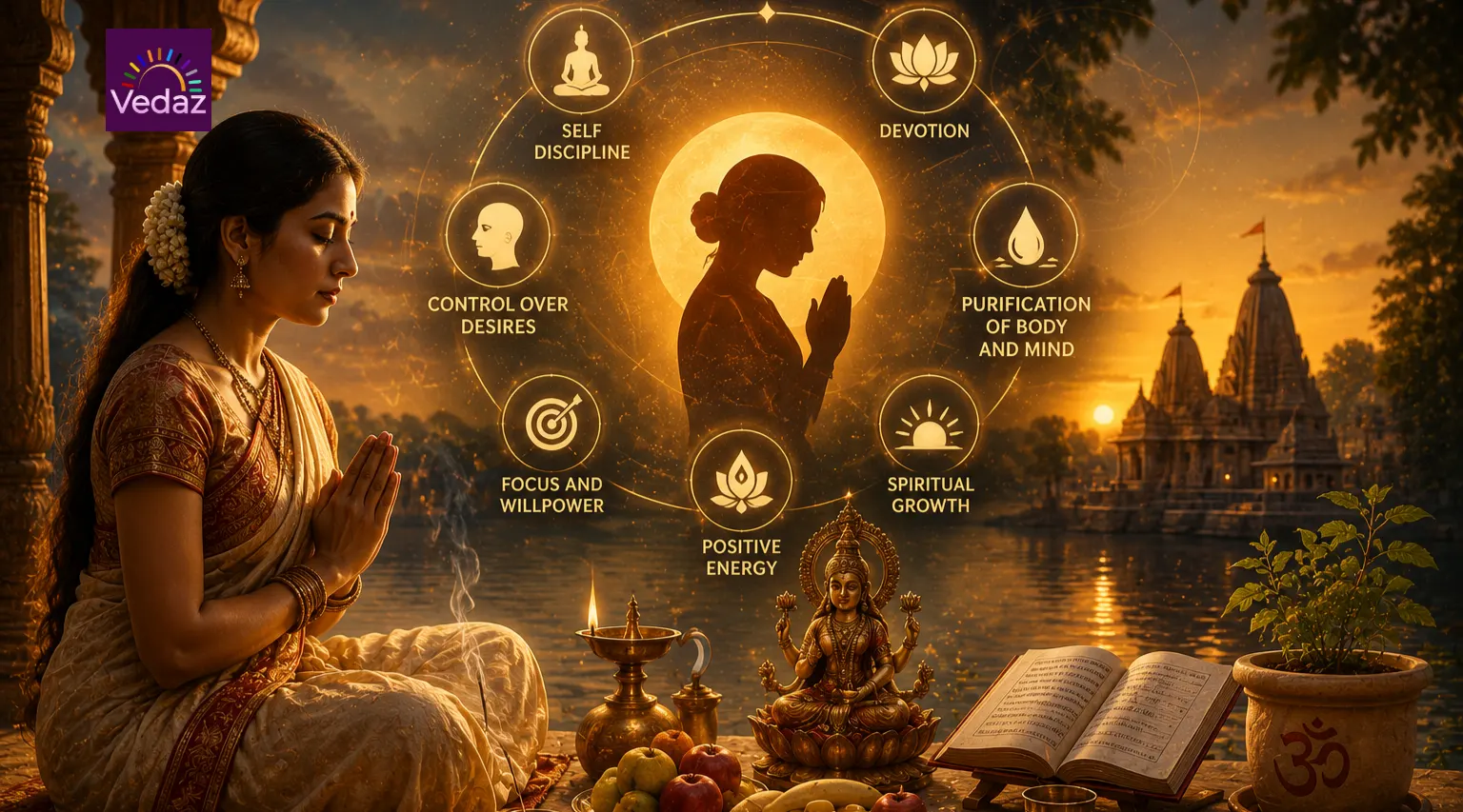
Vrat (fasting) in Vedic astrology is a committed observance combining dietary discipline, devotion, and intention — observed on the day associated with a specific planet. Each weekday links to one of the nine grahas. Saturday fasting addresses Saturn, Tuesday fasting addresses Mars. A vrat is never just skipping meals — the devotional dimension is essential.
Fasting is one of those practices that sounds simple until you actually look at what the tradition says about it. Skip a meal on Saturday, worship Shani, and your Saturn problems ease. That's how it gets summarized. But that summary leaves out almost everything that actually makes a vrat work.
The word itself gives it away. Vrat doesn't mean "fast." It means a vow — a committed observance. The dietary restriction is just one part of it. What makes it a vrat, rather than just skipping lunch, is the combination of discipline, devotion, and conscious intention held together in a single practice.
This guide covers all seven planetary fasting days, the major vrat observances of the tradition, the different fasting methods, how to use fasting as an astrological remedy — and, importantly, honest guidance on who should and shouldn't fast at all.
Vrat and Fasting: Quick Reference
| Detail | Information |
|---|---|
| Vrat / Upvas | A committed religious observance combining fasting, devotion, and intention |
| Planetary fasting days | Each weekday is associated with a planet and its deity |
| Common vrat types | Full fast, partial fast, fruit/milk fast, nirjala (waterless) fast |
| Astrological role | Strengthening or pacifying a specific planet through observance on its day |
| Key principle | Discipline + devotion + intention — not merely skipping meals |
| Important caution | Not appropriate for everyone — health must always be considered |
The Seven Planetary Fasting Days in Vedic Astrology
Each day of the week is governed by a planet and associated with a deity. Fasting on a planet's day — combined with the relevant devotional practice — is the traditional way to strengthen or pacify that planet.
Sunday — Sun (Surya)
For strengthening the Sun: vitality, authority, confidence, the relationship with your father, heart and eye health, and government-related matters.
The Sunday vrat traditionally involves avoiding salt, eating one meal before sunset, and worshipping Surya.
The practice of offering water (Arghya) to the rising sun is a central observance — one of the most accessible and widely recommended Sun-strengthening practices in the entire tradition.
Monday — Moon (Chandra) / Lord Shiva
For strengthening the Moon and deepening devotion to Lord Shiva: emotional stability, mental peace, and the mother-relationship.
The Somvar Vrat is one of the most widely observed weekday fasts — particularly for those seeking emotional steadiness, or traditionally by unmarried women seeking a good marriage.
It involves Shiva worship, Shiva mantra recitation, and a simple sattvic diet. If your Moon is weak or heavily afflicted, Monday fasting is one of the gentlest and most consistent remedies available.
Tuesday — Mars (Mangal) / Lord Hanuman
For strengthening Mars and pacifying Mars-related difficulties: courage, energy, protection, and relief from Manglik Dosha.
The Mangalvar Vrat involves Hanuman worship, recitation of the Hanuman Chalisa Benefits Guide practice, and a diet typically avoiding salt — sometimes featuring wheat-based foods and jaggery.
Hanuman embodies ideal Mars energy, which is exactly why Tuesday worship of Hanuman is the classical remedy for Mars afflictions.
Wednesday — Mercury (Budha) / Lord Vishnu / Lord Ganesha
For strengthening Mercury: intelligence, communication, commerce, and learning capacity.
The Wednesday vrat supports intellectual and business matters and is associated with Vishnu and Ganesha worship. Particularly relevant for those in communication-heavy professions or studies where Mercury's support is needed.
Thursday — Jupiter (Brihaspati) / Lord Vishnu
For strengthening Jupiter and worshipping Lord Vishnu: wisdom, dharma, prosperity, education, and marriage prospects.
The Guruvar Vrat (or Brihaspativar Vrat) often involves yellow foods, avoidance of salt, and worship of Vishnu or the guru.
It is one of the most widely observed fasts for prosperity and dharmic blessing — and because Jupiter is a natural benefic, the Thursday fast is one of the more broadly recommended vrats in the tradition.
Friday — Venus (Shukra) / Goddess Lakshmi / Goddess Durga
For strengthening Venus and worshipping the Goddess: relationships, harmony, material comfort, and artistic capacity.
The Shukravar Vrat is associated with Lakshmi worship for prosperity and Santoshi Mata worship in some traditions. It's a natural fit for those working on relationship harmony, creative capacity, or material wellbeing — all of which Venus governs.
Saturday — Saturn (Shani) / Lord Hanuman
For pacifying Saturn and finding relief during difficult Saturn periods: Sade Sati, Shani Dosha, Saturn Mahadasha, and career instability.
The Shanivar Vrat is the most commonly observed astrological remedy fast in the entire tradition — and for good reason. Saturn-related periods affect such a large proportion of people that Saturday fasting becomes relevant to most at some point.
It typically involves worship of Lord Shani, donation of black items, and recitation of the Hanuman Chalisa practice.
Many traditions recommend observing it for a committed series — 7, 11, or 16 consecutive Saturdays — rather than occasionally.
Major Vrat Observances Beyond Weekday Fasting
The weekly planetary fasts are just the foundation. The tradition includes a rich calendar of lunar-day and festival-based vrats:
- Ekadashi — the 11th lunar day of each fortnight, observed twice monthly; one of the most important fasts, associated with Lord Vishnu
- Pradosh Vrat — 13th lunar day, associated with Lord Shiva; particularly powerful during Pradosh Kaal (dusk) — pairs naturally with the Mahamrityunjaya Mantra Guide practice
- Sankashti Chaturthi — 4th lunar day after the full moon, associated with Lord Ganesha and removal of obstacles
- Purnima Vrat — full moon day fasting
- Amavasya Vrat — new moon day fasting, associated with ancestral observances
- Navratri fasting — the nine-day observance dedicated to the Goddess, twice yearly
- Karva Chauth — observed by married women for the wellbeing of their husbands
- Maha Shivaratri — the great night of Shiva; one of the most significant annual fasts in the entire calendar
- Festival-specific vrats — many festivals carry their own distinct fasting traditions
Traditional Fasting Methods: What a Vrat Actually Looks Like
Vrat is not one single practice. The tradition recognizes several intensities, and the right method depends on the observance, the person, and their health.
- Phalahar vrat — a fruit and milk fast; no grains or cooked meals, but fruits, milk, nuts, and certain permitted foods are allowed. The most common form for many weekday fasts
- One-meal vrat — a single sattvic meal during the day, typically after worship or before sunset
- Saltless fast — eating but avoiding salt; a common form for weekday planetary fasts
- Liquid fast — only water, milk, or fruit juices
- Nirjala vrat — the most intensive: a complete fast without even water, observed for specific occasions like Nirjala Ekadashi. This form requires particular caution and is not appropriate for most people
- Partial-day fast — fasting until a specific point (sunset, moonrise, completion of worship) and then eating
One thing is consistent across all of these: a vrat is dietary discipline plus devotional practice plus intention. Skipping meals without the worship, the mantra, and the conscious intention is not — traditionally — a vrat. It is just skipping meals.
How to Use Fasting as an Astrological Remedy
Choosing the right planetary fast comes down to understanding your chart. Here's the classical framework:
- For a weak but benefic planet — fast on that planet's day to strengthen it (e.g., Thursday fast for a weak but benefic Jupiter)
- For Sade Sati or Saturn afflictions — Saturday fast is the primary recommendation
- For Manglik Dosha or Mars afflictions — Tuesday fast with Hanuman worship
- For the planet ruling your current Mahadasha — fast on its day for support throughout that period
- For your Lagna lord — fasting on its day supports overall vitality and life direction
A few practical points on consistency:
- Begin on an auspicious date — many traditions recommend starting on a specific tithi or during a favorable period
- Commit to a number — 7, 11, or 16 consecutive observances is more traditional than occasional fasting
- Conclude properly — some traditions include a concluding ritual (udyapan) after the committed series
To identify which planet your chart actually needs this support for, working from your birth chart is the essential starting point. And if you want to explore how fasting combines with other remedy types, the Navagraha Mantras Guide explains how mantra practice on a planet's day amplifies the vrat's effect considerably.
If you're unsure which planetary fast is right for your current situation, Yajna, Vedaz's AI astrologer specializing in problem-solving can help you identify which planet needs attention and which fasting practice suits your chart.
Important Cautions on Fasting
This section matters — please read it carefully.
Fasting is not appropriate for everyone. The following groups should consult a doctor before undertaking any vrat, and many should not fast at all:
- People with diabetes or blood sugar conditions
- Those with low blood pressure
- Anyone with an eating disorder or a history of one
- Pregnant or nursing women
- The elderly
- Growing children
- Anyone with a medical condition affected by food restriction
A few more things worth being direct about:
- A vrat should never become disordered eating or self-punishment. The tradition frames fasting as devotional discipline — not deprivation, not harm
- Nirjala (waterless) fasting carries genuine physical risk, especially in hot climates. It is not appropriate for most people
- If fasting produces dizziness, weakness, or distress, break it. The tradition itself permits this — health is not sacrificed for observance
- Fasting purely for weight loss or out of anxiety is not a spiritual practice. The intention matters as much as the act
- Listen to your body. The purpose of vrat is spiritual focus and planetary support — never physical harm
For those going through intense Saturn periods where both fasting and mantra practice are recommended together, Zen, Vedaz's AI astrologer specializing in calm and mind relaxation can help you build a sustainable, grounded practice that supports you without causing stress.
A Final Word
Vrat is one of the most complete remedy practices in the Vedic tradition — because it engages the whole person. The body through dietary discipline. The heart through devotion. The mind through conscious intention. All three, held together, pointed toward the same planetary energy.
As an astrological remedy, fasting on a planet's day is a time-honored and accessible practice. But what the tradition actually asks for is more than a skipped meal. It asks for the vow — the commitment, the worship, the awareness of why you are doing it.
Take it up that way. With devotion and intention. With honesty about your health. And with the freedom to break the fast when your body asks for it.
The discipline is the point. Harm never is.
And if the Vedic Gemstones Complete guide is also part of your remedy exploration — fasting on a planet's day, paired with its mantra, is often a wiser and safer starting point than reaching for a gemstone. The tradition's gentler remedies deserve their moment first.
Pandita Nandini Sharma
Hindu Rituals, Vrats & Religious Observances | 12+ Years
Pandita Nandini Sharma specializes in Hindu rituals, fasting traditions, and devotional observances. She writes practical guides that help readers understand the cultural and spiritual significance of various vrats and fasting practices.
Frequently Asked Questions
1. What is a vrat?
A vrat (also called upvas) is a committed religious observance in the Hindu tradition combining fasting, devotional practice, and conscious intention. It is far more than simply skipping meals — a true vrat unites dietary discipline with worship, mantra or scripture, and a specific spiritual intention. Vrats are observed on days associated with particular planets or deities, or on lunar days and festivals.
2. Which day should I fast for which planet?
Sunday for the Sun, Monday for the Moon and Lord Shiva, Tuesday for Mars and Lord Hanuman, Wednesday for Mercury, Thursday for Jupiter and Lord Vishnu, Friday for Venus and the Goddess, Saturday for Saturn and Lord Hanuman. To strengthen a weak but benefic planet, or pacify a planet causing difficulty, fast on that planet's day with the associated devotional practice.
3. What is the best fast for Saturn problems?
The Saturday fast (Shanivar Vrat) is the primary fasting remedy for Saturn-related difficulties including Sade Sati, Shani Dosha, and Saturn Mahadasha. It typically involves worship of Lord Shani and Lord Hanuman, Hanuman Chalisa recitation, donation of black items, and a saltless or one-meal fast. Many traditions recommend observing it for a committed series — 7, 11, or 16 consecutive Saturdays.
4. What are the different types of fasting in the Hindu tradition?
The main types are: phalahar vrat (fruit and milk fast, no grains), one-meal vrat (a single sattvic meal), saltless fast (eating but avoiding salt), liquid fast (only water, milk, or juice), nirjala vrat (complete fast without even water — requires special caution), and partial-day fast (fasting until sunset, moonrise, or completion of worship). The right type depends on the observance, the individual, and their health.
5. Is fasting safe for everyone?
No. People with diabetes, low blood pressure, eating disorders, those who are pregnant or nursing, the elderly, growing children, and anyone with a health condition affected by fasting should consult a doctor first — and many should not fast at all. Nirjala (waterless) fasting carries particular physical risk. The tradition permits breaking a fast when health requires it. A vrat should never become disordered eating or self-punishment.
6. How long should I observe a planetary fast?
Traditionally, a planetary vrat is observed for a committed series — common commitments are 7, 11, 16, or 21 consecutive observances. Some traditions specify completing the vrat with a concluding ritual (udyapan) after the committed number. Consistency over a sustained period is the traditional approach, but the observance should always be adjusted or stopped if health requires it.
Related Blogs

Boost Your Health with Astrology
Boost your health with astrology using zodiac-based habits, wellness tips, and simple routines for better physical and mental balance.

The Socking Truth Behind Wearing A Black Thread
Uncover the mystery behind the black thread. From protection to spiritual energy—here’s why everyone’s suddenly wearing one.

Hidden Messages In Your Moles
What if that little mole on your cheek is more than just a mark? Explore the fascinating meanings behind mole placements and what they reveal about your future.
Who Is Your Ishta Devata?
Explore the concept of your personal God in Hinduism. Learn how to discover, connect with, and build a relationship with your Ishta Devata for inner peace and spiritual growth.