Navagraha Mantras Explained: Benefits, Chanting Rules and Remedies
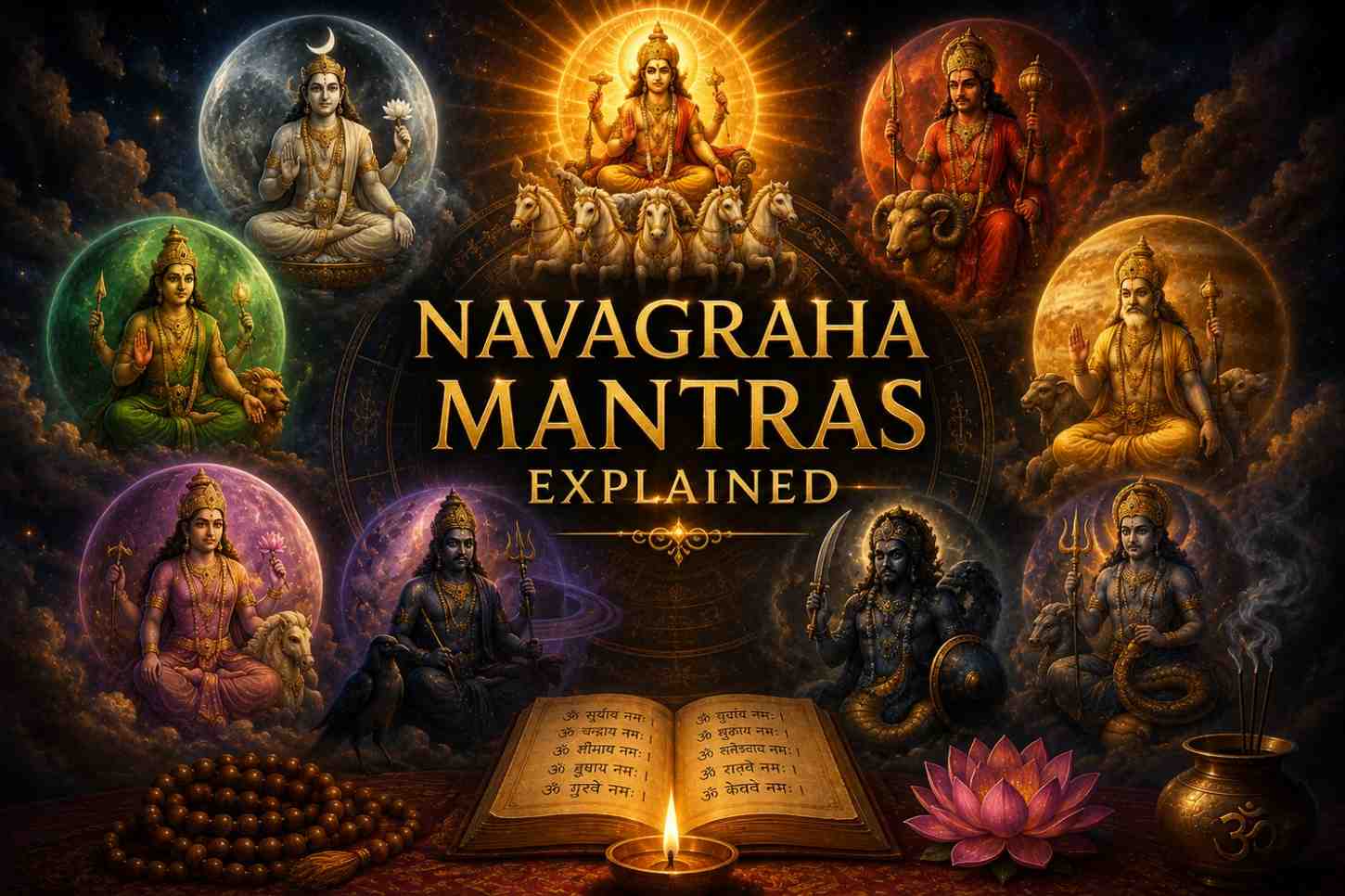
The Navagraha mantras are nine planetary mantras in Vedic astrology — one for each graha. They come in three types: Naam, Beej, and Vedic mantras. Among the safest and most accessible remedies in the system, they require no cost, carry minimal risk, and can be practiced by anyone. Daily recitation of 108 repetitions is the standard practice.
If you're just getting started with Vedic astrological remedies, the Navagraha mantras are honestly the best place to begin. They cost nothing, they carry almost no risk. They don't require a jeweler, a priest, or an expensive consultation just to get started. And they work — not through magic, but through the sustained practice of turning your attention toward the planetary energy you're trying to strengthen.
Unlike gemstones — which can cause real harm if worn for the wrong planet — mantras are gentle. The worst that happens with a suboptimal choice is that the practice simply doesn't help as much as it could. That's a very different kind of risk.
This guide covers all nine planetary mantras across the three traditional types, how to choose which one your chart needs, and how to practice properly.
Navagraha Mantras: Quick Reference
| Detail | Information |
|---|---|
| Number of mantras | Nine — one per graha |
| Three types | Beej (seed), Vedic, and Naam (name) mantras |
| Risk level | Among the safest remedies — minimal risk of harm |
| Cost | Free — requires only time and consistency |
| Standard count | 108 per sitting (one mala) |
| Best approach | Practice the mantra of the planet your chart specifically needs |
The Three Types of Navagraha Mantras
The Vedic tradition uses three categories of mantras for each planet — and understanding the difference helps you choose the right starting point.
Naam Mantras are the simplest form: "Om [planet name] Namah." Accessible to everyone, suitable for beginners, and entirely sufficient for daily personal practice. This is where most people should start.
Beej Mantras use specific sacred seed syllables and are considered more potent. They benefit from correct pronunciation guidance — ideally from a reliable audio source or teacher — before you begin regular practice.
Vedic Mantras are longer compositions drawn directly from the Vedas — the most traditional and elaborate form, often used in formal worship and havan (fire ceremonies). For most people's personal daily practice, these aren't necessary.
The honest recommendation: start with Naam mantras. They are completely sufficient for personal remedy practice. Graduate to Beej mantras once pronunciation is solid, if you feel called to deepen the practice.
The Nine Navagraha Mantras: Complete Reference
Sun (Surya)
- Naam Mantra: Om Suryaya Namah
- Beej Mantra: Om Hraam Hreem Hraum Sah Suryaya Namah
- Day: Sunday
- Best supported by: Aditya Hridaya Stotram
- Use for: Weak Sun, authority and confidence issues, father-relationship, Surya Grahan Dosha
Moon (Chandra)
- Naam Mantra: Om Chandraya Namah
- Beej Mantra: Om Shraam Shreem Shraum Sah Chandraya Namah
- Day: Monday
- Best supported by: Lord Shiva worship
- Use for: Weak or afflicted Moon, emotional instability, mother-relationship, mental peace, Chandra Grahan Dosha
Mars (Mangal)
- Naam Mantra: Om Mangalaya Namah (also Om Angarakaya Namah)
- Beej Mantra: Om Kraam Kreem Kraum Sah Bhaumaya Namah
- Day: Tuesday
- Best supported by: Hanuman Chalisa Benefits Guide
- Use for: Manglik Dosha, weak Mars, courage and energy issues, conflict patterns
Mercury (Budha)
- Naam Mantra: Om Budhaya Namah
- Beej Mantra: Om Braam Breem Braum Sah Budhaya Namah
- Day: Wednesday
- Best supported by: Vishnu Sahasranama
- Use for: Weak Mercury, communication and intellect issues, nervous system, commerce
Jupiter (Brihaspati / Guru)
- Naam Mantra: Om Brihaspataye Namah (also Om Gurave Namah)
- Beej Mantra: Om Graam Greem Graum Sah Gurave Namah
- Day: Thursday
- Best supported by: Vishnu worship
- Use for: Weak Jupiter, wisdom and dharma issues, education, marriage prospects, Guru Chandal Dosha
Venus (Shukra)
- Naam Mantra: Om Shukraya Namah
- Beej Mantra: Om Draam Dreem Draum Sah Shukraya Namah
- Day: Friday
- Best supported by: Lakshmi worship
- Use for: Weak Venus, relationship and marital harmony, creativity, material comfort
Saturn (Shani)
- Naam Mantra: Om Shanecharaya Namah (also Om Shanaye Namah)
- Beej Mantra: Om Praam Preem Praum Sah Shanaischaraya Namah
- Day: Saturday
- **Best supported by:**Hanuman Chalisa Benefits Guide and Shani Stotram
- Use for: Sade Sati, Shani Dosha, Saturn Mahadasha, Kantaka Shani, Ashtama Shani, discipline and career
Rahu
- Naam Mantra: Om Rahave Namah
- Beej Mantra: Om Bhraam Bhreem Bhraum Sah Rahave Namah
- Day: Saturday
- Best supported by: Durga worship
- Use for: Rahu afflictions, Kaal Sarp Dosha, Shani Shrapit Dosha, confusion and unconventional difficulty
Ketu
- Naam Mantra: Om Ketave Namah
- Beej Mantra: Om Sraam Sreem Sraum Sah Ketave Namah
- Day: Saturday
- Best supported by: Ganesha worship
- Use for: Ketu afflictions, Kaal Sarp Dosha, spiritual confusion, sudden losses
How to Choose Which Navagraha Mantra to Practice
This is where most people get stuck — and it's worth slowing down on. Unlike the Hanuman Chalisa, which works as a universal remedy across most difficult configurations, the Navagraha mantras are planet-specific. Choosing the right one requires identifying which planet actually needs support in your chart.
Here are the most reliable ways to identify that:
- The mantra of your Lagna lord — strengthens your overall vitality and life direction
- The mantra of a weak but functionally benefic planet — supports that planet directly
- The mantra of your current Mahadasha ruler — for navigating that period more smoothly
- The mantra of a dosha-causing planet — Mars for Manglik, Saturn for Shani Dosha, etc.
- The mantra of the planet governing a life area you need to strengthen — Mercury for communication, Jupiter for wisdom, Venus for relationships
A quick note on risk: just as with gemstones, strengthening a functionally malefic planet through its mantra can be counterproductive in some charts. But — and this is important — mantras are far gentler than gemstones.
The worst typical outcome of a suboptimal choice is that the practice simply doesn't help much, rather than causing active harm. Still, for the most precise practice, knowing your birth chart well enough to identify which planet genuinely needs support makes a real difference.
How to Practice Navagraha Mantras
- Choose one planet your chart needs and stick to one consistent mantra — Naam mantra is sufficient for most
- Recite 108 times per sitting using a mala — rudraksha or the planet-appropriate bead
- Practice on the planet's day for amplified effect (Saturn mantra on Saturday, Sun mantra on Sunday, etc.)
- Dawn (Brahma Muhurta) is the most auspicious time, though any consistent daily time works
- Steady rhythm with attention to the sound — mechanical speed is less effective than focused recitation
- For intensive practice, classical tradition gives planet-specific total counts: around 7,000 for the Sun, 11,000 for the Moon, up to 18,000–19,000 for Rahu and Saturn — completed over a committed period
- Consistency over time matters more than any single session — daily practice over months is the real foundation
For health and longevity configurations specifically — Ashtama Shani, afflicted Lagna lord — the Mahamrityunjaya Mantra Guide covers a specialized practice that pairs naturally with Saturn and Sun mantras.
Honest Guidance on Mantra Practice
A few things worth saying plainly:
- Navagraha mantras are among the safest and most accessible remedies — free, low-risk, and practiceable by anyone willing to be consistent
- Naam mantras are entirely sufficient for personal practice; Beej and Vedic mantras are more potent but benefit from pronunciation guidance before use
- Consistency above all — daily practice over months and years produces genuine benefit; occasional intensity does not
- Identifying the right planet makes the practice more precise, but mantras are gentle enough that the risk of a suboptimal choice is minimal
- Mantras support but do not replace practical action and, where relevant, professional care
- No reputable tradition charges large fees to "give" you a Navagraha mantra — these are freely available. Be cautious of anyone monetizing basic mantra access
- Correct pronunciation matters, especially for Beej mantras — learning from a reliable audio or teacher source before beginning is worthwhile
If you want to understand which planetary mantra is genuinely indicated for your chart, you can speak with Buddhi, Vedaz's AI astrologer specializing in Vedic knowledge and facts — who can walk you through the planetary analysis your chart needs.
For those also exploring gemstone remedies alongside mantra practice, the Vedic Gemstones Complete guide explains how the two systems interact — and why mantras are often the wiser starting point.
A Final Word
The Navagraha mantras are, in many ways, the ideal entry point into astrological remedy practice. Free, low-risk, accessible to anyone, and rewarding of nothing more than consistency and sincerity. Where gemstones demand caution and expense, the planetary mantras ask only for time and steady practice.
Choose the mantra of the planet your chart genuinely needs — your Lagna lord, a weak benefic, your current Mahadasha ruler. Practice it daily with attention to its sound and meaning. And let the practice deepen over time.
The benefit doesn't come through magic. It comes through the sustained turning of attention toward the planetary energy you're working to strengthen — and through the discipline that consistent practice itself quietly builds.
Start simple. Stay consistent. The rest follows.
For those wanting to round out a complete remedy practice, the Rudraksha Complete Guide covers how Rudraksha beads work alongside mantra recitation — and which bead corresponds to which planet. You can also speak with Atri, Vedaz's AI astrologer specializing in astrological remedies for a personalized remedy plan built around your specific chart.
Saanvika Iyengar
Vedic Remedies, Mantra Shastra & Planetary Worship | 11+ Years
Saanvika Iyengar is a Vedic astrology researcher focusing on mantra-based remedies, planetary worship practices, and spiritual observances. She writes practical guides that help readers understand traditional remedial approaches.
Frequently Asked Questions
1. What are the nine Vedic gemstones?
The nine planetary gemstones (Navaratna) are: Ruby (Sun), Pearl (Moon), Red Coral (Mars), Emerald (Mercury), Yellow Sapphire (Jupiter), Diamond (Venus), Blue Sapphire (Saturn), Hessonite Garnet (Rahu), and Cat's Eye (Ketu). Each is believed to resonate with and strengthen the energy of its associated planet.
2. How do Vedic gemstones work?
Gemstones strengthen their associated planet — amplifying its effects, both beneficial and difficult. This means you should only wear the gemstone of a planet that is both benefic for your specific chart and weak or in need of support. Never wear the gemstone of a malefic planet, as it amplifies difficulty. Whether a planet is benefic or malefic depends entirely on your specific Lagna.
3. Is there a universally lucky gemstone?
No — and this is the single most important misconception in popular gemstone practice. There is no universally lucky gemstone. The same planet, and therefore the same gemstone, can be benefic for one Lagna and malefic for another. A blue sapphire that transforms one person's life can genuinely harm another. Gemstones are entirely chart-specific.
4. Why is Blue Sapphire considered dangerous?
Blue Sapphire (Neelam) strengthens Saturn and is famous for producing rapid, powerful effects — sometimes dramatically positive, sometimes dramatically negative. It is contraindicated for many charts. The classical tradition is unanimous: never wear Blue Sapphire without thorough chart analysis and a trial period of typically 3 days. If it produces negative effects during the trial, remove it immediately.
5. Can I choose a gemstone based on my zodiac sign?
No. Choosing a gemstone based on your Sun sign, Moon sign, popular lucky-stone charts, or a jeweler's recommendation is not consistent with the classical system and carries genuine risk. A competent astrologer must evaluate whether the planet is functionally benefic for your Lagna, whether it is weak or strong, and whether contraindications exist — along with the appropriate finger, metal, weight, and timing.
6. Are gemstones better than other Vedic remedies?
Not necessarily — and they are the highest-risk remedy category. Devotional remedies (mantras, worship, charity, service) are lower-risk and often equally effective. Many experienced astrologers recommend devotional remedies first, and gemstones only when specifically indicated. The gemstone trade also carries commercial incentives and significant fraud risk, so caution is always warranted.
Related Blogs

Boost Your Health with Astrology
Boost your health with astrology using zodiac-based habits, wellness tips, and simple routines for better physical and mental balance.

The Socking Truth Behind Wearing A Black Thread
Uncover the mystery behind the black thread. From protection to spiritual energy—here’s why everyone’s suddenly wearing one.

Hidden Messages In Your Moles
What if that little mole on your cheek is more than just a mark? Explore the fascinating meanings behind mole placements and what they reveal about your future.
Who Is Your Ishta Devata?
Explore the concept of your personal God in Hinduism. Learn how to discover, connect with, and build a relationship with your Ishta Devata for inner peace and spiritual growth.