How to Choose the Right Rudraksha: Mukhi, Planets and Remedies
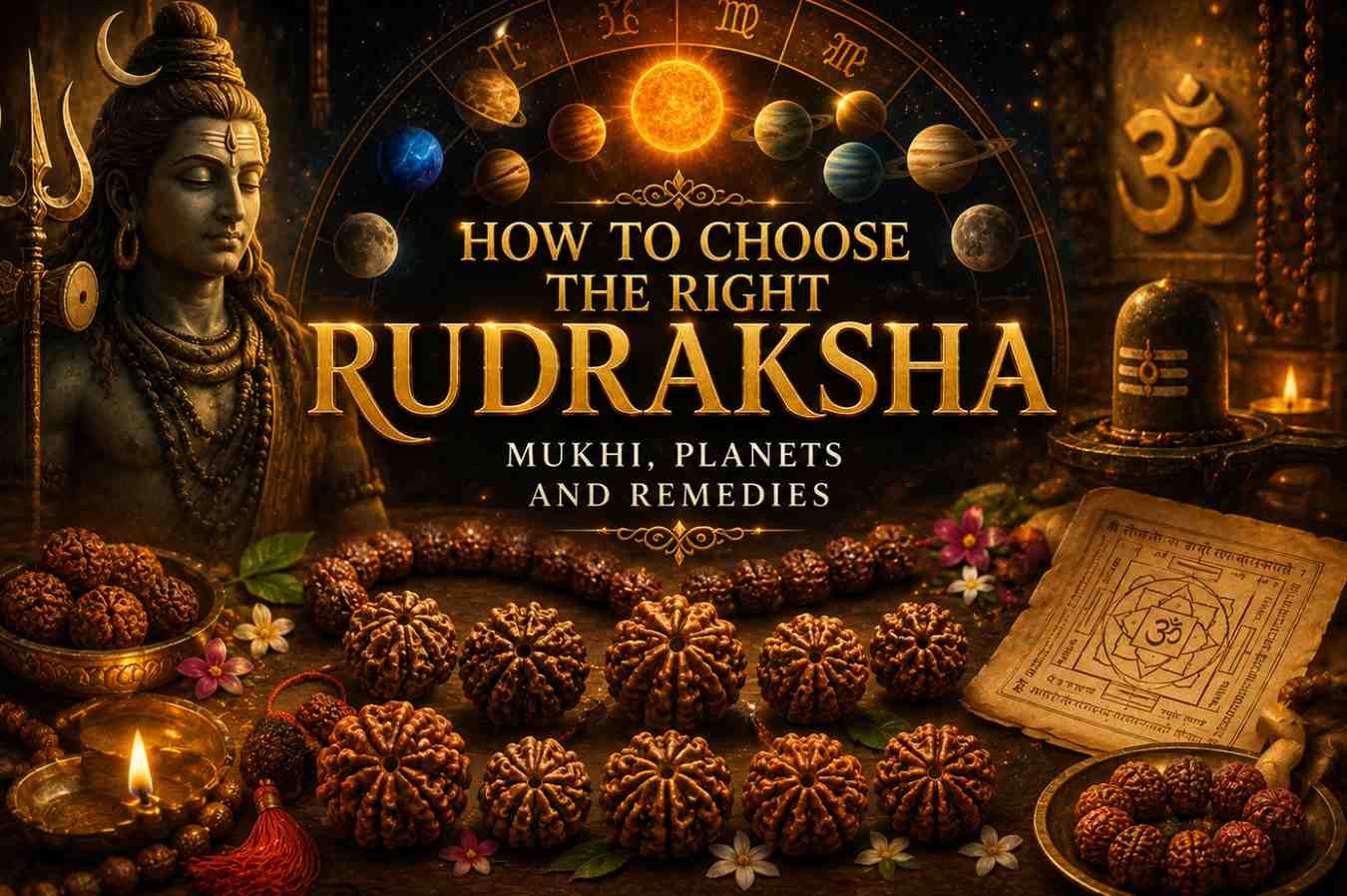
Rudraksha beads are seeds of the Elaeocarpus ganitrus tree, defined by their natural "mukhi" (face) lines. In Vedic astrology, specific mukhi types support specific planets. The 5 mukhi is the most common and universally safe. Unlike gemstones, rudraksha is generally gentle and lower-risk — but authenticity is a serious concern given widespread market fraud.
Walk into any temple shop, any astrology consultation, or browse any spiritual marketplace and you'll find rudraksha beads everywhere. Single-bead pendants, thick malas, bracelets stacked with different mukhis — all promising different benefits, all at wildly different prices.
The problem is that the rudraksha market is also one of the most fraud-prone spaces in the entire spiritual products world. Carved fakes, misrepresented mukhi counts, and inflated claims are everywhere.
So before anything else: knowing what rudraksha actually is, how it works in the classical system, and how to buy authentically is the foundation of any meaningful engagement with these beads.
This guide covers all of that — the complete mukhi reference, the astrological applications, and honest practical guidance on choosing and using rudraksha properly.
Rudraksha: Quick Reference
| Detail | Information |
|---|---|
| Origin | Seeds of Elaeocarpus ganitrus tree — Nepal, Indonesia, India |
| Etymology | Rudra (Lord Shiva) + aksha (eye/teardrop) — "the tears of Shiva" |
| Defining feature | Mukhi — natural vertical lines dividing the bead's surface |
| Mukhi range | 1 mukhi (rarest) to 21 mukhi and beyond; 5 mukhi most common |
| Primary association | Lord Shiva; different mukhis link to different deities and planets |
| Risk level | Generally lower-risk than gemstones — gentle and supportive |
| Primary use | Spiritual practice, meditation, planetary support, general wellbeing |
What Rudraksha Beads Actually Are
Rudraksha beads are the seeds of the Rudraksha tree, grown primarily in the Himalayan regions of Nepal and parts of Indonesia and India. The name itself tells you what the tradition believes about them: Rudra (Lord Shiva) + aksha (eye or teardrop) — classical tradition holds that these beads originated from the tears of Lord Shiva.
The defining feature of any rudraksha is its mukhi — the natural vertical clefts that run from the top to the bottom of the bead, dividing its surface into segments or "faces."
Bead with five clefts is a 5 mukhi, one with six clefts is a 6 mukhi, and so on. The number of mukhis determines everything about the bead's spiritual and astrological associations.
The 5 mukhi rudraksha is by far the most common. It is associated with Lord Shiva himself — considered universally beneficial and safe for anyone to wear. This is why it is the standard bead for malas used in mantra practice. If you're just starting out, the 5 mukhi is where to begin.
The Mukhi Types: Complete Reference
| Mukhi | Associated Deity | Planet | Key Qualities |
|---|---|---|---|
| 1 Mukhi | Lord Shiva | Sun | Spiritual liberation, supreme consciousness — extremely rare |
| 2 Mukhi | Ardhanareshwara (Shiva-Parvati) | Moon | Relationships, harmony, emotional balance |
| 3 Mukhi | Agni (fire) | Mars | Confidence, release of past guilt, energy |
| 4 Mukhi | Brahma | Mercury | Knowledge, communication, intellectual capacity |
| 5 Mukhi | Lord Shiva (Kalagni Rudra) | Jupiter | General wellbeing, peace, spiritual practice — universally safe |
| 6 Mukhi | Kartikeya | Venus | Emotional grounding, relationships, willpower |
| 7 Mukhi | Goddess Lakshmi | Saturn | Prosperity, relief from Saturn-related difficulty |
| 8 Mukhi | Lord Ganesha | Rahu | Removal of obstacles, protection from Rahu effects |
| 9 Mukhi | Goddess Durga | Ketu | Courage, energy, protection from Ketu effects |
| 10 Mukhi | Lord Vishnu | General | Protection from negative energies and planetary afflictions |
| 11 Mukhi | Lord Hanuman | — | Courage, wisdom, protection |
| 12 Mukhi | Surya (Sun) | Sun | Leadership, vitality, radiance |
| 13 Mukhi | Indra | Venus | Charisma, fulfillment of desires |
| 14 Mukhi | Lord Shiva | — | Intuition, protection — highly revered |
| Gauri Shankar | Shiva-Parvati (naturally joined pair) | — | Relationship harmony, union |
Astrological Applications of Rudraksha
In remedy practice, specific mukhi beads are recommended to support specific planets. Here's the classical mapping:
- Sun-related concerns — 1 mukhi or 12 mukhi
- Moon-related concerns — 2 mukhi
- Mars-related concerns (including Manglik Dosha) — 3 mukhi
- Mercury-related concerns — 4 mukhi
- Jupiter-related concerns — 5 mukhi (also the universal bead)
- Venus-related concerns — 6 mukhi or 13 mukhi
- Saturn-related concerns (Sade Sati, Shani Dosha) — 7 mukhi or 14 mukhi
- Rahu-related concerns — 8 mukhi
- Ketu-related concerns — 9 mukhi
- General protection from multiple afflictions — 10 mukhi
- Courage and Hanuman-related support — 11 mukhi
This is worth comparing to how gemstones work. In the Vedic Gemstones Complete guide, gemstones are described as amplifying their planet — which is exactly what makes them powerful and risky at the same time. Rudraksha, by contrast, is considered supportive and balancing rather than amplifying. That's why the risk profile is lower.
Still — for rarer, more specific mukhis being used as targeted planetary remedies, a consultation to confirm the bead is appropriate for your specific chart remains advisable. The 5 mukhi, however, needs no such confirmation. It's genuinely safe for anyone.
To understand which planet your chart actually needs support for, a solid reading of your birth chart is the necessary starting point.
How to Choose an Authentic Rudraksha
This is where most people go wrong — and where it really matters. The rudraksha market has serious fraud: fake beads carved from wood or other seeds, beads with artificially carved mukhi lines, and misrepresented mukhi counts are all common.
Here's how to protect yourself:
- Buy from reputable, established sellers with verifiable sourcing — not roadside vendors or unverified online sellers
- For higher-value rare mukhis, insist on lab certification — X-ray certification can verify the internal seed structure and confirm the mukhi count
- Genuine mukhi lines are natural clefts, not carved grooves — carved lines look too regular and uniform; natural lines have slight irregularity
- A genuine rudraksha has natural surface texture and irregular contours — machine-perfect beads are a red flag
- The traditional water test and copper coin test are folk methods with limited reliability — certification is far more dependable
- Be skeptical of extremely cheap "rare mukhi" beads — genuine 1 mukhi, high-mukhi, and Gauri Shankar beads are genuinely rare and priced accordingly
- Nepali and Indonesian (Java) rudraksha differ in size and appearance — both can be genuine; knowing the difference helps you evaluate what you're buying
How to Wear and Care for Rudraksha
- Rudraksha can be worn as a single bead pendant, a bracelet, or a full mala (typically 108 beads plus a meru/guru bead)
- Traditionally energized before first wearing — through mantra recitation, ideally the Mahamrityunjaya Mantra Guide practice or "Om Namah Shivaya"
- String on silk thread, copper, silver, or gold — iron is avoided in some traditions
- Keep the bead clean; periodically clean with water and re-oil lightly to prevent cracking
- Many traditions recommend removing rudraksha during sleep, though others permit continuous wearing
- Maintain respect for the bead as a sacred object — general cleanliness and mindful handling
- A rudraksha mala used for japa (mantra repetition) is the most traditional and genuinely beneficial use — pairing it with the Navagraha Mantras Guide practice is a natural combination
Honest Guidance on Rudraksha
A few things worth being direct about:
- Rudraksha is generally lower-risk than gemstones — the 5 mukhi especially is considered safe for anyone, no chart analysis required
- For rare and specific mukhis used as targeted planetary remedies, confirm appropriateness with a knowledgeable astrologer
- Authenticity is the biggest practical challenge — buy from reputable sources and insist on certification for higher-value beads
- Rudraksha works best as part of genuine spiritual practice — especially japa and mantra repetition — not merely as a worn object
- Be skeptical of extreme claims from unverified sellers; rudraksha is supportive, not magical
- The most accessible and traditional use — a 5 mukhi mala for daily mantra practice — is also one of the most genuinely beneficial
If you're building a complete remedy practice and want to understand how rudraksha fits alongside mantra work, you can speak with Apala, Vedaz's AI astrologer specializing in mantra and meditation — who can help you identify which mukhi and which mantra combination suits your chart.
A Final Word
Rudraksha beads occupy a gentler place in the remedy tradition than gemstones — supportive rather than amplifying, and in the case of the 5 mukhi, genuinely safe for anyone to use.
The practical reality is straightforward: a 5 mukhi rudraksha mala used for daily mantra practice is among the most accessible and genuinely beneficial spiritual tools in the entire system. It asks nothing more than consistent, sincere use.
If you pursue rudraksha as a remedy, two things matter above everything else. Authenticity — the market has real fraud, so buy from reputable sources and certify rare beads. And genuine practice — a rudraksha is not a magical object that transforms your life by sitting on your wrist.
It is a support for spiritual practice, most powerful when it is actually used: as a mala for japa, as a focus for devotion, as a tangible connection to the practice it serves.
For those working through the Hanuman Chalisa Benefits Guide alongside rudraksha practice, the 11 mukhi — associated with Lord Hanuman — is a natural pairing worth exploring. And if you want a personalized remedy plan that brings mantras, rudraksha, and chart analysis together, Atri, Vedaz's AI astrologer specializing in astrological remedies can map out exactly what your chart needs.
Harinarayan Deshpande
Sacred Beads, Shaiva Traditions & Spiritual Accessories | 13+ Years
Harinarayan Deshpande is a researcher of Shaiva traditions, Rudraksha practices, and sacred symbols used in Hindu spirituality. His work combines scriptural references with practical guidance for spiritual seekers.
Frequently Asked Questions
1. What is a rudraksha?
A rudraksha is the seed of the Rudraksha tree (Elaeocarpus ganitrus), grown mainly in Nepal, Indonesia, and India. The name combines "Rudra" (Lord Shiva) and "aksha" (eye/teardrop) — classical tradition holds the beads originated from Shiva's tears. The defining feature is the mukhi — natural vertical clefts dividing the bead's surface into faces. The mukhi count determines the bead's spiritual and astrological associations.
2. What is the most common rudraksha?
The 5 mukhi rudraksha is by far the most common. Associated with Lord Shiva (Kalagni Rudra) and Jupiter, it is considered universally beneficial and safe for anyone to wear — no chart analysis needed. This is why 5 mukhi beads are the standard for malas used in mantra practice. For general wellbeing, peace, and spiritual practice, it is the accessible and recommended starting point.
3. Which rudraksha is good for Saturn problems?
The 7 mukhi (associated with Goddess Lakshmi and Saturn) and the 14 mukhi (highly revered, associated with Shiva and intuition) are classically recommended for Saturn-related concerns including Sade Sati and Shani Dosha. For these more specific mukhis used as targeted planetary remedies, consultation with a knowledgeable astrologer is recommended to confirm appropriateness for your chart.
4. Are rudraksha beads safer than gemstones?
Generally yes. Unlike gemstones, which amplify a single planet and can cause harm if the wrong planet is amplified, rudraksha beads are considered gentle and supportive rather than amplifying. The 5 mukhi in particular is considered safe for anyone. This lower risk profile is one reason rudraksha is often recommended as a more accessible remedy — though for rare specific mukhis, chart consultation is still advisable.
5. How do I know if a rudraksha is authentic?
The market has significant fraud. Buy from reputable, established sellers with verifiable sourcing. For higher-value rare mukhis, insist on lab certification — X-ray certification verifies internal seed structure and mukhi count. Genuine mukhi lines are natural clefts, not carved grooves. Be skeptical of extremely cheap "rare mukhi" beads. Traditional water and copper tests have limited reliability; certification is more dependable.
6. How should I wear and care for a rudraksha?
Rudraksha can be worn as a pendant, bracelet, or full 108-bead mala. Energize it before first use through mantra recitation (Mahamrityunjaya Mantra or "Om Namah Shivaya"). String on silk, copper, silver, or gold. Keep it clean and periodically re-oil to prevent cracking. Some traditions recommend removing it during sleep. Using a 5 mukhi mala for daily japa is among the most traditional and beneficial applications.
Related Blogs

Boost Your Health with Astrology
Boost your health with astrology using zodiac-based habits, wellness tips, and simple routines for better physical and mental balance.
The Socking Truth Behind Wearing A Black Thread
Uncover the mystery behind the black thread. From protection to spiritual energy—here’s why everyone’s suddenly wearing one.
Hidden Messages In Your Moles
What if that little mole on your cheek is more than just a mark? Explore the fascinating meanings behind mole placements and what they reveal about your future.
Who Is Your Ishta Devata?
Explore the concept of your personal God in Hinduism. Learn how to discover, connect with, and build a relationship with your Ishta Devata for inner peace and spiritual growth.