Hanuman Chalisa Explained: Meaning, Benefits, and Daily Practice Guide
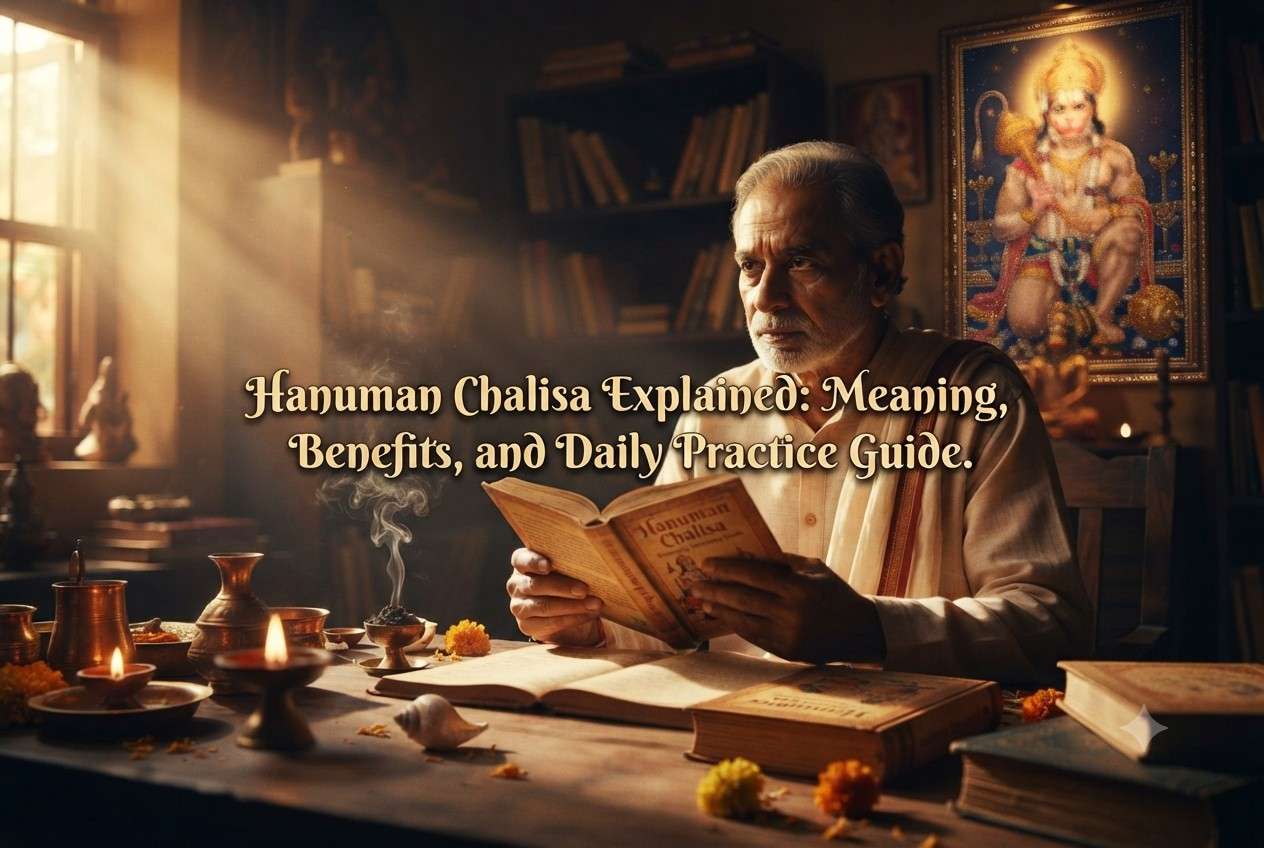
The Hanuman Chalisa, a 40-verse hymn by Tulsidas, is Vedic astrology's most universal remedy due to Hanuman's protective bond with Saturn, ideal channeling of Mars energy, and shield against Rahu-Ketu afflictions. Reciting daily, especially Tuesdays and Saturdays at dawn, helps with Sade Sati, Manglik Dosha, and general anxiety through sustained devotion.
If there's one remedy that comes up again and again in Vedic astrology — across different astrologers, different traditions, different chart problems — it's the Hanuman Chalisa. Saturn giving you trouble? Recite the Chalisa. Mars affliction? Chalisa. Kaal Sarp Dosha, Sade Sati, difficult Mahadasha? Chalisa, Chalisa, Chalisa.
That kind of universal recommendation can start to sound like a catch-all non-answer. But there are actually very specific, classical reasons why this one practice covers so much ground — and understanding those reasons makes the practice itself more meaningful.
This guide covers what the Hanuman Chalisa is, why it works across so many chart configurations, what the tradition says about its benefits, and how to actually practice it properly.
Hanuman Chalisa: Quick Reference
| Detail | Information |
|---|---|
| Composition | 40 verses (chaupais) plus opening and closing dohas |
| Author | Tulsidas (16th century), composed in Awadhi language |
| Primary deity | Lord Hanuman — devoted servant of Lord Rama |
| Astrological role | Universal remedy across nearly all difficult planetary configurations |
| Best days | Tuesday and Saturday |
| Best times | Dawn (Brahma Muhurta) and dusk |
| Recitation duration | Approximately 8–12 minutes per full recitation |
| Traditional counts | 1, 7, 11, 21, or 108 times depending on intensity of practice |
Why the Hanuman Chalisa Is Vedic Astrology's Most Universal Remedy
The Hanuman Chalisa appears as a recommended remedy more frequently than any other single practice in Vedic astrology. That's not an accident — it comes from three very specific classical relationships.
Hanuman and Saturn (Shani): The Core Protective Relationship
This is the most important astrological reason. Classical tradition holds that Lord Hanuman has a special protective bond with Shani (Saturn). In a well-known legend, Hanuman rescued Shani from captivity under Ravana — and in gratitude, Shani promised that devoted worshippers of Hanuman would be protected from his harsher effects.
Why does this matter so much? Because Saturn is behind an enormous proportion of difficult chart configurations — Sade Sati, Shani Dosha, Kantaka Shani, Ashtama Shani, Saturn Mahadasha. When one planet accounts for this many challenging periods, the remedy associated with its "protector" becomes relevant to most people at some point in their lives.
Hanuman and Mars (Mangal): Ideal Energy, Rightly Channeled
Hanuman is considered the embodiment of ideal Mars energy — courage, strength, and decisive action expressed through perfect devotion and discipline rather than ego or aggression.
This makes Hanuman worship the primary remedy for Mars-related afflictions: Manglik Dosha, Mars debilitation, Mars in difficult houses, and Mars Mahadasha challenges. The Chalisa doesn't suppress Mars energy — it channels it constructively.
Hanuman and the Nodes (Rahu-Ketu): Protection from Shadow Energy
Classical tradition also positions Hanuman as a protector against the shadowy, boundary-crossing energy of Rahu and Ketu. This makes the Chalisa relevant for Kaal Sarp Dosha, Shani Shrapit Dosha, Grahan Dosha, and other nodal configurations that tend to create confusion, fear, and instability.
Because Saturn, Mars, and the nodes together account for such a large proportion of difficult chart configurations, the Hanuman Chalisa ends up being genuinely relevant to most people seeking astrological remedy. That's why it's near-universally recommended — and it's a classical position, not a lazy catch-all.
Benefits Classical Tradition Associates with Regular Recitation
Astrological and Protective Benefits
- Protection from Saturn's harsher effects during Sade Sati and Saturn-related periods
- Constructive channeling of Mars energy for Manglik and Mars-affliction natives
- Protection against nodal afflictions — Rahu-Ketu configurations, Kaal Sarp Dosha
- General protection from negative influences, fears, and obstacles
- Support during difficult Mahadasha and Antardasha periods
Psychological and Practical Benefits
- Reduction of anxiety and fear — Hanuman is specifically the deity of courage
- Increased mental discipline and focus through the structure of regular practice
- A grounding daily ritual that provides stability during turbulent periods
- Cultivation of Hanuman's qualities — devotion, strength, humility, service
- A steady sense of inner support during uncertainty and difficulty
One honest note worth keeping in mind: the Hanuman Chalisa is a devotional and spiritual practice, not a transactional spell. Its benefits come through the sustained cultivation of inner qualities — courage, discipline, equanimity — and through the grounding structure that consistent practice builds over time. It is most effective as one element of a conscious life, not as a quick fix.
How to Recite the Hanuman Chalisa
Preparation
- Bathe and wear clean clothes before recitation when possible
- Face east or northeast during recitation
- Sit before an image or idol of Lord Hanuman if available
- Light a lamp (preferably sesame oil) and incense
- Offer red flowers, sindoor (vermilion), or a small offering if you wish
The Recitation
- Begin with the opening dohas (couplets) that invoke the guru and Hanuman
- Recite the 40 chaupais (verses) with attention to meaning, not just speed
- Conclude with the closing doha
- For deeper practice, recite 7, 11, or 21 times in one sitting
- Maintain steady rhythm — the Chalisa has a natural meter that supports concentration
Timing and Frequency
- Daily recitation (even once) is the foundational practice
- Tuesday and Saturday recitation is particularly powerful
- Dawn (Brahma Muhurta, roughly 4–6 AM) is the most auspicious time; dusk also works well
- During Sade Sati or difficult periods, increase to 7 or 11 times daily
- Consistency matters more than intensity — daily single recitation beats occasional long sessions
Specific Astrological Applications
| Configuration | Recommended Practice |
|---|---|
| Sade Sati | Daily recitation; increase to 7–11 times during Peak phase (Phase 2) |
| Manglik Dosha | Daily recitation with Tuesday emphasis |
| Shani Dosha / Saturn Mahadasha | Daily recitation with Saturday emphasis |
| Kaal Sarp Dosha | Daily recitation combined with Lord Shiva worship |
| Ashtama Shani | Daily recitation combined with Mahamrityunjaya Mantra Guide practice |
| Rahu-Ketu afflictions | Daily recitation; pair with Navagraha Mantras Guide for fuller practice |
| General anxiety, fear, obstacles | Daily recitation as grounding practice |
| Eclipse periods | Recitation as protective practice |
Honest Guidance on the Practice
A few things worth saying plainly:
- This is a genuine spiritual practice, not a transactional spell. Its benefits come through sustained devotion and the cultivation of inner qualities — not through mechanical repetition alone.
- Consistency matters more than intensity. Daily single recitation over years produces far more than occasional marathon sessions.
- Understanding the meaning deepens everything. Reciting with comprehension is more powerful than rote repetition. Many editions include translations — learning the meaning of the verses over time is strongly recommended.
- The Chalisa supports but does not replace practical action. If your difficulty has a practical solution, pursue it alongside the practice.
- For mental health concerns, the Chalisa can be a supportive grounding practice — but it does not replace professional mental health care.
- No reputable tradition charges large fees for "teaching" the Hanuman Chalisa. It is freely available and freely practiced.
If you're working through a difficult planetary period and want to understand which specific remedies your chart actually calls for, you can speak with Atri, Vedaz's AI astrologer specializing in astrological remedies — who can map your chart's needs and suggest a personalized practice.
For those exploring gemstone-based remedies alongside mantra practice, the Vedic Gemstones Complete guide explains how the two remedy systems interact.
To understand which planetary configurations in your chart need attention in the first place, start with your birth chart — the foundation of any remedy decision.
For Rudraksha-based remedy practice as a complement to mantra recitation, the Rudraksha Complete Guide covers the classical system in full.
A Final Word
The Hanuman Chalisa is the most universally recommended remedy in Vedic astrology — not because it's a catch-all, but because Hanuman's protective relationships with Saturn, Mars, and the nodes make it genuinely relevant to the configurations most people struggle with at some point in their lives.
The honest understanding is this: its benefits come through devotion and the sustained cultivation of what Hanuman embodies — courage in the face of fear, strength channeled through humility, discipline grounded in service. If you take up this practice, take it up genuinely. Daily. With attention to meaning. Sustained over years.
The Chalisa rewards consistency and sincerity. It is not a transaction — it is a relationship built over time. And the protection it offers is, in large part, the inner steadiness that the practice itself builds.
Dr. Charudatta Joshi
Devotional Literature, Hindu Scriptures & Bhakti Traditions | 15+ Years
Dr. Charudatta Joshi is a scholar of Hindu devotional literature and Bhakti traditions. His work explores the spiritual significance, historical context, and contemporary relevance of sacred hymns, prayers, and devotional practices.
Frequently Asked Questions
1. What is the Hanuman Chalisa?
The Hanuman Chalisa is a 40-verse devotional hymn in praise of Lord Hanuman, composed by the 16th-century poet-saint Tulsidas in the Awadhi language. "Chalisa" means "forty." Beyond its devotional significance, it holds a central place in Vedic astrological remedy practice as the single most frequently recommended remedy across difficult planetary configurations.
2. Why is the Hanuman Chalisa recommended for so many astrological problems?
Three specific reasons: Hanuman has a classical protective relationship with Saturn — whose harsher effects he promised to shield his devotees from — and Saturn is involved in many difficult configurations. Hanuman also embodies ideal Mars energy, making the Chalisa the primary remedy for Mars-related doshas. Finally, Hanuman is a protector against Rahu-Ketu nodal afflictions. Since Saturn, Mars, and the nodes account for most difficult chart configurations, the Chalisa becomes near-universally relevant.
3. When should I recite the Hanuman Chalisa?
Daily recitation is the foundational practice — even once daily is meaningful. Tuesday and Saturday are particularly powerful days. Dawn (Brahma Muhurta, roughly 4–6 AM) is the most auspicious time, though dusk also works well. During Sade Sati or intense planetary periods, increase to 7 or 11 times daily. Consistency matters more than intensity.
4. How many times should I recite the Hanuman Chalisa?
Once daily for foundational practice. Traditional intensified counts are 7, 11, 21, or 108 times in one sitting. During Sade Sati Peak phase, Ashtama Shani, or other intense periods, 7–11 times daily is commonly recommended. The key principle: daily single recitation sustained over years produces more benefit than occasional marathon sessions.
5. Do I need to understand the meaning to benefit from the Hanuman Chalisa?
Reciting with comprehension deepens the practice significantly. While the tradition holds that even mechanical recitation carries benefit through sound and devotion, understanding the meaning transforms the practice from rote repetition into genuine contemplation. Learning the meaning of the verses over time is strongly recommended.
6. Can the Hanuman Chalisa replace medical or practical solutions?
No. Its benefits come through cultivating inner qualities — courage, discipline, equanimity — and through the grounding of consistent practice. It supports but does not replace practical action or professional care. For mental health concerns, the Chalisa can be supportive but does not replace professional mental health care.
Related Blogs

Boost Your Health with Astrology
Boost your health with astrology using zodiac-based habits, wellness tips, and simple routines for better physical and mental balance.

The Socking Truth Behind Wearing A Black Thread
Uncover the mystery behind the black thread. From protection to spiritual energy—here’s why everyone’s suddenly wearing one.

Hidden Messages In Your Moles
What if that little mole on your cheek is more than just a mark? Explore the fascinating meanings behind mole placements and what they reveal about your future.
Who Is Your Ishta Devata?
Explore the concept of your personal God in Hinduism. Learn how to discover, connect with, and build a relationship with your Ishta Devata for inner peace and spiritual growth.