The Mahamrityunjaya Mantra Explained: Protection, Healing, and Spiritual Power
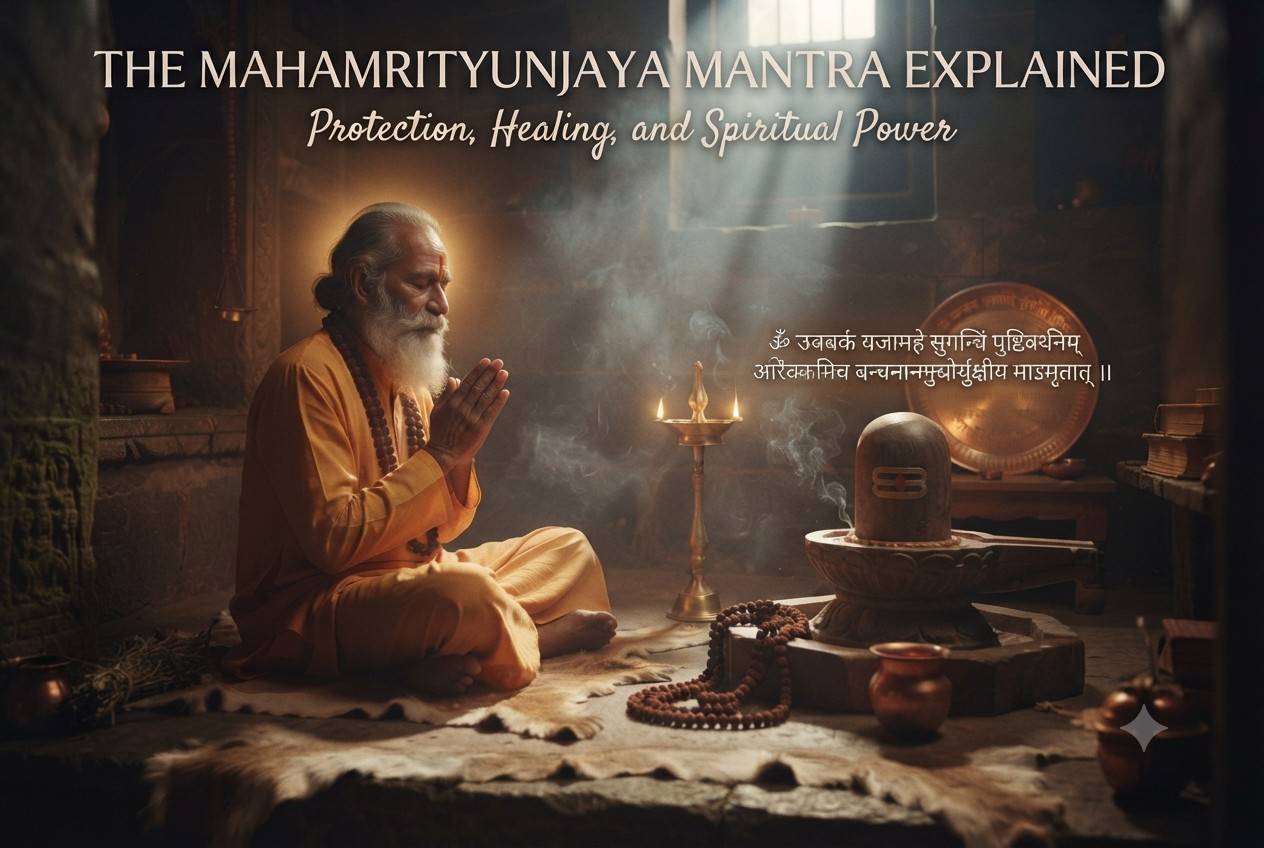
The Mahamrityunjaya Mantra is a Rigvedic mantra dedicated to Lord Shiva, known as the Great Death-Conquering Mantra. In Vedic astrology, it is the primary remedy for health, longevity, and accident protection — especially during Ashtama Shani, Sade Sati Peak, and difficult 8th-house periods. Daily recitation of 11–108 repetitions is the standard practice.
- ◦Mahamrityunjaya Mantra: Quick Reference
- ◦The Mantra and Its Meaning
- ◦Why the Mahamrityunjaya Mantra Is Vedic Astrology's Primary Health Remedy
- ◦Benefits Classical Tradition Associates with the Mantra
- ◦How to Practice the Mahamrityunjaya Mantra
- ◦Specific Astrological Applications
- ◦Important Cautions
- ◦A Final Word
Some mantras are recited for prosperity. Some for relationships. Some for focus or clarity. The Mahamrityunjaya Mantra stands apart — it is the mantra you turn to when life itself feels fragile. When health is threatened, when a loved one is seriously ill, when an astrological period feels genuinely dangerous. It is the Vedic tradition's great prayer of protection.
And yet it's also widely misunderstood — treated as a magical shield against death, or reduced to a remedy to recite mechanically during difficult transits. The actual depth of this mantra is much greater than either of those framings.
This guide covers what the mantra actually means, why classical Vedic astrology recommends it so consistently for health and protection, which specific configurations call for it, and how to practice it properly.
Mahamrityunjaya Mantra: Quick Reference
| Detail | Information |
|---|---|
| Source | Rigveda (Mandala 7, Hymn 59, Verse 12) — also in Yajurveda |
| Also called | Tryambakam Mantra, Rudra Mantra, Death-Conquering Mantra |
| Primary deity | Lord Shiva (as Tryambaka, the three-eyed one) |
| Astrological role | Health, longevity, accident protection, recovery from serious difficulty |
| Best day | Monday |
| Best times | Dawn (Brahma Muhurta) and Pradosh Kaal (dusk) |
| Traditional counts | 11, 21, 108, or 1,008 times; intensive practice uses 125,000 over a period |
| Key applications | Ashtama Shani, Sade Sati Peak, Nadi Dosha, health-affliction transits |
The Mantra and Its Meaning
The Mahamrityunjaya Mantra invokes Lord Shiva as Tryambaka — the three-eyed one — and asks for healing, liberation, and freedom from the bondage of death and suffering.
In essence, the prayer says: "We worship the three-eyed one, who is fragrant and who nourishes all beings. May he liberate us from the bondage of death — like a ripe cucumber is effortlessly separated from its vine — freeing us toward liberation, not away from immortality."
The central image here is worth pausing on. The mantra doesn't ask to avoid death through force or struggle. It asks to be released from the bondage of mortality like a ripe fruit naturally separating from the vine — gently, at the right time, in the right way. That's a very different kind of prayer.
At its deepest level, the Mahamrityunjaya Mantra is a prayer for moksha — liberation from the cycle of suffering itself. Health and longevity are what we often seek from it. But the tradition understands what it actually offers as something greater: freedom from fear itself.
Why the Mahamrityunjaya Mantra Is Vedic Astrology's Primary Health Remedy
In Vedic astrology, several configurations relate specifically to health, longevity, and vulnerability to accidents or serious difficulty:
- The 8th house and its lord — governing longevity and sudden, transformative events
- Ashtama Shani — Saturn's transit through the 8th from the Moon, emphasizing health and transformation
- Affliction to the Lagna or Lagna lord — directly affecting vitality and the physical body
- Nadi Dosha — the marriage compatibility factor with classical health-related concerns
- Difficult Mars or Saturn placements affecting health houses
- Mahadasha periods of malefics aspecting health-related houses
Classical tradition recommends the Mahamrityunjaya Mantra as the primary remedy for all of these.
The reasoning is direct: Lord Shiva is the deity of dissolution and regeneration — the master of the cycle of death and rebirth. Invoking Shiva through this specific mantra is considered the most powerful protective practice available for matters of health, longevity, and recovery from serious difficulty.
Benefits Classical Tradition Associates with the Mantra
Astrological and Protective Benefits
- Protection during health-vulnerable transit periods — Ashtama Shani, difficult 8th-house activations
- Support for recovery from illness or serious difficulty
- Accident protection during high-risk dasha or transit periods
- Strengthening of vitality when the Lagna or Lagna lord is afflicted
- Primary remedy for Nadi Dosha in marriage compatibility
- Support during Sade Sati Peak phase and other intense Saturn periods
Psychological and Spiritual Benefits
- Reduction of fear — particularly fear of death, illness, or loss
- A grounding practice during genuine crisis — when everything else feels uncertain
- Cultivation of equanimity in the face of mortality
- Deepening of spiritual orientation and connection to the liberation the mantra invokes
- Mental steadiness during health challenges affecting yourself or loved ones
One honest note: the Mahamrityunjaya Mantra is a profound spiritual practice, not a medical substitute. The classical tradition itself is clear on this — it positions the mantra as spiritual support that strengthens the inner ground from which both healing and acceptance become possible. It works alongside appropriate medical care, never instead of it.
How to Practice the Mahamrityunjaya Mantra
Preparation
- Bathe and wear clean clothes before practice
- Face east or north during recitation
- Sit before an image of Lord Shiva or a Shiva Lingam if available
- Light a lamp and incense; offer water, bilva (bel) leaves, or white flowers
- Use a rudraksha mala for counting repetitions
The Practice
- Begin with a moment of stillness and intention-setting
- Recite the mantra with steady rhythm and attention to its sound
- For daily practice, 11 or 21 repetitions is a meaningful and sustainable foundation
- For intensive practice, 108 repetitions — one full mala round
- For serious health concerns, classical tradition recommends extended practice — sometimes 1,008 daily, or 125,000 total over a sustained period, traditionally done under qualified guidance
- Conclude with a moment of stillness and gratitude
Timing and Frequency
- Daily practice is the foundation — 11–21 repetitions is sustainable for most
- Monday is the most powerful day (Shiva's day)
- Dawn (Brahma Muhurta) and Pradosh Kaal (the period around dusk) are most auspicious
- During Ashtama Shani or health-vulnerable periods, increase repetitions and maintain daily discipline
- For specific health concerns, some traditions recommend a structured anushthana (committed practice over a fixed period) under qualified guidance
Specific Astrological Applications
| Configuration | Recommended Practice |
|---|---|
| Ashtama Shani | Daily Mahamrityunjaya practice — one of the primary classical remedies |
| Sade Sati Peak (Phase 2) | Combined with Hanuman Chalisa Benefits Guide practice |
| Nadi Dosha in marriage | Recited by both partners before and around marriage |
| Afflicted Lagna or Lagna lord | For strengthening vitality and physical resilience |
| Difficult 8th house activations | Protection during longevity-themed periods |
| Serious illness (self or loved ones) | Supportive spiritual practice alongside medical care |
| High-risk dasha periods | For accident protection — increase daily count |
For understanding how mantra remedies compare to gemstone remedies for Saturn and health configurations, the Vedic Gemstones Complete guide covers the classical distinctions in detail.
Important Cautions
- This mantra is spiritual support, not medical treatment. For any health concern, appropriate medical care is essential — the mantra works alongside it, never instead of it.
- The classical tradition itself does not position the mantra as a replacement for treatment.
- Be skeptical of anyone charging large fees to "perform" the Mahamrityunjaya Mantra on your behalf — sincere personal practice carries the genuine benefit.
- For intensive structured practice (large repetition counts over fixed periods), guidance from a qualified teacher is traditionally recommended.
- The mantra's deepest purpose is spiritual liberation, not merely physical life-extension — understanding this deepens the practice considerably.
- Pronunciation matters in mantra practice. Learning correct pronunciation from a reliable source before beginning is well worth the effort.
To understand which specific planetary configurations in your chart make this mantra relevant for you, start with your birth chart — where health indicators, the 8th house, and longevity factors are all clearly mapped.
For those also exploring the Navagraha Mantras Guide and Rudraksha Complete Guide as part of a broader remedy practice, the Mahamrityunjaya Mantra pairs naturally with both — particularly with Rudraksha beads, which the tradition specifically associates with Lord Shiva.
If you want personalized guidance on whether this mantra is the right remedy for your current planetary period, you can speak with Apala, Vedaz's AI astrologer specializing in mantra and meditation — or with Ayush, Vedaz's AI astrologer focused on health astrology — both of whom can assess your chart's specific health and remedy indicators.
A Final Word
The Mahamrityunjaya Mantra is the great prayer of the Vedic tradition for health, protection, and ultimately liberation. Its power doesn't lie in magically extending life — it lies in the equanimity it cultivates. The capacity to face mortality, illness, and loss from a place of spiritual steadiness rather than fear.
If you take up this practice during a difficult health period or a vulnerable astrological transit, take it up as genuine spiritual practice alongside appropriate medical care — not instead of it.
The mantra's deepest gift is the inner ground it builds: the steadiness from which healing becomes possible when healing is possible, and acceptance becomes possible when acceptance is what is needed.
That is what "conquering death" actually means in this tradition. Not escaping mortality — but being freed from its bondage of fear.
Dr. Charudatta Joshi
Vedic Mantras, Sanskrit Texts & Spiritual Practices | 15+ Years
Dr. Charudatta Joshi specializes in Vedic mantras, Sanskrit scriptures, and meditative traditions. He is passionate about making ancient spiritual teachings accessible to modern readers while preserving their traditional essence.
Frequently Asked Questions
1. What is the Mahamrityunjaya Mantra?
The Mahamrityunjaya Mantra is a revered Vedic mantra dedicated to Lord Shiva, drawn from the Rigveda. Called the Great Death-Conquering Mantra, it invokes Shiva as Tryambaka (the three-eyed one) and prays for healing, protection, longevity, and ultimately liberation from the bondage of suffering. It holds a central place in Vedic astrological remedy practice for matters of health and protection.
2. What does the Mahamrityunjaya Mantra mean?
The mantra worships Lord Shiva — the three-eyed one who is fragrant and nourishes all beings — and asks him to liberate us from the bondage of death, like a ripe cucumber effortlessly separating from its vine. The central image is one of natural, gentle liberation rather than violent struggle against mortality. At its deepest level, the mantra is a prayer for moksha (spiritual liberation), not merely physical life-extension.
3. When should I recite the Mahamrityunjaya Mantra?
Daily practice is the foundation — 11 or 21 repetitions is a sustainable starting point. Monday (Shiva's day) is the most powerful day. Dawn (Brahma Muhurta) and Pradosh Kaal (the period around dusk) are the most auspicious times. During Ashtama Shani, Sade Sati Peak, or health-vulnerable periods, increase repetitions and maintain daily discipline.
4. What astrological problems does the Mahamrityunjaya Mantra address?
Classical tradition recommends it for Ashtama Shani, Sade Sati Peak phase, Nadi Dosha in marriage compatibility, afflicted Lagna or Lagna lord, difficult 8th-house activations, high-risk dasha periods for accident protection, and during serious illness as supportive spiritual practice alongside medical care.
5. Can the Mahamrityunjaya Mantra cure illness?
The mantra is spiritual support, not medical treatment. For any health concern, appropriate medical care is essential — the mantra works alongside it, never instead of it. The classical tradition itself does not position it as a replacement for treatment. Its benefits come through cultivating equanimity, reducing fear, and strengthening the inner ground from which both healing and acceptance become possible.
6. How many times should I recite the Mahamrityunjaya Mantra?
For daily practice, 11 or 21 repetitions is a meaningful foundation. For intensive practice, 108 repetitions — one full mala round. For serious concerns, classical tradition recommends extended structured practice: sometimes 1,008 daily, or a committed anushthana of 125,000 total repetitions over a sustained period, ideally under qualified guidance. Consistency matters more than count.
Related Blogs
Boost Your Health with Astrology
Boost your health with astrology using zodiac-based habits, wellness tips, and simple routines for better physical and mental balance.

The Socking Truth Behind Wearing A Black Thread
Uncover the mystery behind the black thread. From protection to spiritual energy—here’s why everyone’s suddenly wearing one.

Hidden Messages In Your Moles
What if that little mole on your cheek is more than just a mark? Explore the fascinating meanings behind mole placements and what they reveal about your future.
Who Is Your Ishta Devata?
Explore the concept of your personal God in Hinduism. Learn how to discover, connect with, and build a relationship with your Ishta Devata for inner peace and spiritual growth.