Navaratna Guide: Meaning, Planetary Connections, and Wearing Rules
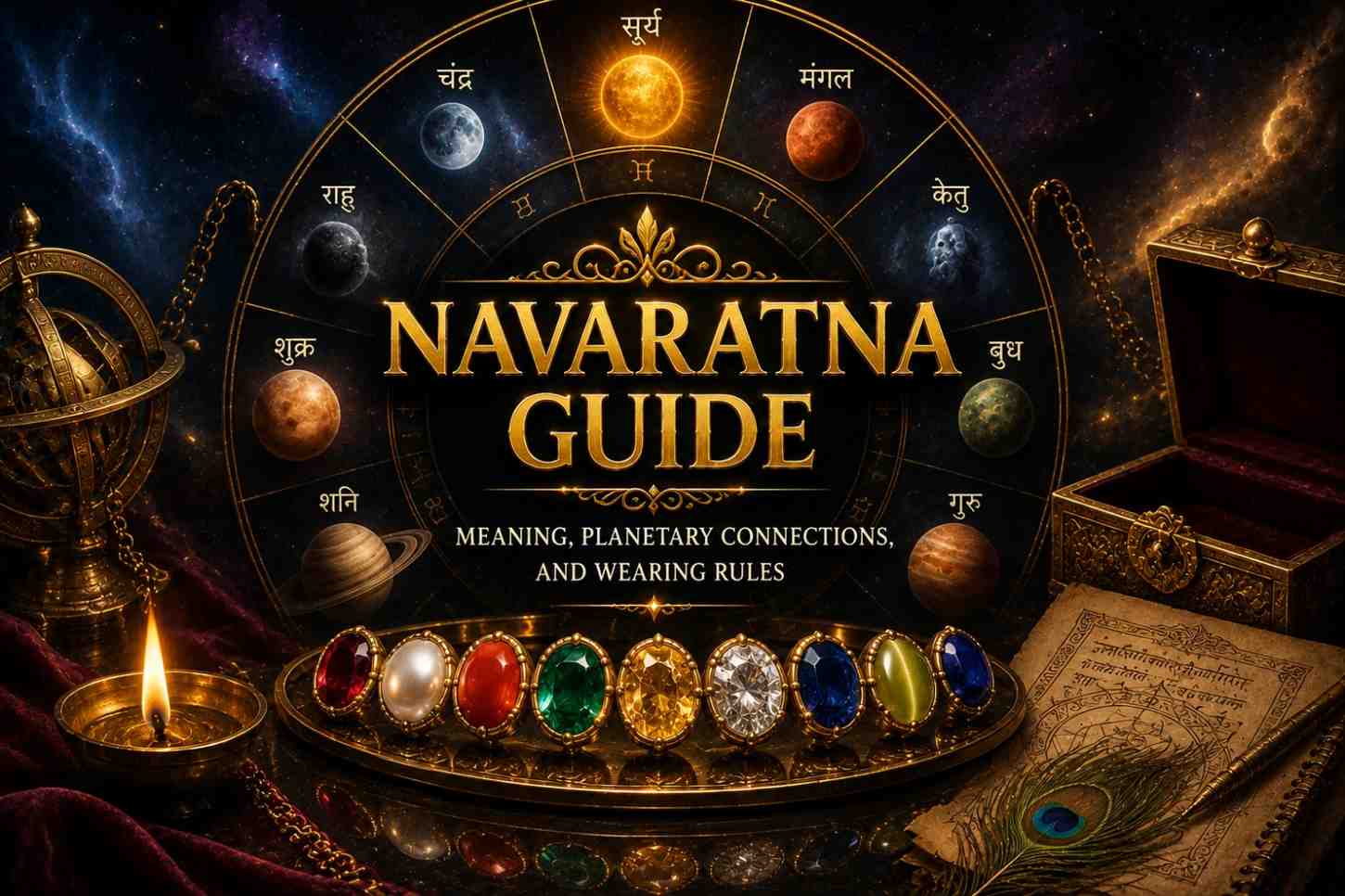
The nine Vedic gemstones (Navaratna) are Ruby, Pearl, Red Coral, Emerald, Yellow Sapphire, Diamond, Blue Sapphire, Hessonite Garnet, and Cat's Eye — each linked to one of the nine planets. They work by strengthening their planet, not neutralizing it. Wearing the wrong one can cause real harm.
Gemstones are everywhere in the world of Vedic astrology. Walk into any astrology consultation, scroll through any astrology page online, and you'll almost certainly come across a gemstone recommendation within minutes. Wear a yellow sapphire for luck. Wear a blue sapphire for career. Wear a ruby for confidence.
But here's what most people aren't told: gemstones are the most powerful and most misused remedy in the entire Vedic system. When used correctly — after proper chart analysis — they can genuinely support a person. When used incorrectly, they can amplify exactly the wrong energy in a person's life.
This guide is about getting it right. We'll walk through the nine planetary gemstones, how the classical system actually works, and why you should think carefully — very carefully — before wearing any stone.
Quick Answers
- What are the nine stones? Ruby, Pearl, Red Coral, Emerald, Yellow Sapphire, Diamond, Blue Sapphire, Hessonite Garnet, Cat's Eye — one for each graha
- How do they work? They strengthen their planet — amplifying both its good and difficult effects
- Who should wear them? Only someone whose chart confirms the planet is benefic AND weak
- Most dangerous stone? Blue Sapphire (Neelam) — powerful, fast-acting, contraindicated for many charts
- Is there a universally lucky gemstone? No — this is the biggest misconception in popular gemstone practice
- What's safer? Devotional remedies (mantras, worship, charity) — lower risk, often equally effective
The Nine Planetary Gemstones (Navaratna) in Vedic Astrology
The classical Vedic system assigns one primary gemstone to each of the nine grahas (planets). Together, these nine are called the Navaratna — literally, the nine jewels.
| Planet | Gemstone | Colour |
|---|---|---|
| Sun (Surya) | Ruby (Manik) | Red |
| Moon (Chandra) | Pearl (Moti) | White |
| Mars (Mangal) | Red Coral (Moonga) | Red |
| Mercury (Budha) | Emerald (Panna) | Green |
| Jupiter (Brihaspati) | Yellow Sapphire (Pukhraj) | Yellow |
| Venus (Shukra) | Diamond (Heera) | Clear/White |
| Saturn (Shani) | Blue Sapphire (Neelam) | Blue |
| Rahu | Hessonite Garnet (Gomed) | Honey-Brown |
| Ketu | Cat's Eye (Lehsunia) | Chatoyant Grey-Green |
How the Vedic Gemstone System Actually Works
This is the part most people skip — and it's the most important part.
The classical theory is straightforward: each gemstone resonates with the energy of its associated planet. Wearing the stone strengthens that planet's influence in your life. Simple enough. But the implications are everything.
- Gemstones strengthen a planet — they amplify its effects, both the positive and the difficult
- You only wear a gemstone for a planet that is (a) benefic for your specific chart and (b) weak or in need of support
- You should never wear the gemstone of a planet that is malefic for your chart — it will amplify difficulty, not reduce it
- Whether a planet is benefic or malefic depends entirely on your Lagna (ascendant) and the planet's placement in your specific chart
- The same planet can be benefic for one Lagna and malefic for another — there is no universal good or bad gemstone
That last point is worth sitting with. A blue sapphire that transforms someone's career can genuinely damage another person's life. Not because the stone is cursed — but because Saturn, which it strengthens, plays a completely different role in different charts.
The entire "lucky stone by zodiac sign" industry ignores this. And that's where the harm comes from.
If you're unsure what role each planet plays in your chart, a good starting point is understanding your birth chart — the foundation of any gemstone decision.
The Nine Vedic Gemstones Explained
Ruby (Manik) — Gemstone of the Sun
Ruby strengthens the Sun: authority, vitality, confidence, the relationship with your father, connection to government and leadership.
It's considered when the Sun is weak but functionally benefic for your Lagna. Worn in gold, on the ring finger, ideally on a Sunday.
Caution: Ruby amplifies ego and authority themes strongly. If the Sun is malefic for your chart, this stone can increase arrogance, conflict with authority figures, or health issues related to the Sun.
Pearl (Moti) — Gemstone of the Moon
Pearl strengthens the Moon: emotional stability, mental peace, intuition, the relationship with your mother, nurturing capacity.
It's one of the gentler stones in the system — considered relatively safe for most charts when the Moon genuinely needs support. Worn in silver, on the little finger, ideally on a Monday. Particularly considered for a weak or heavily afflicted Moon.
Red Coral (Moonga) — Gemstone of Mars
Red Coral strengthens Mars: courage, energy, decisive action, physical vitality, protection from enemies.
Considered when Mars is weak but benefic. Worn in gold or copper, on the ring finger, ideally on a Tuesday.
Caution: Mars energy is heat and aggression. If your chart already has excess Mars energy — or if Mars is malefic for your Lagna — Red Coral will amplify conflict, impulsiveness, and physical strain.
Emerald (Panna) — Gemstone of Mercury
Emerald strengthens Mercury: intelligence, communication, commerce, learning, and the nervous system.
Considered when Mercury is weak but benefic. Worn in gold, on the little finger, ideally on a Wednesday. Generally one of the more broadly beneficial stones — but chart confirmation is still required before wearing.
Yellow Sapphire (Pukhraj) — Gemstone of Jupiter
Yellow Sapphire strengthens Jupiter: wisdom, dharma, prosperity, education, spiritual growth, and marriage prospects (especially in classical texts for women).
Because Jupiter is a natural benefic, Yellow Sapphire is often considered one of the more broadly auspicious stones in the system. Worn in gold, on the index finger, ideally on a Thursday. Lower-risk than stones linked to malefic planets — but still not universally safe. Chart confirmation matters.
Diamond (Heera) — Gemstone of Venus
Diamond strengthens Venus: relationships, beauty, artistic capacity, marital harmony, material comfort, and luxury.
Considered when Venus is weak but benefic. Worn in gold or platinum, on the little or middle finger, ideally on a Friday.
This is a potent stone. Venus governs some of the most emotionally sensitive areas of life — and amplifying it in the wrong chart can create imbalance in relationships and desires.
Blue Sapphire (Neelam) — Gemstone of Saturn
Blue Sapphire is the most powerful and most dangerous gemstone in the Vedic system. Full stop.
It strengthens Saturn: discipline, career, longevity, focus, and institutional success. And it is famous — across centuries of classical literature — for producing rapid, dramatic effects. Sometimes dramatically positive. Sometimes dramatically negative. Quickly.
- It is contraindicated for many charts
- The classical tradition is unanimous: never wear Blue Sapphire without thorough chart analysis
- A trial period of typically 3 days is standard — observe the effects before committing to wearing it long-term
- If it produces clearly negative effects during the trial, remove it immediately
No stone in the system demands more caution. If someone recommends Blue Sapphire casually — without a detailed chart analysis — that is a serious red flag.
Hessonite Garnet (Gomed) — Gemstone of Rahu
Gomed strengthens Rahu: handling of unconventional situations, foreign success, protection from Rahu-related confusion, and sudden gains.
Worn in silver or white metal, on the middle finger, ideally on a Saturday. Rahu is a shadow planet — its amplification needs precise justification from the chart. Careful analysis is non-negotiable before wearing this stone.
Cat's Eye (Lehsunia) — Gemstone of Ketu
Cat's Eye strengthens Ketu: spiritual insight, protection from sudden losses, occult capacity, and detachment.
Worn in silver or gold, on the middle finger, ideally on a Saturday or Thursday. Like Gomed, this requires careful chart analysis. Ketu's shadow nature means its amplification can be deeply transformative — in either direction.
Why Chart Analysis Is Non-Negotiable Before Wearing a Gemstone
Before wearing any gemstone, a competent astrologer needs to evaluate:
- Is the planet functionally benefic or malefic for your specific Lagna?
- Is the planet weak (needing support) or already strong (not needing amplification)?
- Is it a yogakaraka, functional benefic, or functional malefic for your ascendant?
- Are there contraindications from the planet's placement, aspects, or current dasha?
- Which finger, metal, weight, and day are appropriate for your chart?
- Should the stone be worn permanently or only during a specific dasha or transit period?
Choosing a gemstone based on your Sun sign, your Moon sign, a popular "lucky stone" chart, or — and this is common — a jeweler's recommendation, is not consistent with the classical system. And it carries genuine risk of amplifying exactly the wrong planetary energy in your life.
For deeper context on how mantras interact with planetary energy as a safer alternative, the Navagraha Mantras Guide is worth reading alongside this.
Honest Guidance on Vedic Gemstone Remedies
Here's what most gemstone articles won't tell you:
- Gemstones are the highest-risk remedy in Vedic astrology — because they amplify rather than merely channel. Amplifying the wrong planet causes harm.
- Devotional remedies — mantras, worship, charity, service — are lower-risk and often equally effective. Many experienced astrologers recommend these first, and gemstones only when specifically indicated.
- Blue Sapphire especially must never be worn without thorough analysis and a proper trial period.
- A genuine gemstone must be natural, untreated, and of sufficient quality and weight. Synthetic or heavily treated stones don't carry the classical effect — and gemstone fraud is widespread in the trade.
- The gemstone industry has strong commercial incentives to recommend stones. Be cautious of astrologers who also sell the gemstones they recommend. These are not always the same interest.
- A gemstone producing clearly negative effects during a trial period must be removed immediately.
- No single gemstone is universally lucky. The entire "lucky stones by zodiac sign" framing misrepresents the classical system.
If you're drawn to mantra-based remedies as a gentler alternative, the Hanuman Chalisa Benefits Guide and Mahamrityunjaya Mantra Guide cover two of the most powerful and widely recommended practices.
For those navigating a difficult planetary period, you can also speak with Atri, Vedaz's AI astrologer specializing in astrological remedies — who can help you understand whether a gemstone or a devotional remedy is the right fit for your chart and current dasha.
A Final Word on Gemstone Remedies
Gemstone remedies occupy a strange place in Vedic astrology — simultaneously among the most popular and the most misused.
The classical system is precise and unambiguous: gemstones strengthen their planet, you only wear stones for planets that are both benefic and weak in your chart, and the entire determination is chart-specific.
The popular practice — lucky stones by zodiac sign, jeweler recommendations, wearing whatever feels appealing — bears little resemblance to this. And it carries real consequences.
If you're seriously considering a gemstone, get a thorough chart analysis from a competent astrologer who does not also profit from selling you the stone. Know that devotional remedies — mantras, worship, charity, service — are lower-risk, widely effective, and recommended first by most experienced practitioners.
The gemstone is a powerful tool. But power that amplifies the wrong energy isn't a benefit. Caution here isn't excessive — it's the classical position itself.
Ridhima Agnihotri
Gemstone Astrology, Planetary Remedies & Spiritual Practices | 9+ Years
Ridhima Agnihotri is a spirituality writer specializing in gemstone astrology, traditional remedial measures, and planetary balancing practices. Her work focuses on presenting classical recommendations in a practical and reader-friendly manner.
Frequently Asked Questions
1. What are the Navagraha mantras?
The Navagraha mantras are nine planetary mantras in Vedic astrology — one for each graha (Sun, Moon, Mars, Mercury, Jupiter, Venus, Saturn, Rahu, Ketu). They come in three types: Naam mantras like "Om Suryaya Namah," Beej mantras using sacred syllables, and Vedic mantras from the Vedas. They are among the safest and most accessible remedies in the entire system.
2. Which Navagraha mantra should I recite?
The Navagraha mantras are planet-specific, so choosing requires identifying which planet needs support in your chart — your Lagna lord (for overall vitality), a weak but benefic planet, your current Mahadasha ruler, or a planet causing a dosha. Identifying the right planet ideally involves chart analysis, though mantras are gentle enough that the risk of a suboptimal choice is minimal.
3. Are Navagraha mantras safe to practice?
Yes — they are among the safest remedies in Vedic astrology. Unlike gemstones, which can cause active harm if they amplify the wrong planet, mantras are gentle. The worst typical outcome of a suboptimal choice is that the practice simply doesn't help much rather than causing harm. They are free, require no initiation for Naam mantras, and can be practiced by anyone.
4. How many times should I recite a Navagraha mantra?
For daily practice, 108 times per sitting (one mala round) is the standard. Practice on the planet's day for amplified effect. For intensive committed practice, classical tradition gives planet-specific total counts — around 7,000 for the Sun, 11,000 for the Moon, and 18,000–19,000 for Rahu and Saturn — completed over a sustained period. Consistency over time matters more than any single count.
5. What is the difference between Naam, Beej, and Vedic mantras?
Naam mantras are the simplest form ("Om [planet name] Namah"), accessible to everyone and sufficient for personal daily practice. Beej mantras use specific sacred seed syllables and are more potent but benefit from correct pronunciation guidance. Vedic mantras are longer compositions drawn from the Vedas, used in formal worship and fire ceremonies. For most people, Naam mantras are the recommended starting point.
6. Can I practice a Navagraha mantra for a malefic planet?
With some caution. Strengthening a functionally malefic planet through its mantra can be counterproductive in certain charts — but mantras are far gentler than gemstones. The worst typical outcome is limited benefit rather than active harm. For precise practice, identify which planet your chart actually needs, ideally with astrological guidance. When in doubt, the Hanuman Chalisa Benefits Guide is a universal, low-risk alternative.
Related Blogs
How Gemstones and Planets Shape Your Destiny
Were you aware that the gemstones you wear could hold the key to unlocking your destiny?
9 Crystals Aligned with Your Birth Chart for Instant Manifestation
Learn about the 9 crystals that resonate with your astrological birth chart. Find out how to amplify manifestation using zodiac-based crystal energy.

Gemstone Recommendation in Astrology: How to Get an Honest One and Avoid Being Overcharged
Understand how gemstone recommendations are derived, why astrologers differ, and how to avoid urgency, inflated pricing, and pressure.