Plot Vastu Guide: Shapes, Slopes, Directions, and Land Selection Tips
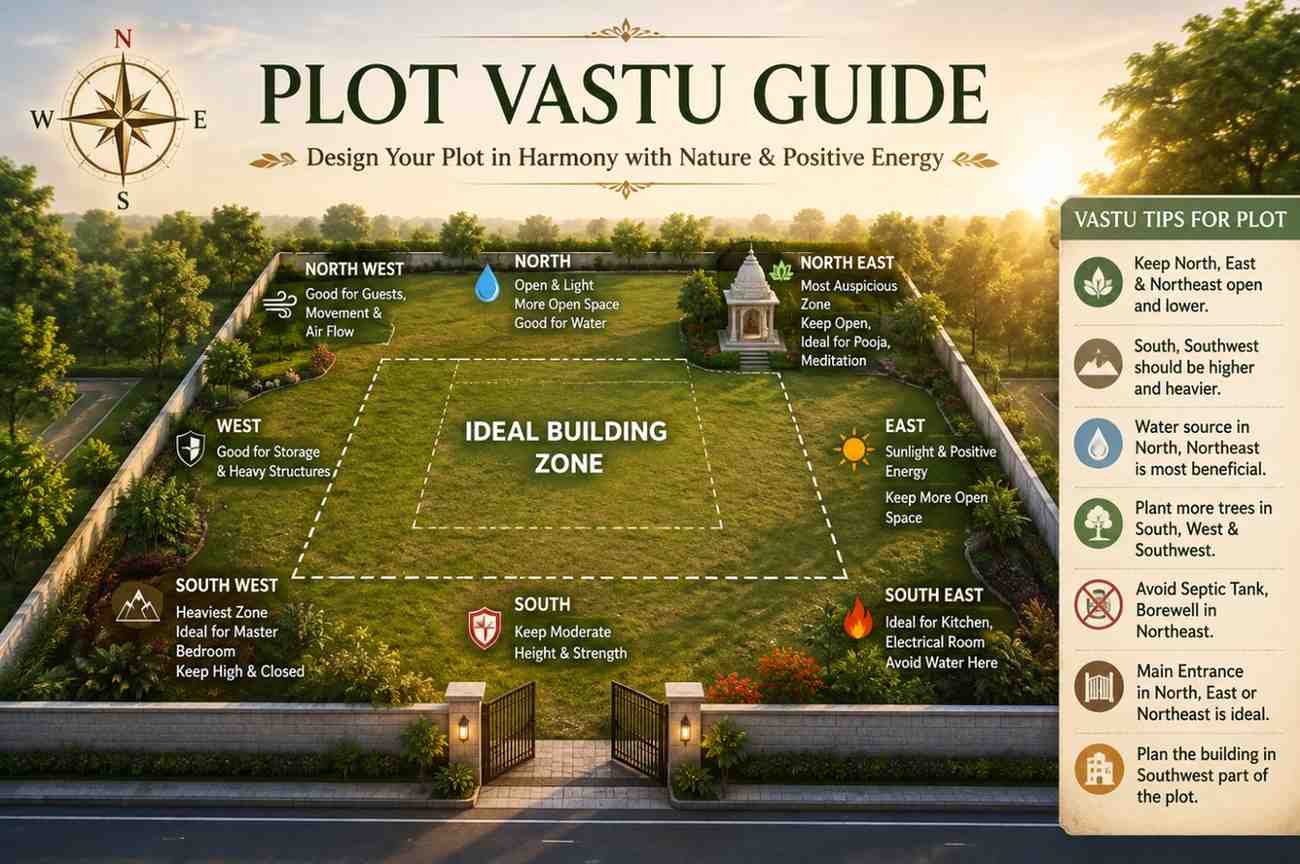
In Vastu Shastra, the ideal plot for a home is square-shaped, slopes from Southwest (high) to Northeast (low), faces North or East, and has open space or water in the Northeast direction. These are the foundational principles of plot selection Vastu applied before any construction begins.
- ◦Quick Answers — Plot Selection Vastu at a Glance
- ◦What Is the Best Plot Shape According to Vastu Shastra?
- ◦Plot Slope and Elevation — Why the Direction of the Slope Matters in Vastu
- ◦How Roads and Surroundings Affect Plot Vastu
- ◦Soil Quality and Natural Features — What Classical Vastu Says About the Land Itself
- ◦Cut Corners and Extensions — Which Directions Matter Most
- ◦Direction-Specific Plot Considerations in Vastu
- ◦Practical Plot Evaluation Framework — How to Actually Assess a Plot
- ◦When You're Evaluating a Built Home, Not Raw Land
- ◦Honest Framing — What Plot Vastu Can and Cannot Do
- ◦Final Thought
Choosing a plot is the single most important Vastu decision you'll ever make. Every wall, every door, every room placement comes after — but the land itself? That's where it all begins. Classical Vastu has detailed, specific guidance on what makes a plot favorable or not — and this guide covers all of it.
When people talk about Vastu, they usually jump straight to room placement — where the kitchen should go, which direction the bed should face.
But honestly, if the plot itself has serious problems, no amount of room arrangement is going to fix things at the root. The plot is the canvas. Get the canvas right, and everything else becomes easier.
The good news is that plot selection is where Vastu gives you the most freedom. No design decisions are locked in yet. You're simply evaluating land — shape, slope, surroundings, soil — and comparing your options.
This guide walks you through every classical principle you need to know, in plain language, so you can actually use this when you're standing on a piece of land deciding whether to buy it.
And if you're buying a built home rather than raw land, don't skip this — most of these same principles apply to evaluating how the home sits on its plot.
Quick Answers — Plot Selection Vastu at a Glance
- Best shape: Square (ideal); rectangle within 1:2 ratio (acceptable)
- Avoid shapes: Triangular, L-shaped, plots with Northeast cut corner
- Best slope: High Southwest, low Northeast — the classical ideal
- Avoid slope: High Northeast, low Southwest (reverse of classical)
- Best orientation: North-facing, East-facing, or Northeast-facing plots
- Best surroundings: Water or open space in Northeast/North; taller structures in South/West
- Avoid surroundings: Hospital, cemetery, or T-junction roads hitting the North or Northeast
- Soil: Fertile, life-supporting soil is auspicious; barren or troubled history plots need investigation
- Cut corners: Northeast cut is worst; Southwest cut is sometimes acceptable
- Extensions: Northeast extension is auspicious; Southwest extension is less favorable
- Bottom line: No plot is perfect — weigh favorable elements against concerns honestly
What Is the Best Plot Shape According to Vastu Shastra?
This is usually the first thing to assess when you walk a piece of land, and the classical answer is straightforward.
Square plots are the ideal. The reason is rooted in the Vastu Purusha Mandala itself — the cosmic grid that underlies all classical Vastu is a perfect square divided into cells. A square plot lets this grid map cleanly onto your land without distortion. Energy distributes evenly. All directions get their proper weight.
Rectangular plots are also good, with one condition: the length shouldn't exceed twice the width. A 1:2 ratio is the outer limit. Within that, a rectangle longer along the North-South axis is slightly preferred over one longer along the East-West axis — but both are workable.
On a rectangular plot, the home itself should ideally sit toward the Southwest corner, leaving more open space stretching toward the Northeast.
Irregular shapes are a mixed bag. Modern urban plots are rarely perfect squares — road angles, neighbor boundaries, and zoning realities create all kinds of irregular shapes. Some are fine, some are genuinely problematic:
- Gomukhi (narrow front, wide back) — auspicious for residential use, especially when you enter from the narrow end; the plot literally opens up as you go deeper
- Singhmukhi (wide front, narrow back) — better suited for commercial use like shops; less ideal for homes
- L-shaped plots — generally problematic; the direction of the L's arms matters a lot
- Triangular plots — classically considered very unfavorable; avoid if you can
- Plots with cut corners — depends entirely on which corner; more on this below
- Plots with Northeast extension — actually favorable; extra space in the most sacred direction is considered auspicious
Plot Slope and Elevation — Why the Direction of the Slope Matters in Vastu
Many people overlook slope when evaluating a plot. That's a mistake. Classical Vastu considers the natural slope of the land to be highly significant.
Favorable slope patterns:
- High Southwest, low Northeast — this is the classical ideal. The heavy, stable Southwest being elevated, with the open spiritual Northeast being lower, supports the classical directional logic throughout. Water naturally flows from Southwest toward Northeast, which is exactly what Vastu wants.
- High West, low East — a solid secondary pattern; also favorable
- High South, low North — workable
Unfavorable slope patterns:
- High Northeast, low Southwest — the reverse of the classical ideal; considered unfavorable
- High East, low West — generally unfavorable
A note on flat plots: if the land is essentially flat with no visible elevation change, the slope principle has less direct relevance. Slope concerns become significant when there's actual visible grade. For genuinely flat land, you simply move on to the other evaluation criteria.
How Roads and Surroundings Affect Plot Vastu
The land doesn't exist in isolation. What's around the plot — roads, structures, water bodies, trees — all feed into the Vastu of the overall environment, which in turn influences the plot itself.
Roads and access:
- Roads on the North and East are the classical preference — these are the Sun direction and the Kubera (wealth) direction
- Corner plots with roads on multiple sides, especially a Northeast corner plot, are considered particularly auspicious
- Roads only on the South or West are generally less favorable, though workable with careful design
- T-junction plots (where a road dead-ends directly into the plot) are classically considered problematic; the severity depends on which direction the road is approaching from
Surrounding structures:
- Taller buildings should be in the South and West of your plot — that's exactly where the heavier directions are supposed to be
- Open space to the North and East is ideal — you want those directions light and unobstructed
- A temple in the East or Northeast is auspicious, though classical sources generally prefer at least one plot of separation rather than a direct boundary wall
- A hospital or cemetery in the North or Northeast is considered unfavorable
- Tall trees directly shadowing the home from the Northeast or East are problematic — they block light and energy from directions that should stay most open
Water bodies:
- River, lake, or water in the North or Northeast is highly auspicious — one of the most favorable surroundings a plot can have
- Water in the South or West is less favorable in classical tradition
Soil Quality and Natural Features — What Classical Vastu Says About the Land Itself
This section surprises a lot of people — classical Vastu has specific views on the soil itself, not just the shape and direction of the land.
- Fertile soil that supports healthy plant growth is auspicious; the reasoning is practical as much as classical — soil that sustains life is a genuinely good sign
- Sandy, rocky, or unpleasant-smelling soil is less favorable for residential plots
- Plots where healthy plants and trees are already growing are generally auspicious; the earth is alive
- Plots with a history of suffering — battlefields, sites of violence, mass burial grounds — are classically avoided; purification ceremonies are recommended if you proceed
- Underground water that can support a well is considered auspicious; a very low water table or boggy surface water is less favorable
The practical takeaway: walk the plot, look at what's growing there, smell the soil if you can, and ask about the history of the land. These are things Vastu practitioners have always considered — and they're not unreasonable things to investigate before a major purchase.
Cut Corners and Extensions — Which Directions Matter Most
This is one of the more nuanced areas of plot selection Vastu, and it matters more than most people realize.
Cut corners (where a piece of the plot is removed at one corner) — favorable or unfavorable depends entirely on which corner:
- Northeast cut — the most problematic; the Northeast is the most sacred direction in Vastu, and cutting it diminishes the direction that should be most open and unobstructed
- Southeast cut — the fire direction is diminished; can affect themes related to kitchen and vitality
- Northwest cut — moderate concern
- Southwest cut — sometimes acceptable or even neutral; reducing the already-heavy Southwest zone doesn't carry the same concern as cutting the Northeast
Plot extensions are the inverse of cuts:
- Northeast extension — auspicious; extra space in the spiritual direction is welcome
- Southwest extension — less favorable; the Southwest should be contained and heavy, not sprawling outward
Direction-Specific Plot Considerations in Vastu
The direction a plot faces — determined primarily by where the road is and where the main entrance will eventually be — is a significant factor in evaluation.
- North-facing plots — classical preference; associated with Kubera (wealth and prosperity)
- East-facing plots — strong classical preference; associated with the Sun — light, health, and vitality
- Northeast-facing plots — often considered the most auspicious of all, combining the energies of both North and East
- South-facing plots — workable with careful Vastu design; less preferred in classical tradition, though many homes on South-facing plots do well when internal design is properly executed. The Main Door / Entrance Vastu placement becomes especially important here
- West-facing plots — generally workable; not the first classical choice but not disqualifying. How you plan the Bedroom Vastu and sleeping directions matters more on a West-facing plot
- Southwest-facing plots — the most challenging orientation; the Southwest is the direction of heaviness and closure, not of welcome and entry. If you proceed, getting the Kitchen Vastu and master bedroom placement right becomes critical
Practical Plot Evaluation Framework — How to Actually Assess a Plot
When you're standing on a plot and need to evaluate it, work through these questions in order:
1. What is the shape? Square or rectangle within a 1:2 ratio = favorable. Irregular = depends on specifics. Triangular = avoid.
2. What is the natural slope? High Southwest to low Northeast = classical ideal. Reverse = unfavorable. Flat = neutral.
3. What direction does the plot face, and where is the road access? North, East, or Northeast = most favorable. South or West = workable with care. Southwest = challenging.
4. What is in the surroundings? Open space, water, or a temple in the Northeast or North = auspicious. Hospital, cemetery, or tall obstructions in the Northeast = concerning.
5. Are there cut corners? Northeast cut = most concerning. Other cuts = depends on direction.
6. What is the soil like? Fertile, supporting plant life = good. Barren or troubled history = investigate before proceeding.
7. How does the plot relate to the buyer's birth chart? For the most complete and accurate picture, understanding your birth chart alongside the plot Vastu is essential — what's favorable for one person may not be optimal for another, and a personalized reading accounts for both.
No plot will score perfectly on every point. The real question is whether the favorable elements substantially outweigh the concerns, and whether the concerns are the kind that remedies can address or the kind that are structurally unchangeable.
If you want personalized guidance on a specific plot and how it aligns with your chart, Yajna - yajna specializes in helping people work through property and life decisions from both a Vastu and astrological angle.
When You're Evaluating a Built Home, Not Raw Land
Most people aren't choosing empty land — they're buying a home that's already built. The principles still apply, but the practical questions shift:
- What direction does the home face? This is the most consequential single factor for an existing home
- Where is the home placed on the plot relative to the plot center? Southwest of center is classical; Northeast of center is less favorable
- What can be done with the open space? Water features in the Northeast, heavier planting in the Southwest — these are real levers even when the structure is fixed
- For genuinely difficult configurations: A Vastu Shanti ceremony (the classical housewarming-and-purification practice) and ongoing remedial practices are the traditional responses when the structure can't be changed
If you're navigating a remedial approach for an existing home, Atri - atri can guide you through the right Vastu and astrological remedies for your specific situation.
Honest Framing — What Plot Vastu Can and Cannot Do
Let's be direct about this, because a lot of Vastu content isn't.
Plot Vastu matters most when you actually have a choice. If you're comparing three or four available plots, applying classical principles to the evaluation is genuinely useful and can inform a better decision.
In constrained markets, the ideal isn't always available. Urban plots with perfect shape, ideal slope, and Northeast road access at an affordable price are rare.
The practical question in most real buying situations is evaluating the available options against each other, not against a classical ideal that may not exist at available price points.
No plot is perfect. Almost every plot has some Vastu concern. The honest question is always about the balance — do the favorable elements substantially outweigh the concerns?
Remedies can mitigate but not fully eliminate. For genuinely problematic plots, the classical remedies help, but an honest cost-benefit analysis should weigh the severity of the structural concern against the likely benefit of the remedy.
Be skeptical of extremes. Any consultant who declares a plot "perfect" or "catastrophic" with high certainty isn't doing honest Vastu evaluation. Every plot is a mixed picture. Nuanced assessment is the mark of credible analysis.
Final Thought
Plot selection is the moment when Vastu principles can be applied most freely — before any design decisions have been made, the land itself becomes the foundation on which everything else rests.
For those buying land to build, this is the single most consequential Vastu decision in the entire process. For those buying built homes, the same logic applies to evaluating how the home sits on its plot.
The classical preferences are clear: square or rectangular plots, slope from Southwest to Northeast, road access on the North or East, favorable surroundings in the Northeast, fertile soil that supports life. But real-world plot buying is almost always about trade-offs.
The honest engagement with plot Vastu isn't about finding a mythical perfect plot — it's about evaluating what's actually available with clear eyes, understanding both what's favorable and what needs remedy, and making the best decision possible with real information.
The plot supports the home. The home supports the life. The life supports the practice. Each level rests on the one before — and conscious attention at each level, including the plot itself, is exactly what classical Vastu has always pointed toward.
Siddharth Deopujari
Vastu Architecture, Sacred Geometry & Building Design | 16+ Years
Siddharth Deopujari is an architectural researcher specializing in Vastu-based building design, sacred geometry, and traditional planning systems. His articles explore the historical foundations and practical applications of Vastu in contemporary construction.
Frequently Asked Questions
1. What is the best plot shape according to Vastu?
A perfect square is the classical ideal — the Vastu Purusha Mandala is itself a square grid, and square plots support balanced energy distribution. Rectangular plots are also favorable when the length does not exceed twice the width. Avoid triangular plots (classically very unfavorable), L-shaped plots, and plots with Northeast cut corners.
2. Which plot orientation is most auspicious?
North-facing, East-facing, or Northeast-facing plots are the classical preference. Road access on the North and East is favorable. Corner plots with roads on multiple sides — especially Northeast corner plots — are considered particularly auspicious. South-facing and Southwest-facing plots are workable but require more careful internal design.
3. What is the ideal slope for a building plot?
The classical ideal is high Southwest, low Northeast — the land slopes from an elevated Southwest down to a lower Northeast. This supports water and energy flow toward the open spiritual Northeast. Avoid the reverse (high Northeast, low Southwest). Flat plots are generally neutral with respect to slope.
4. What surroundings should I look for or avoid?
Favorable: Roads on North and East, taller structures in South and West, open space or water bodies in the Northeast or North, a temple in the East or Northeast (with some separation), healthy plant growth. Unfavorable: Hospitals or cemeteries in the North or Northeast, T-junction plots, tall trees shadowing from the Northeast, water bodies in the South or West.
5. Are cut corners always bad for a plot?
It depends entirely on which corner is cut. The Northeast cut is the most problematic — the most sacred direction diminished. Southeast cut reduces the fire direction. Northwest cut is a moderate concern. Southwest cut is sometimes acceptable or neutral. Northeast extension, by contrast, is actually auspicious.
6. How do I evaluate a plot when no perfect option is available?
Work through the practical framework: shape, natural slope, primary direction and road access, surroundings, soil and natural character, cut corners. The honest question is whether the favorable elements substantially outweigh the concerns. Practical considerations — cost, location, infrastructure, family needs — all matter alongside Vastu. The buyer's birth chart should also be considered alongside the plot for the most complete analysis.
Related Blogs

Feng Shui Chinese Art of Finding Love
Simple, down-to-earth Feng Shui love hacks to help you shift your space, clear emotional blocks, and invite real, meaningful love into your life.
Effortless Feng Shui Tips to Boost Romance
Unlock the magic of love with astrology-backed rituals to attract your soulmate using candles, moon phases, and vision boards.

Why Every Home Needs Vastu Shanti?
Find out the 10 strong Vastu Shanti advantages that can make your house more energy level, eliminate the negativity, and bring abundance, bliss and well-being.
Vastu for Home Explained: Best Directions, Room Placement & Easy Fixes
Complete Vastu guide for home: directions, kitchen, bedroom, entrance & remedies. Improve energy, health & prosperity easily.