Main Entrance Vastu Guide: Placement, Design, Decorations, and Remedies
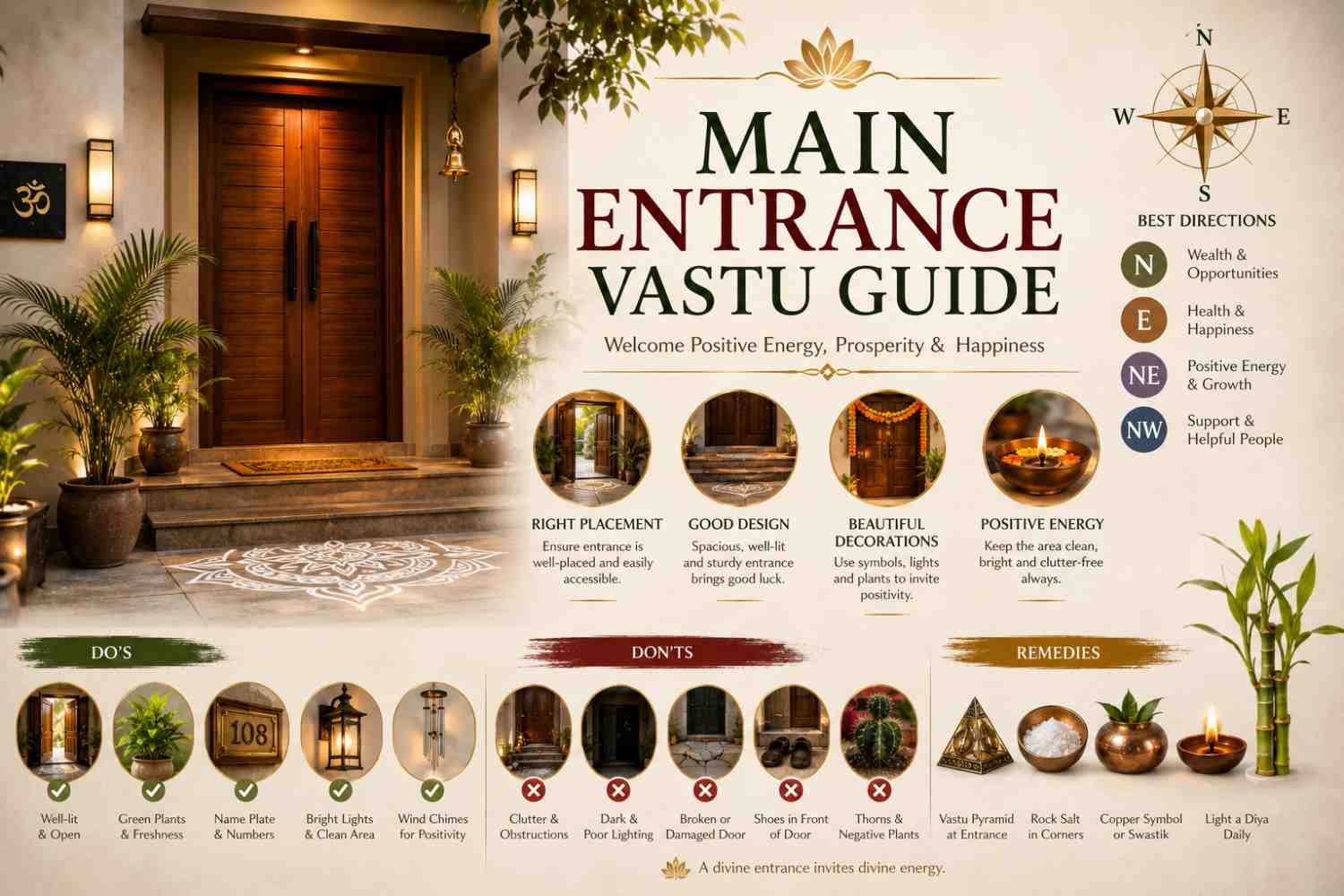
In Vastu Shastra, the main door is the single most important element of a home. North, East, and Northeast are the most auspicious directions for a main entrance. The door should open inward, be the largest in the home, and have a well-maintained threshold with auspicious decorative elements.
- ◦Quick Answers — Main Door Vastu at a Glance
- ◦The Eight Directional Options for a Main Door — What Vastu Says About Each
- ◦Main Door Design Elements That Classical Vastu Actually Cares About
- ◦Auspicious Decoration for the Main Door — What to Add
- ◦What to Avoid at the Main Entrance
- ◦When Ideal Direction Isn't Available — Remedies That Actually Work
- ◦How Main Door Vastu Connects to Your Birth Chart and Astrology
- ◦Main Door Vastu and the Rest of the Home — How It All Connects
- ◦Final Thought
Think about it this way — every single thing that enters your home, whether it's energy, people, opportunities, or just the morning light, comes through one place. The main door. Classical Vastu has always treated it as the mouth of the home, and that's not just poetic language. It's a functional description. What enters through that mouth shapes everything that happens inside.
This is why, in the Vastu Shastra Complete framework, if someone asks "where do I start?" the answer is almost always the same: start with the main door.
Get that right, and you've done the most important thing. Get it wrong, and no amount of clever room arrangement fully makes up for it.
This guide covers everything — the eight directional options and what each one means, the design details classical tradition actually cares about, what to avoid, and the practical remedies for when your entrance direction isn't ideal (which, honestly, is most homes).
Quick Answers — Main Door Vastu at a Glance
- Most auspicious directions: North (wealth, Kubera), East (vitality, Sun), Northeast (sacred Ishana zone)
- Generally favorable: West — works well with correct placement within the wall
- Requires care: South — workable but needs thoughtful placement toward the Southeast portion
- Most challenging: Southwest — the most difficult direction; avoid if possible
- Mixed directions: Northwest (movement themes), Southeast (fire themes)
- Door design: Opens inward, largest door in the home, solid wood preferred
- Threshold: Small raised threshold is classical; keep it crack-free and clean
- Decoration: Toran, Ganesha, Lakshmi feet, Om symbol — all auspicious
- Universal principle: Clean, well-lit, clutter-free entrance supports good flow in any direction
The Eight Directional Options for a Main Door — What Vastu Says About Each
North-Facing Main Door Vastu
Highly auspicious. The North is the direction of Kubera, the god of wealth, and Mercury. A North-facing main door is classically associated with wealth, career growth, and commercial opportunity.
If you're in business, finance, or any field where upward movement matters, a North-facing entrance works strongly in your favor. The door should sit in the Northern half of the wall, ideally toward the more Eastern portion of the North.
East-Facing Main Door Vastu
Highly auspicious — and arguably the most universally favorable of all. The East is the direction of Indra (king of the gods) and the rising Sun.
Morning sunlight entering through an East-facing door brings vitality, health, new beginnings, and the kind of forward energy that actually carries through the day. Particularly favorable for those in education, leadership, or dharmic work. If you're choosing between options, East is rarely the wrong answer.
Northeast-Facing Main Door Vastu
Highly auspicious. The Northeast — Ishanya — is the direction of Lord Shiva and the most sacred zone in the entire Vastu grid. A Northeast-facing entrance combines the favorable qualities of both North and East and adds the spiritually significant Ishana energy on top.
If your life is oriented around spiritual development, contemplative work, or wisdom-based careers, this entrance direction aligns particularly well. Within the Northeast wall, the Northern half is slightly preferred over the Eastern half if you have a choice.
West-Facing Main Door Vastu
Generally favorable with conditions. The West is the direction of Varuna (god of waters) and Saturn. West-facing entrances are extremely common in modern apartments and developer-built homes where directional choice is limited — and they work well when placement within the wall is done correctly.
The key: place the door in the Northern half of the West wall, not the Southern half. Most life patterns are compatible with a West-facing entrance.
South-Facing Main Door Vastu
Requires specific care — but not categorically inauspicious. The South is the direction of Yama and Mars. This is where a lot of Vastu content gets unnecessarily alarming — South-facing homes are not doomed, and many function very well.
The critical factor is where on the South wall the door sits. Place it toward the Southeast portion (more Eastern side of the South wall), not toward the Southwest. With the right placement and design, a South-facing entrance works fine.
Southwest-Facing Main Door Vastu
Particularly challenging — avoid if possible. The Southwest (Nairutya) is meant to be heavy, grounded, and contained. It's classically the location of the master bedroom and household authority — not the point of entry. A Southwest-facing entrance disrupts the classical pattern more significantly than any other direction.
Where you genuinely cannot avoid it, substantial remedies are needed. This is the one case where honest evaluation is more useful than false reassurance.
Northwest-Facing Main Door Vastu
Mixed — depends on the resident's life pattern. The Northwest is the direction of Vayu (wind) and carries qualities of movement, outward flow, and social energy.
Northwest-facing entrance can function well, but classical tradition notes that the wind-like impermanence of this direction may produce themes of frequent change in the household — moves, career shifts, transient relationships.
For those whose work genuinely involves movement (travel-heavy careers, international work), this aligns naturally. For those seeking deep stability, it may create some friction.
Southeast-Facing Main Door Vastu
Less common, with mixed effects. The Southeast (Agneya) is the direction of Agni (fire) — classically the zone of the kitchen, not the entrance.
A Southeast-facing main door can bring themes of heat, intensity, or financial pressure into the household dynamic. Some classical sources treat Southeast entrances as workable with proper design; others recommend alternative placement when available.
If you're working with a Southeast-facing entrance, the design and remedial elements below matter more than usual.
Main Door Design Elements That Classical Vastu Actually Cares About
Direction gets most of the attention, but the design of the door itself is a meaningful part of main door Vastu. Here's what the classical tradition addresses:
Door size and proportion:
- The main door should be the largest door in the home — its size reflects its importance
- Classical proportions favor doors that are taller rather than wider; height typically 1.5 to 2 times the width
- The door should open inward toward the home, not outward — the home is receiving energy, drawing it in
- Double-leaf doors are classically auspicious for main entrances when the space allows
Threshold (Dehri):
- The threshold is treated as deeply significant in classical tradition — it marks the symbolic boundary between outside and inside
- A small raised threshold is traditional and considered auspicious
- If the threshold is cracked or damaged, repair it promptly — this matters more than most people realize
- Crossing the threshold consciously is part of traditional entry practice, especially the first time you enter a new home
Materials:
- Solid wood is the classical preferred material, particularly hardwoods that age well
- Solid wood doors carry stronger Vastu associations than hollow or thin doors
- Metal elements — handles, hinges, decorative metalwork — are acceptable and often traditional
- The door should be sturdy and well-maintained; a strong door symbolizes the home's protective quality
Auspicious Decoration for the Main Door — What to Add
The entrance is the first thing the home presents to the world — and classical tradition has always treated it as a space worth decorating intentionally.
- Toran (decorative hanging above the door) — traditional and widely considered auspicious across regions
- Ganesha image or statue near the entrance — Ganesha as the remover of obstacles is the natural deity for the entry point
- Lakshmi feet at the threshold — welcoming the goddess of prosperity into the home
- Om or Swastik symbol on the door (the genuine Indian auspicious symbol, completely distinct from its later misappropriation)
- Kolam or rangoli at the entrance threshold, drawn fresh daily — traditional in many regions and considered to invite auspicious energy
- Fresh flowers, marigold garlands, or bilva leaves during festivals and auspicious occasions
- Nameplate — clear, readable, and well-maintained; this is a small thing that carries more Vastu significance than most people give it
What to Avoid at the Main Entrance
Just as important as what to add is what not to have at the entrance:
- Shoe piles at the entrance — use a closed shoe cabinet rather than open piles
- Clutter, garbage, or unmaintained items of any kind
- A mirror directly facing the main door — classical tradition holds that a mirror opposite the entrance reflects incoming energy back out
- A toilet door directly opposite the main entrance — one of the more commonly cited main door problems in apartment Vastu
- Tall trees or large obstructions directly in front of the entrance — blocking the flow before it even enters
- Cracked or damaged door, threshold, or surrounding walls — repair these before anything else
When Ideal Direction Isn't Available — Remedies That Actually Work
Here's the reality: most people don't get to choose their main door direction. Apartments, rented spaces, and developer-built homes almost never offer that choice. Classical Vastu has always known this, and the remedial tradition is extensive.
For any non-ideal entrance direction:
- Auspicious imagery — Ganesha near the entrance, Lakshmi feet at the threshold, Om symbol on the door
- Keep the entrance area well-lit — natural light where possible, warm artificial light otherwise
- Color adjustments on entrance walls — yellow for South entrances, green for East, blue or black for North, white for West
- Fresh healthy plants near the entrance; avoid thorny plants directly at the door
- Metal wind chimes — particularly helpful for movement-direction entrances like Northwest
- Daily cleanliness and order — the single most universally applicable remedy, and genuinely effective
For South or Southwest entrances specifically:
- Ensure the door area is heavy and well-grounded — substantial threshold, solid door, no lightness or fragility at the entry
- Add Hanuman imagery at or near the entrance
- Regular Hanuman Chalisa recitation is the classical spiritual remedy for South and Southwest directions
- Strict maintenance of cleanliness and the absence of clutter
If you'd like personalized remedial guidance specific to your entrance situation and birth chart, Atri - atri specializes in Vastu and astrological remedies and can walk you through what's most effective for your specific configuration.
How Main Door Vastu Connects to Your Birth Chart and Astrology
This is where main door Vastu gets genuinely personal — and it's worth understanding before making any major decisions.
The combination of chart and Vastu is the classical comprehensive approach to home design:
- A native's favorable directions, based on your birth chart analysis, can directly inform main door preference when you actually have a choice
- For specific chart configurations, certain directions are more strongly supportive than others — a competent astrologer can identify directional preferences for your specific chart
- When your chart and Vastu both point to the same direction, that alignment is particularly powerful
- When the chart suggests one direction but your home offers another, the symbolic and remedial elements above carry additional importance — they're not just aesthetic, they're compensatory
The interplay between personal chart and home Vastu is one of the most nuanced and interesting areas of classical Indian tradition. The home isn't just a space — it's an extension of the inhabitant, and the classical view has always treated them as related systems.
Main Door Vastu and the Rest of the Home — How It All Connects
The main door doesn't operate in isolation. It's the starting point of a flow that moves through every other space in the home.
- Energy entering through the main door flows toward the Pooja room — which classical Vastu places in the Northeast or North, directly in the path of favorable incoming energy. Getting your Pooja Room Vastu right matters especially when the main door direction is strong
- The master bedroom in the Southwest receives the energy that hastraveled through the home — a well-placed main door supports restful and authoritative energy reaching the bedroom. See Bedroom Vastu for how sleeping direction and room placement build on the entrance foundation
- The kitchen in the Southeast receives fire energy — a Southeast-facing entrance can intensify this beyond what's comfortable, which is one reason Southeast entrances require particular care. Kitchen Vastu placement becomes especially important to balance when the entrance introduces fire-direction energy
Final Thought
The main door is, in classical Vastu, the single most consequential element of any home. It's the threshold — the literal and symbolic boundary between the outside world and the space where your life actually happens.
If you have a choice in entrance direction, choose North, East, or Northeast when possible. If you're working with an existing home whose direction is already fixed, put your energy into the design, decoration, and remedial elements with care.
The practical principle that runs through all of this is simple: a clean, well-maintained, intentionally cared-for entrance supports good flow regardless of technical direction.
The classical tradition's accumulated wisdom isn't magic — it's the observation that homes whose entrances are treated with attention and respect function better than those where the entrance is neglected.
Treat your main door as the threshold it actually is. The boundary between outside and inside. The point of transition into the space where your life unfolds.
The respect you give it — in cleanliness, design, and conscious daily care — is, in the end, the deepest and most effective form of main door Vastu practice.
Niharika Venkataraman
Home Vastu, Interior Layouts & Spatial Design | 11+ Years
Niharika Venkataraman writes extensively on home Vastu, interior planning, and harmonious living environments. She combines traditional Vastu principles with practical design insights to create accessible guidance for modern homes and apartments.
Frequently Asked Questions
1. What is the best direction for a main door according to Vastu?
The three most auspicious directions are North (Kubera — wealth and opportunity), East (Indra — vitality and beginnings, considered most universally favorable), and Northeast (Ishana — the most sacred direction). West is generally favorable with appropriate placement. South and Northwest require specific care. Southeast and particularly Southwest are most challenging and should be avoided when possible.
2. Is a Southwest-facing main door always bad?
It is the most challenging directional choice in classical Vastu. The Southwest is meant to be heavy and grounded — the location of master bedroom and household authority, not the point of entry. However, substantial remedies exist: Hanuman imagery near the entrance, regular Hanuman Chalisa recitation, ensuring the door area is heavy and well-grounded, strict cleanliness, and consciously protective decorative elements. Many Southwest-facing homes function workably with these remedies in place.
3. What direction should my main door open?
Classical Vastu specifies that the main door should open inward (toward the inside of the home) rather than outward. This is symbolic — the home is receiving energy, drawing it in rather than pushing it out. The door should swing freely and smoothly, opening fully without obstruction. Doors that stick, scrape, or don't open fully should be repaired promptly.
4. What should I avoid at the main entrance?
Avoid shoe piles (use closed storage), clutter and garbage, mirrors directly facing the main door, a toilet door directly opposite the main entrance, tall trees or large obstructions blocking flow directly in front of the door, and cracked or damaged door, threshold, or surrounding areas. The entrance area should be clean, clear, and well-maintained — the home's first impression to entering energy.
5. What remedies work for a non-ideal main door direction?
Classical remedies include: auspicious imagery (Ganesha, Lakshmi feet, Om), Toran above the door, color adjustments aligned with the direction, healthy plants near the entrance (avoiding thorny varieties), wind chimes for movement directions, daily cleanliness and maintenance, kolam or rangoli at the threshold, and direction-specific spiritual practice (Hanuman Chalisa for South or Southwest, Ganesha worship for Southeast). The remedies are typically modest in effort and expense.
6. How does main door Vastu relate to astrology?
A native's favorable directions based on chart analysis can directly inform main door preference when choice is available. When chart and Vastu both point to the same direction, the alignment is particularly strong. When the chart suggests one direction but the home offers another, symbolic and remedial elements take on additional importance. The combination of chart-informed and Vastu-informed home design is the classical comprehensive approach.
Related Blogs
Feng Shui Chinese Art of Finding Love
Simple, down-to-earth Feng Shui love hacks to help you shift your space, clear emotional blocks, and invite real, meaningful love into your life.
Effortless Feng Shui Tips to Boost Romance
Unlock the magic of love with astrology-backed rituals to attract your soulmate using candles, moon phases, and vision boards.
Why Every Home Needs Vastu Shanti?
Find out the 10 strong Vastu Shanti advantages that can make your house more energy level, eliminate the negativity, and bring abundance, bliss and well-being.
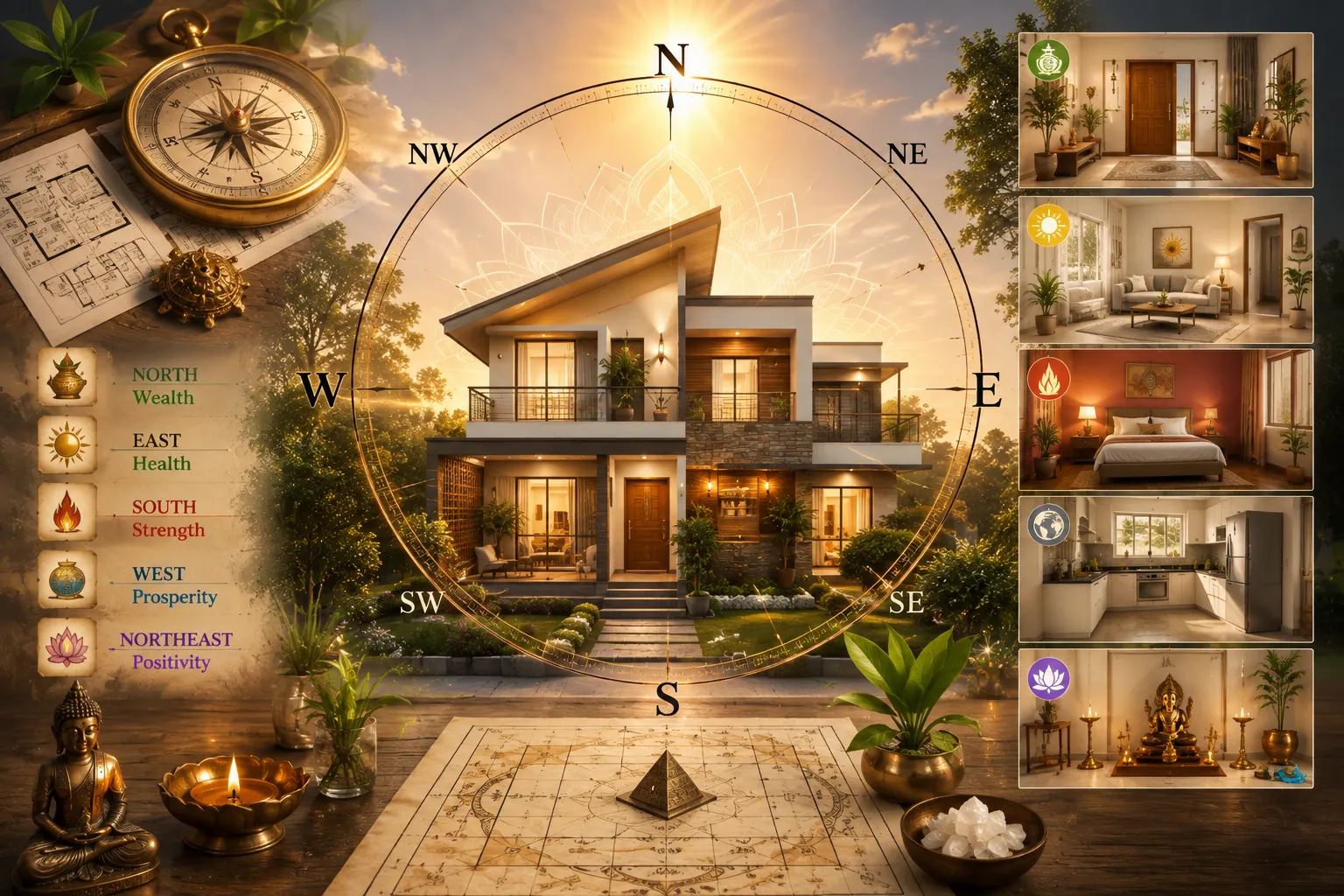
Vastu for Home Explained: Best Directions, Room Placement & Easy Fixes
Complete Vastu guide for home: directions, kitchen, bedroom, entrance & remedies. Improve energy, health & prosperity easily.