Complete Vastu Shastra Guide for Homes: Directions, Elements, Mandala, and Remedies
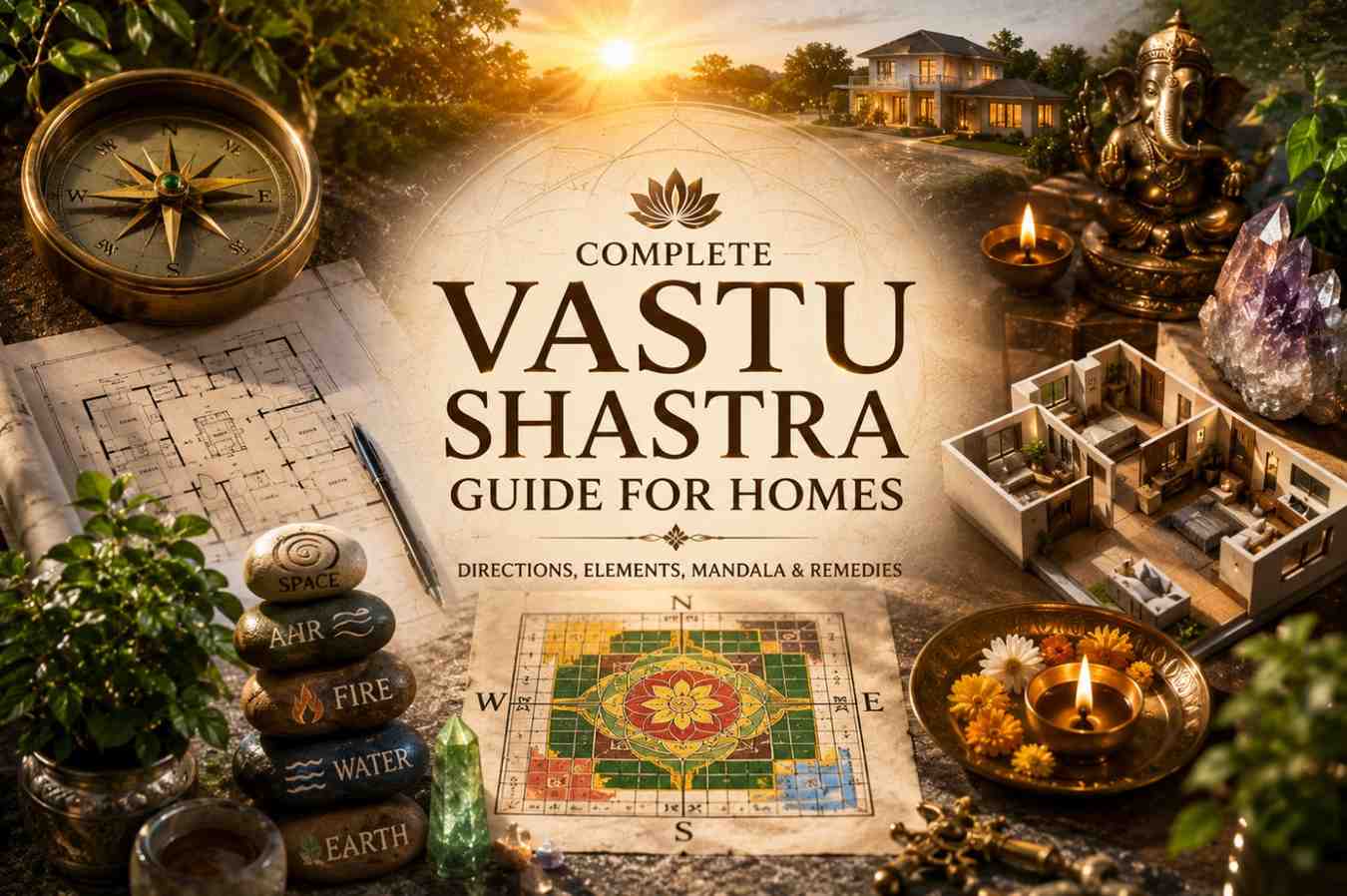
Vastu Shastra is a classical Indian system of architecture and spatial design, continuously practiced for over 3,000 years. It uses eight directional zones, five elements (Pancha Mahabhuta), and the Vastu Purusha Mandala to guide how homes, temples, and buildings should be arranged for wellbeing and natural energy flow.
- ◦What Vastu Shastra Actually Is — and Why It Still Matters
- ◦The Eight Directions in Vastu Shastra — What Each One Governs
- ◦The Five Elements of Vastu — Pancha Mahabhuta
- ◦The Vastu Purusha Mandala — The Geometric Foundation
- ◦How Vastu Shastra and Vedic Astrology Actually Relate
- ◦The Room-Specific Vastu Guides — What's Covered in This Series
- ◦The Honest Framing on Vastu Shastra — What It Can and Can't Do
- ◦Final Thought
You've probably heard someone say their home has "bad Vastu" — and then watched them spend a weekend rearranging furniture or moving a mirror from one wall to another. Maybe you've rolled your eyes a little. Or maybe you were the one doing the rearranging.
Either way, there's something in this that's worth taking seriously. Vastu Shastra isn't a superstition invented last century to sell pyramid crystals.
It's a living architectural tradition that's been shaping how Indians build and inhabit spaces for over three thousand years. And once you understand what it actually says — not the fear-mongering version, not the paid-consultation version — it starts making a lot of sense.
This is the complete guide. It covers what Vastu actually is, the eight directions, the five elements, the Vastu Purusha Mandala, how Vastu and Vedic astrology relate, and the honest framing you deserve before applying any of this to your home.
Quick Answers
- What is Vastu Shastra? Classical Indian science of architecture — "Vastu" (dwelling) + "Shastra" (science/treatise)
- How old is it? Practiced for over 3,000 years; classical texts include Mayamatam, Manasara, Brihat Samhita
- Core principles? Eight directions, five elements (Pancha Mahabhuta), Vastu Purusha Mandala
- Is it the same as astrology? No — separate discipline, but both share the same foundational Vedic worldview
- Does it work? Many principles align with modern environmental design; some elements are specifically classical — honest application matters
What Vastu Shastra Actually Is — and Why It Still Matters
Let's start with the basics. Vastu Shastra comes from two Sanskrit words — Vastu meaning dwelling or structure, and Shastra meaning science or treatise. So literally, it's the science of how you build and inhabit a space.
The core idea is simple but profound: built spaces are not neutral. The way your home is arranged affects how you feel, how you sleep, how clearly you think, how easily daily life flows.
Some arrangements support you; others create friction you can't quite explain. Vastu Shastra is the accumulated tradition — refined over millennia — of identifying which arrangements do which.
The classical texts that carry this tradition include the Brihat Samhita, Mayamatam, Manasara, and the Samarangana Sutradhara, among others. These aren't obscure manuscripts — they were actively used in temple construction, royal palace design, and city planning across the Indian subcontinent for centuries.
Here's what's interesting: many Vastu principles overlap significantly with what modern environmental design and building science have independently concluded. Orientation toward natural light. Attention to air flow. Separating cooking and sleeping zones. Careful placement of water sources.
Modern architects working from first principles often arrive at the same conclusions. That's not a coincidence — it's what happens when a system has been refined through sustained observation over a very long time.
Where Vastu goes further than modern design is in its classical dimensions — the assignment of directions to specific deities and elements, the use of the Vastu Purusha Mandala, the integration of a building with broader cosmic patterns.
This is where the tradition becomes distinctly its own, and where honest assessment matters about what carries universal applicability and what is specifically traditional.
The Eight Directions in Vastu Shastra — What Each One Governs
The eight directions are the organizing backbone of Vastu. Every zone of your home corresponds to a direction, a deity, a planet, and a quality. Understanding these gives you a working map of your space.
The Four Cardinal Directions
-
North (Uttara) — governed by Kubera (god of wealth) and Mercury. This is the direction of prosperity, opportunity, and career advancement. Keeping the North open and uncluttered is one of the most commonly recommended Vastu basics — and one of the most practical.
-
East (Purva) — governed by Indra (king of the gods) and the rising Sun. Associated with vitality, health, and new beginnings. The classical preferred direction for main entrances and prayer rooms. If your home can have an east-facing door, traditional Vastu strongly favors it.
-
South (Dakshina) — governed by Yama (god of death) and Mars. Associated with strength and endurance — but also with difficulty if not consciously managed. The South needs weight and grounding; it shouldn't be left open and empty.
-
West (Paschima) — governed by Varuna (god of waters) and Saturn. Associated with gains, profit, and professional outcomes. Favorable for dining areas and certain commercial activities.
The Four Intercardinal Directions
-
Northeast (Ishanya) — governed by Ishana (Lord Shiva). The most sacred direction in Vastu, full stop. The classical placement for puja rooms, water sources, and spiritual activity. The Northeast should be kept light, open, and unobstructed — this is one principle that comes up in virtually every Vastu consultation.
-
Southeast (Agneya) — governed by Agni (fire god). The classical direction of fire and transformation, and the traditional placement for kitchens. When your kitchen sits in the Southeast, the fire element is in its natural zone.
-
Southwest (Nairutya) — governed by Nairuti, associated with stability and grounding. The traditional placement for master bedrooms, heavy furniture, and the center of household authority. The Southwest should feel substantial and settled.
-
Northwest (Vayavya) — governed by Vayu (god of wind). Associated with movement, social activity, and outward flow. Traditional placement for guest rooms, exits, and spaces that involve frequent coming and going.
These directional assignments aren't arbitrary. They reflect classical observation of how light, wind, and natural forces actually move through built spaces in the Indian subcontinent — layered with the deity-element symbolism that gives the system its full classical expression.
The Five Elements of Vastu — Pancha Mahabhuta
Vastu Shastra shares with broader Indian philosophy the framework of five elements — the Pancha Mahabhuta — which are understood as the building blocks of all physical reality. In Vastu, each element has a natural home in a specific directional zone:
-
Earth (Prithvi) — solidity, stability, structure. Classically associated with the Southwest. This is why the Southwest zone needs weight — heavy furniture, closed walls, the master bedroom. The Earth element grounds the home.
-
Water (Jal) — flow, coolness, life. Classically associated with the Northeast. Water sources — underground tanks, wells, water features — ideally belong here. The Northeast is where clarity and purification enter the home.
-
Fire (Agni) — heat, transformation, energy. Classically associated with the Southeast. The kitchen belongs here because cooking is fire — placing fire in its elemental zone keeps the transformation energy contained and appropriate.
-
Air (Vayu) — movement, breath, exchange. Classically associated with the Northwest. Good ventilation, cross-breezes, and social flow are supported by keeping this zone active and open.
-
Space (Akasha) — the underlying field in which the other four elements exist. Associated with the center of the space — the Brahmasthan. Vastu consistently recommends keeping the center of a home open and unobstructed if possible, since this is where the space element needs room to breathe.
The underlying logic is elegant: when elements are placed in zones that match their nature, daily life flows more easily.
When they're placed in conflict with their natural zones — a kitchen in the Northeast, for example, putting fire against water — tradition holds that friction builds over time. Whether you approach this cosmologically or practically, the spatial logic holds up.
The Vastu Purusha Mandala — The Geometric Foundation
This is where Vastu gets architecturally sophisticated. The Vastu Purusha Mandala is a geometric grid — most commonly 9×9 = 81 cells — that maps the qualities of every zone of a building plot or floor plan.
Each cell is associated with one of the 45 deities of the Vastu Mandala, and the combined pattern represents the body of the Vastu Purusha — a mythological figure who lies face-down across the grid, head in the Northeast, feet in the Southwest, different body parts corresponding to different zone qualities.
In classical architectural practice, this Mandala was used to determine where every function belongs: temples, throne rooms, kitchens, water sources, sleeping quarters, storage.
The principle is that placing functions in their appropriate Mandala zones aligns the building with the cosmic pattern the Mandala represents.
For most people designing or assessing a home today, the practical application typically involves:
- Identifying the Brahmasthan (center) — to be kept open and unobstructed where possible
- Mapping the eight directional zones to the rooms and functions they contain
- Checking the key placements — entrance, kitchen, master bedroom, puja room, water sources
Full Mandala-based design is more commonly used in temple construction and major commercial buildings. For residential design, the simpler direction-and-element framework described above carries most of the practical weight.
How Vastu Shastra and Vedic Astrology Actually Relate
People often assume Vastu and Vedic astrology are the same thing, or that one is a branch of the other. They're not. They're distinct disciplines — but they're closely related, and they're often used together with good reason.
Here's what they share:
- Both originated within the same broader Vedic intellectual tradition
- Both rely on the same foundational cosmology — the five elements, the planetary system, directional symbolism
- Both treat human life as embedded in larger structural patterns that can be consciously aligned with
- Both have practitioners who range from genuinely skilled to commercially exploitative — more on that below
The specific intersections are meaningful. Planetary directions in Vastu reflect Vedic astrological associations — Sun rules the East, Saturn rules the West, Mercury rules the North.
Both systems treat the Northeast as particularly auspicious for spiritual practice. A practitioner versed in both will naturally look at a client's birth chart and the home's Vastu together, since they're reading different expressions of the same underlying framework.
But neither is a substitute for the other. If you're curious about how your personal planetary patterns shape your tendencies, temperament, and life path, that's a conversation for Vedic astrology — specifically, for reading your birth chart.
Vastu works at the level of the space you inhabit. Both layers matter; they work best together.
The Room-Specific Vastu Guides — What's Covered in This Series
Each major area of a home has its own classical Vastu treatment, and each is covered in detail in the guides that accompany this pillar:
- Main Door and Entrance Vastu — the most important single element; the entrance is where energy enters the home
- Bedroom Vastu — particularly the master bedroom, which receives significant classical attention
- Kitchen Vastu — fire-element placement and the Southeast direction
- Pooja Room Vastu — spiritual space placement, ideally Northeast
- Study and Office Vastu — direction and arrangement for focused intellectual work
- Bathroom and Toilet Vastu — placement of water elements and waste zones
- Plot Selection Vastu — for those choosing land to build on
- Shop and Commercial Vastu — for business premises
- Vastu Remedies — what to do when ideal placement isn't possible
- Housewarming and Vastu Shanti — the traditional ceremonial entry into a new home
The Honest Framing on Vastu Shastra — What It Can and Can't Do
This section matters. Vastu Shastra is a genuine classical discipline with thoughtful, practical applications — but it's also one of the most commercially overclaimed traditional practices in modern India. You deserve a clear picture of both sides.
What Vastu genuinely offers:
- A coherent framework for thinking about how spatial arrangement affects wellbeing
- Principles that align significantly with modern environmental design and building science
- A classical tradition with millennia of refined practice behind it
- Practical guidance that, applied with judgment, can meaningfully support how a home functions
What to be cautious about:
- Consultants who use fear-based framing ("your Vastu doshas are causing all your problems")
- Recommendations for expensive structural changes to address moderate issues
- Claims that Vastu adjustments will guarantee specific outcomes
- Very large fees for advice that amounts to general principles
The honest classical tradition treats Vastu as a system for supporting wellbeing and harmonious functioning — not as a magical fix or a transactional guarantee. Life outcomes are shaped by many factors; Vastu is one considered input, not a determinant.
For most homes, the most important elements are the basics: main entrance orientation, kitchen placement, master bedroom placement, and keeping the Northeast open. These four address most of what Vastu actually claims to matter for daily living.
For homes that can't be structurally modified — rented apartments, fixed layouts — Vastu remedies (object placement, color, symbolic adjustments) are the classical approach, and they're typically modest in expense and effort.
If you want guidance on what remedies make sense for your specific space, Atri on Vedaz specializes in astrological remedies and can help you work through practical adjustments that fit your actual situation.
Vastu works best as one element of conscious home design — not a replacement for thoughtful design overall. A home that is well-lit, well-ventilated, organized, and intentionally cared for will function well by both Vastu standards and modern design standards. The two reinforce each other.
Final Thought
Vastu Shastra is among the oldest sustained traditions of intentional architectural design in human history — a system that has been refined across millennia of practice, observation, and classical scholarship.
The honest engagement with Vastu means recognizing both its genuine merit and the commercial noise that has accumulated around it.
The underlying principle is sound: built environments matter to wellbeing, and thoughtful arrangement supports daily functioning.
The classical framework of directions, elements, and the Vastu Purusha Mandala gives you a coherent, tested system for applying that principle.
The practical applications, when undertaken with judgment rather than fear, can genuinely make homes and buildings work better for the lives lived within them.
If you engage with Vastu, engage with it the way the tradition actually intends — as conscious architectural and spatial care, supporting wellbeing through aligned design, undertaken with thoughtful judgment rather than treating any single element as the determinant of your life outcomes.
The room-specific guides that follow this pillar will help you apply these principles where it actually matters — in your entrance, your bedroom, your kitchen, and beyond.
Aditya Somayaji
Vastu Shastra, Residential Planning & Energy Harmony | 14+ Years
Aditya Somayaji is a Vastu researcher and consultant specializing in residential planning, directional balance, and traditional Indian architectural principles. His work focuses on helping homeowners understand how Vastu concepts can be incorporated into modern living spaces while preserving their traditional essence.
Frequently Asked Questions
1. What is Vastu Shastra?
Vastu Shastra is the classical Indian science of architecture and spatial arrangement, practiced continuously for over 3,000 years. The word combines "Vastu" (dwelling, structure) and "Shastra" (science, treatise). The system addresses how built spaces — homes, businesses, temples, cities — should be designed to support natural energy flow, wellbeing of inhabitants, and harmonious daily functioning. Its core principles include the eight directions, the five elements (Pancha Mahabhuta), and the Vastu Purusha Mandala.
2. How are the eight directions used in Vastu?
Each direction carries specific significance: North (Kubera — wealth), East (Indra — vitality, beginnings), South (Yama — strength, endurance), West (Varuna — gains), Northeast (Ishana — most sacred, water and spirituality), Southeast (Agni — fire, kitchen), Southwest (Nairuti — stability, master bedroom), Northwest (Vayu — movement, social flow). The directions guide where specific functions should ideally be placed for harmonious living.
3. What are the five elements in Vastu?
The Pancha Mahabhuta are Earth (Prithvi — solidity, Southwest), Water (Jal — flow, Northeast), Fire (Agni — transformation, Southeast), Air (Vayu — movement, Northwest), and Space (Akasha — the underlying field, center/Brahmasthan). Vastu principles are largely about placing functions in zones that match their elemental nature — fire in the Southeast where the kitchen belongs, water in the Northeast where spiritual space and clarity reside.
4. What is the Vastu Purusha Mandala?
The Vastu Purusha Mandala is the geometric foundation of classical Vastu — a grid (most commonly 9×9 = 81 cells) mapping the qualities of every zone of a building plot. Each cell is associated with one of the 45 deities of the Vastu Mandala, and the combined pattern represents the Vastu Purusha — the mythological figure whose head is in the Northeast and feet in the Southwest. The Mandala guides classical placement of every building function.
5. How are Vastu Shastra and Vedic astrology related?
They are distinct disciplines that share the same foundational Vedic worldview — the five elements, the planetary system, the directional symbolism, and the understanding of human life as embedded in larger structural patterns. They are typically used together: a Vedic astrologer consults on the personal chart, a Vastu consultant on the home. Planetary-directional associations (Sun-East, Saturn-West) appear in both systems, and both treat the Northeast as particularly auspicious for spiritual practice.
6. Is Vastu Shastra effective?
The honest answer requires distinguishing levels. Many Vastu principles — orientation toward natural light, air flow, separation of cooking and sleeping zones — align with what modern environmental design has independently concluded and have real effects on wellbeing. The system's classical elements carry the weight of millennia of refined tradition. However, Vastu is also commercially overclaimed — it is not a magical fix for life problems or a guarantee of specific outcomes. The honest application treats it as one element of conscious home design, not as transactional remedy.
Related Blogs

Feng Shui Chinese Art of Finding Love
Simple, down-to-earth Feng Shui love hacks to help you shift your space, clear emotional blocks, and invite real, meaningful love into your life.
Effortless Feng Shui Tips to Boost Romance
Unlock the magic of love with astrology-backed rituals to attract your soulmate using candles, moon phases, and vision boards.
Why Every Home Needs Vastu Shanti?
Find out the 10 strong Vastu Shanti advantages that can make your house more energy level, eliminate the negativity, and bring abundance, bliss and well-being.
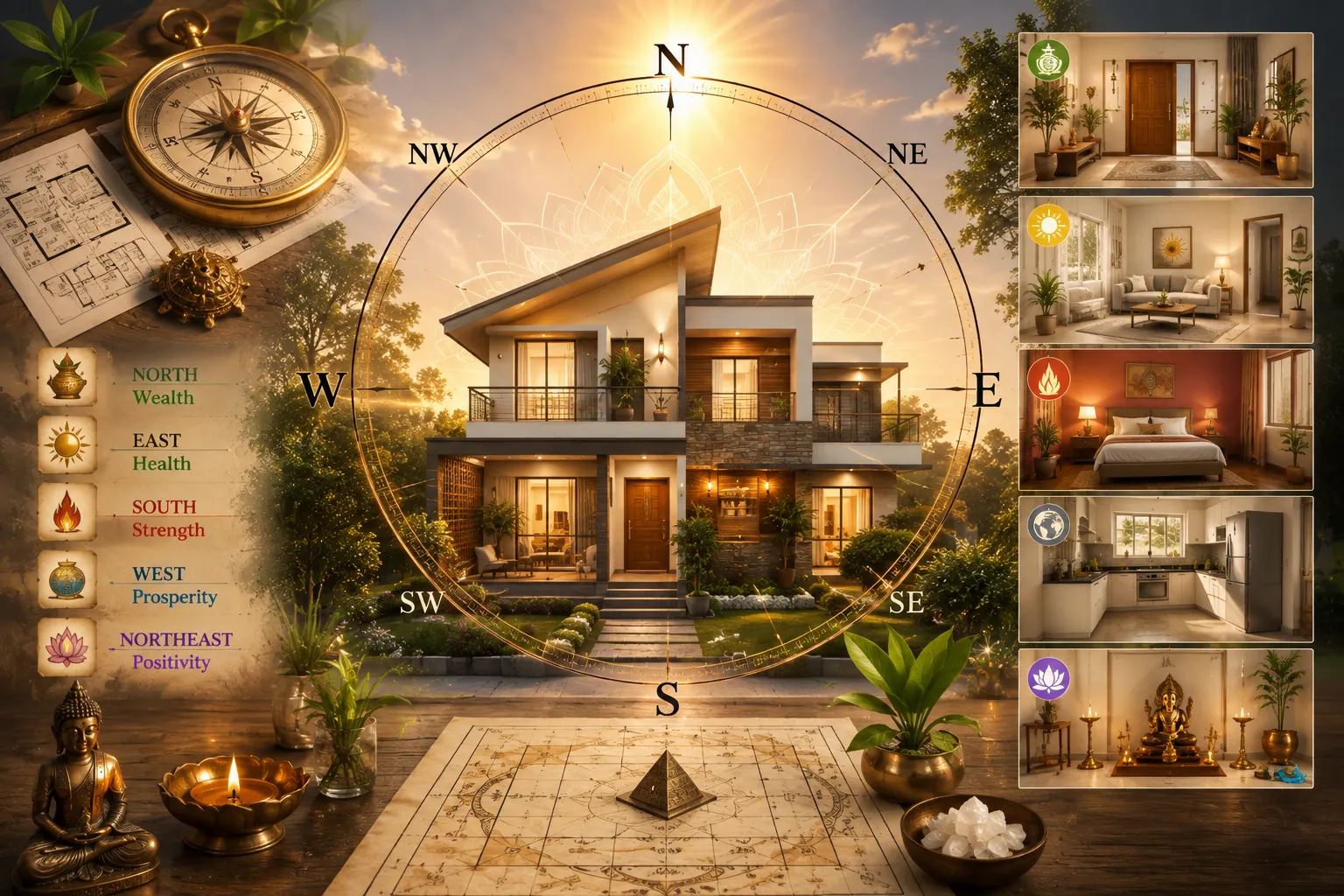
Vastu for Home Explained: Best Directions, Room Placement & Easy Fixes
Complete Vastu guide for home: directions, kitchen, bedroom, entrance & remedies. Improve energy, health & prosperity easily.