Kitchen Vastu Shastra: Ideal Kitchen Direction, Layout and Remedies
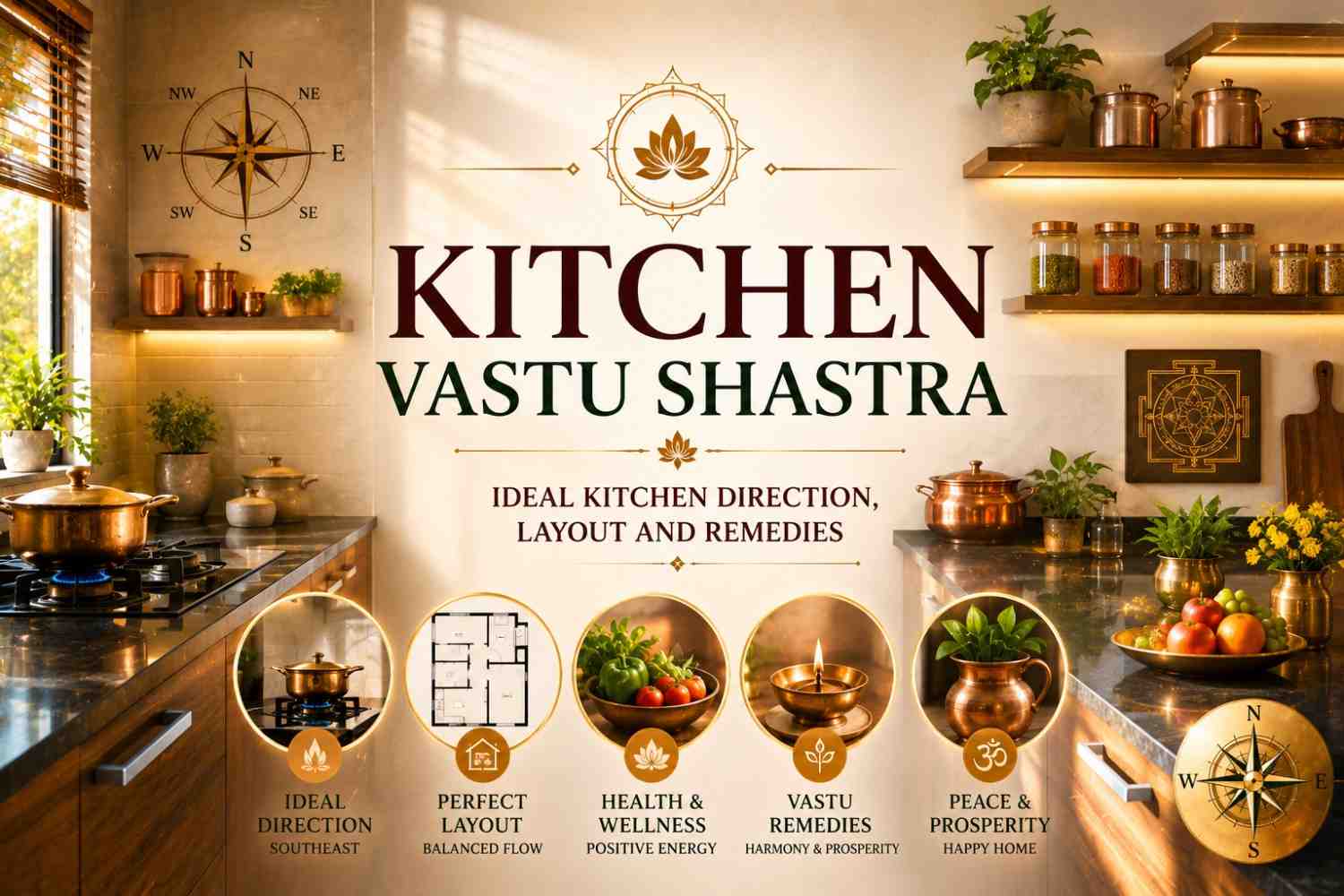
According to Vastu Shastra, the kitchen belongs in the Southeast — the fire-element zone governed by Agni. The stove should face East, water elements should sit in the Northeast, and fire and water should never directly face each other. A well-placed kitchen supports health, family harmony, and positive energy flow.
- ◦Kitchen Vastu Quick Facts
- ◦Why Southeast Is the Right Direction for Your Kitchen
- ◦The Northwest Alternative — and Why It Works
- ◦Directions That Create Vastu Problems for the Kitchen
- ◦Stove Placement and Which Way the Cook Should Face
- ◦Fire and Water in the Same Space — How to Arrange Them
- ◦Full Kitchen Arrangement — Everything Else
- ◦Common Kitchen Vastu Mistakes (and Why They Matter)
- ◦Practical Vastu Remedies for Non-Ideal Kitchens
- ◦How Kitchen Vastu Connects to Your Broader Horoscope
- ◦The Kitchen as Sacred Space
Think about what actually happens in a kitchen. Raw things become food. Hunger becomes nourishment. Disconnected ingredients become a shared meal. In classical Vastu, this isn't just practical chemistry — it's transformation, and transformation is the domain of Agni, the fire god.
That's exactly why the kitchen isn't treated casually in Vastu. It's the fire-element zone of the home, and how it's placed and arranged shapes not just what you eat, but how your household feels.
This guide covers everything the classical texts say about kitchen Vastu — where to place it, how to arrange the stove and sink, what to avoid, and what to do when your kitchen isn't in an ideal spot. Whether you're designing a new home or trying to understand the one you already live in, these principles are practical and genuinely worth knowing.
Kitchen Vastu Quick Facts
| Factor | Classical Guidance |
|---|---|
| Primary kitchen direction | Southeast (Agneya) — fire-element zone |
| Acceptable alternative | Northwest (with care) |
| Directions to avoid | Northeast (most critical), Southwest, North |
| Stove direction | Cook should face East |
| Stove placement within kitchen | Southeast corner |
| Water elements (sink, storage) | Northeast or North of the kitchen |
| Key principle | Fire and water must be separated — never directly aligned |
Why Southeast Is the Right Direction for Your Kitchen
The Southeast direction — called Agneya in Sanskrit — is the zone that classical Vastu maps to Agni, the fire god. Cooking is fire-based activity at its core (whether it's a gas flame or an electric coil, classical Vastu treats both as expressions of agni).
Placing the kitchen here means the activity and the direction are in agreement — and that harmony is exactly what Vastu is designed to create.
There's also a practical logic to it. In the Northern Hemisphere, a Southeast-facing kitchen catches morning sunlight during the hours when most households are preparing breakfast. Natural light, warmth, and air flow — these aren't incidental. They're part of why the Southeast recommendation has held up across centuries of lived experience.
If you're planning the full layout of your home, Main Door / Entrance Vastu is the natural starting point before working inward to room-by-room placement.
If you're thinking about how your home's overall layout connects to these directional principles, the Vastu Shastra Complete guide on Vedaz covers everything from plot orientation to each room's ideal zone.
The Northwest Alternative — and Why It Works
Not every home can have a Southeast kitchen. If yours can't, the Northwest direction (Vayu — the air zone) is the classical secondary option, and it's not a reluctant compromise. Air supports fire — Vayu and Agni have a natural elemental relationship.
A Northwest kitchen, arranged with the same attention to stove placement and fire-water separation, functions well in Vastu terms.
What matters in a Northwest kitchen: the stove should still be on the Eastern wall so the cook faces East. The orientation of the cook doesn't change just because the kitchen's location does.
Directions That Create Vastu Problems for the Kitchen
Northeast — The Most Important Placement to Avoid
This is the one that classical Vastu treats most seriously. The Northeast (Ishanya) is the sacred corner — the water-element zone, meant to stay light, open, and spiritually clear.
It's where puja rooms sit — see Pooja Room Vastu for how that corner should ideally be used — which is exactly why placing a kitchen here creates such direct conflict. Classical texts associate this placement with recurring health issues in the household, persistent family conflict, and disrupted spiritual life.
If your apartment or home has a Northeast kitchen and you can't change it — that's exactly what the remedies section below addresses.
Southwest — Heavy Zone, Wrong Energy for a Kitchen
The Southwest is the grounded, heavy zone — classically meant for the master bedroom, for stability and rest. A kitchen here creates a tension between the active, transformative quality of cooking and the stillness the Southwest is meant to hold. Not as severe as the Northeast problem, but still classically avoided where choice exists.
North — Better Used for Other Rooms
The North (Kubera — wealth direction) is well-suited to living rooms, dining areas, or any space where abundance and flow are the primary energy. A kitchen here isn't catastrophic, but other placements are preferred. If you have options, use North for something else.
Stove Placement and Which Way the Cook Should Face
Stove Position Within the Kitchen
The stove belongs in the Southeast corner of the kitchen — concentrating the fire element in the fire direction, within the fire-direction kitchen. This is the classical strongest arrangement: the right activity, in the right corner, in the right zone of the home.
The Cook Must Face East
This is one of the most consistent single principles in kitchen Vastu: the cook faces East while cooking. East is the direction of vitality, new beginnings, and dharmic energy.
There's also something straightforwardly sensible about it — morning light comes from the East, and most household cooking happens in the morning hours.
Practical implications:
- Southeast kitchen: place the stove in the Southeast corner; cook stands facing the Eastern wall
- Northwest kitchen: stove goes on the Eastern wall; same East-facing orientation
- When East-facing isn't possible: North-facing is the secondary option — avoid South or West facing where you have any choice at all
Fire and Water in the Same Space — How to Arrange Them
Every kitchen has both fire (stove) and water (sink) — and classical Vastu has clear guidance on how they should coexist:
- Stove (fire): Southeast corner of the kitchen
- Sink (water): Northeast or North of the kitchen — separated from the stove
- Direct stove-sink alignment (water directly across from fire): classically avoided — this is elemental opposition in the most literal sense
- Refrigerator: Northwest or Southeast of the kitchen (not interfering with the stove area)
- Drinking water and water storage: Northeast — the classical pure-water direction
- Counter space between stove and sink: the practical implementation — a gap, a working surface, something that separates the two elements
The principle isn't complicated: fire and water should not face each other. They can coexist in the same room, and they do in every kitchen — but they need space between them.
Full Kitchen Arrangement — Everything Else
Once stove and sink are properly placed, the rest of the kitchen arrangement follows a consistent logic:
- Heavy appliances (refrigerator, mixer, large equipment) → Southwest or West of the kitchen
- Lighter items (herbs, spices, small tools) → North and East
- Pantry storage → South or West
- Trash and disposal → Northwest or West — kept clean and emptied regularly (this one aligns Vastu and basic hygiene perfectly)
- Kitchen window → East or North, for light and air
- Counter materials → natural materials (stone, wood) are classically preferred over synthetic
- Kitchen colors → yellow, orange, warm earth tones; avoid dominant blue or cold tones — cooling a fire zone visually creates inconsistency with the elemental quality you're working with
Common Kitchen Vastu Mistakes (and Why They Matter)
Most Vastu problems in kitchens come down to a small set of recurring issues. Here's what to watch for:
- Kitchen in the Northeast — the most significant single placement mistake; needs substantial remediation
- Stove and sink directly aligned — fire facing water; address by repositioning if possible, or use a physical divider
- Cook facing South or West — creates directional friction during one of the most important daily activities in the household
- Toilet door directly facing the kitchen entrance — both energetically and hygienically problematic
- Kitchen and master bedroom sharing a wall, with the bed head against that wall — sleeping directly adjacent to the active fire zone is classically destabilizing; for everything on the bedroom side of this equation, Bedroom Vastu covers the full picture
- Open garbage left overnight — Vastu and hygiene fully agree here
- Sharp knives displayed openly — classically considered visually aggressive energy in the cooking space; store them away
Practical Vastu Remedies for Non-Ideal Kitchens
Not every home has an ideal kitchen placement, and classical Vastu acknowledges this — it offers remediation, not just rules.
For a Northeast kitchen (unavoidable):
- Use red or orange accents — color that invokes fire-element energy in a conflicting zone
- Keep a Hanuman or Ganesha image in the kitchen
- Practice regular offering — giving the first portion of each meal to the deity as a form of acknowledgment
- Immaculate cleanliness as ongoing practice — the most universally applicable Vastu remedy regardless of placement
If you're dealing with a Northeast kitchen and want guidance tailored to your specific layout, Atri - atri specializes in astrological remedies and can walk you through the right corrective approach for your situation.
For stove-sink alignment that can't be changed:
- Place a wooden barrier or visual divider between them
- Keep the area between stove and sink clean and dry — standing water between fire and water elements compounds the conflict
For cook facing non-East (stove can't move):
- A brief moment of conscious East-facing prayer before cooking begins — the intentionality carries its own significance in classical practice
For small apartments with limited options:
- Focus on cleanliness, organization, and regular waste removal
- These practical principles work regardless of dimensional perfection — a well-maintained kitchen with imperfect placement is better than a neglected one with ideal placement
For kitchen-bedroom wall adjacency:
- Hang a heavy decorative piece on the shared wall
- Ensure the bed head is not against this wall
The Annapurna principle: Many traditional families keep a small image of Annapurna — the goddess of food — in the kitchen. This isn't separate from Vastu; it's the recognition that cooking is sacred activity, and that treating the kitchen accordingly is itself a form of Vastu practice.
The kitchen's connection to daily health is real and worth taking seriously. Ayush - ayush can help you understand how your kitchen's Vastu connects to health patterns in your household — particularly useful if recurring health issues seem tied to home environment.
How Kitchen Vastu Connects to Your Broader Horoscope
Vastu and Vedic astrology aren't separate systems — they're complementary. The direction of your kitchen, the placement of fire and water, and the overall energy flow of your home all intersect with the planetary influences operating in your birth chart.
Understanding both together gives you a more complete picture of why certain patterns in household health and harmony persist — and what actually addresses them.
The Kitchen as Sacred Space
The kitchen is the fire-element zone of the home — where transformation happens every single day, where nourishment is created, where one of the most active forms of household energy operates.
Classical Vastu treats it with serious attention because cooking isn't a neutral activity. It involves fire, water, and the careful preparation of what will literally become the bodies and lives of the people you feed.
If you have choice in kitchen placement, Southeast is the classical preference. If your kitchen is already placed, work with what's within it: stove and sink separated, cook facing East, fire elements together in the Southeast corner, water elements in the North or Northeast.
And beyond all the specific placements — clean immaculately, organize intentionally, cook with awareness. The classical recognition of the kitchen as Agneya — the fire god's domain — is the recognition that cooking is, at its deepest level, sacred activity. That awareness is the foundation beneath all the specific principles.
Niharika Venkataraman
Home Vastu, Kitchen Planning & Interior Layouts | 11+ Years
Niharika Venkataraman is a Vastu researcher specializing in kitchen design, home planning, and harmonious living spaces. She combines traditional Vastu principles with practical insights for modern households.
Frequently Asked Questions
1. Which direction should the kitchen be in according to Vastu?
The classical primary kitchen direction is Southeast (Agneya) — the fire-element zone of Agni, the fire god. Cooking is fire-based, so placing it in the fire direction aligns the activity with classical pattern. The acceptable secondary alternative is Northwest. Avoid Northeast (sacred water zone — most strongly avoided), Southwest (master bedroom zone), and North (better suited to living or dining areas).
2. Which direction should the cook face while cooking?
Classical Vastu specifies that the cook should face East while cooking. East is the direction of vitality, beginnings, and dharmic energy. Where East-facing is impossible due to building constraints, North-facing is the secondary option. Avoid South or West facing where possible.
3. Why is a Northeast kitchen considered the worst Vastu placement?
The Northeast (Ishanya) is the most sacred direction and water-element zone — meant to remain light, open, and spiritually clear. Placing a kitchen (fire-element activity) here creates the most directly opposing elemental conflict possible. Classical tradition associates it with health issues, family conflict, and disrupted spiritual life.
4. How should fire and water be arranged in the kitchen?
The stove (fire) goes in the Southeast of the kitchen; the sink (water) goes in the Northeast or North, separated from the stove. Direct alignment of stove and sink is avoided. A gap of counter space between the two elements is the practical implementation. Drinking water storage belongs in the Northeast — the classical pure-water direction.
5. What kitchen Vastu mistakes should I avoid?
The major ones: kitchen in the Northeast, stove and sink directly aligned, cook facing South or West, toilet door facing the kitchen entrance, kitchen-bedroom shared wall with bed head against it, open garbage left overnight, and sharp knives openly displayed. The first three are the most universally addressed in classical texts.
6. What remedies work for a Northeast kitchen that can't be relocated?
Red or orange color accents to invoke fire-element energy; Hanuman or Ganesha image in the kitchen; offering the first portion of food to the deity; immaculate cleanliness as ongoing practice; and an image of Annapurna honoring the kitchen's sacred dimension. Consistent remediation is meaningfully better than no attention to the configuration at all.
Related Blogs

Feng Shui Chinese Art of Finding Love
Simple, down-to-earth Feng Shui love hacks to help you shift your space, clear emotional blocks, and invite real, meaningful love into your life.

Effortless Feng Shui Tips to Boost Romance
Unlock the magic of love with astrology-backed rituals to attract your soulmate using candles, moon phases, and vision boards.

Why Every Home Needs Vastu Shanti?
Find out the 10 strong Vastu Shanti advantages that can make your house more energy level, eliminate the negativity, and bring abundance, bliss and well-being.
Vastu for Home Explained: Best Directions, Room Placement & Easy Fixes
Complete Vastu guide for home: directions, kitchen, bedroom, entrance & remedies. Improve energy, health & prosperity easily.