Shop Vastu Guide: Best Directions, Cash Counter Placement and Business Growth

In commercial Vastu, the shop entrance should face North, East, or Northeast. The owner's seat belongs in the South or Southwest, facing North or East. The cash counter should be positioned so the cashier faces North — the direction of Kubera, the deity of wealth.
- ◦Commercial Vastu Quick Facts
- ◦How Commercial Vastu Differs From Residential Vastu
- ◦Shop Entrance Vastu: The Direction That Determines Whether Customers Come In
- ◦Owner's Seat and Cash Counter Placement in a Shop
- ◦Storage and Inventory Placement in a Shop
- ◦Customer Flow and Display: How Vastu Thinks About Retail Experience
- ◦Vastu Guidelines by Business Type
- ◦Auspicious Imagery and Decor for Commercial Spaces
- ◦Practical Remedies for Non-Ideal Commercial Spaces
- ◦An Honest Note on Commercial Vastu
- ◦Final Thought
Ever walked into a shop and just felt like buying something — even before you saw the products properly? Or walked into another one and felt oddly restless, like you wanted to leave quickly? A lot of that comes down to layout, light, and flow. And classical Vastu has been saying exactly this for centuries.
Commercial Vastu isn't about hanging a few yantras and hoping for the best. It's a systematic way of thinking about business space — where the entrance sits, where the owner commands authority, where money is handled, and how customers naturally move through the space.
Get these things right, and the space works with your business instead of against it.
This guide covers the full picture — shop entrance direction, owner's seat, cash counter placement, storage, customer flow, business-type specifics, and honest remedies for the very common situation of rented or existing commercial spaces where you can't change the structure.
Commercial Vastu Quick Facts
| Factor | Classical Guideline |
|---|---|
| Best entrance directions | North, East, Northeast |
| Avoid for entrance | South, Southwest, Southeast |
| Owner's seat | South or Southwest of the shop, facing North or East |
| Cash counter | Cashier faces North; drawer opens toward North |
| Storage placement | Southwest or South (heavy goods in heavy zones) |
| Light inventory/display | Northeast, East, or North |
| Customer flow | Entrance → interior; not directly past cash counter |
| Key principle | Directional alignment supports commercial activity, not just home harmony |
How Commercial Vastu Differs From Residential Vastu
Same principles, different priorities. That's the key thing to understand here.
In a home, you want privacy, rest, and family harmony. In a business, you want footfall, sales, and active commercial energy. So some things that Vastu recommends for a bedroom are exactly the wrong approach for a shop floor.
Here's how the priorities shift:
- Entrances — residential Vastu favors some privacy; commercial Vastu wants the entrance wide open, welcoming, and easy to enter
- Active vs restful energy — the heaviness ideal for a master bedroom has no place on a shop floor; you want movement, engagement, forward momentum
- The North (Kubera direction) — in residential Vastu it's one of several important directions; in commercial Vastu, it becomes arguably the most important of all
- Cash flow — an entirely commercial focus; the placement of where money is handled becomes a specific Vastu consideration
- Display and inventory — how goods are visible and arranged has its own spatial logic in commercial Vastu
- Welcome over protection — a home keeps the world somewhat at bay; a shop invites the world in
Understanding this shift is what makes commercial Vastu genuinely useful rather than just a copy-paste of home principles.
Shop Entrance Vastu: The Direction That Determines Whether Customers Come In
If there's one element to get right in any commercial space, it's the entrance. Everything else can be adjusted — but the entrance direction shapes the fundamental energy of customer flow.
Most auspicious entrance directions:
- North — the direction of Kubera, the god of wealth; the most classically commercial direction of all; strongly recommended for any business where prosperity is the primary goal
- East — the direction of Indra and the rising Sun; vitality, beginnings, customer attraction; excellent for businesses built on service, dharma, and daily engagement
- Northeast — combines the Kubera and Sun qualities; particularly powerful for businesses where both commercial success and reputation matter
Acceptable:
- West — the direction of Varuna (gains); workable, particularly for established businesses with returning customers
Generally avoid:
- South — the Yama direction; classical tradition associates this with difficulty in drawing new customers
- Southwest — the heavy, grounded zone; not suited for an entrance meant to invite movement and flow; also covered in Main Door / Entrance Vastu for residential context, and the same logic applies commercially
- Southeast — fire zone; can produce friction and conflict energy at the threshold
Practical entrance checklist:
- Wide, clear, well-lit — both Vastu and common retail sense
- No pillars, trees, or obstructions directly in front
- Steps up to entrance in odd numbers (3, 5, 7) — classically preferred
- Business name signage clearly visible
- Ganesha image or toran above the entrance — traditional and auspicious
- No clutter at the threshold — ever
Owner's Seat and Cash Counter Placement in a Shop
Where Should the Owner Sit?
This matters more than most business owners realize. The seat's position is the seat of authority — it should feel and function like one.
- South or Southwest of the shop — the heavy, grounded zones; authority and stability come from sitting in the weightier part of the space
- Facing North or East while working — forward-moving, prosperity-aligned directions
- Solid wall behind the seat — structural support; no open space or window directly behind
- Visible sightline to the main entrance — the owner should be able to see who enters without sitting directly in the path of the door
- Slightly elevated if possible — even a small platform distinction signals authority
- Clearly distinct from customer and employee seating — this isn't about arrogance; it's about spatial clarity
Cash Counter and Money Handling — Get This Right
In commercial Vastu, the cash counter is the pulse point of the business. Its placement is taken very seriously.
- Cashier faces North while handling money — the Kubera direction, most classical for wealth activity
- Cash drawer opens toward the North — a small but significant detail
- Placement in the Northeast or North of the shop where the layout allows
- Lakshmi or Kubera image near the cash counter — traditional, auspicious, widely practiced
- Lord Ganesha image at or near the cash counter — remover of obstacles in financial flow
- Cash counter should not face the entrance directly — customers walking in shouldn't see the cash drawer opening
- Immaculate cleanliness at the cash area — classical tradition is explicit that disorder at the money-handling location attracts financial difficulty; this is one principle that needs no convincing once you've seen a cluttered cash counter in a struggling shop
Storage and Inventory Placement in a Shop
Where you keep your stock matters — and the logic is the same as in home Vastu: heavy things belong in heavy zones.
- Heavy inventory, bulk storage — South or Southwest of the shop
- Light inventory, display items, frequently accessed goods — Northeast, East, or North
- Empty space in the Northeast and center (Brahmasthan) — keep this open where possible; it allows energy to circulate through the space
- Damaged or broken inventory — remove it promptly; don't let it sit; a shop with broken goods on the shelf sends a signal nobody wants to send
- Old or unsold inventory — periodic clearance is both a Vastu principle and a practical commerce principle; stagnant stock creates stagnant energy
Customer Flow and Display: How Vastu Thinks About Retail Experience
Good commercial Vastu and good retail design arrive at remarkably similar conclusions.
- Customer flow should move from the entrance toward the interior — not directly past the cash counter on entry
- Primary items visible from entrance — but not so immediate that customers feel they've seen everything before stepping inside
- Mirrors — classical commercial Vastu uses them strategically to "double" the visual sense of inventory and to reflect Kubera-direction energy back into the space; avoid mirrors directly facing the entrance (they reflect customers back out)
- Aisles wide enough for comfortable movement — cramped aisles inhibit both physical and energetic flow
- Lighting that highlights inventory — not glaring in customers' eyes; the product should be lit, not the customer
Vastu Guidelines by Business Type
Retail Shops
Apply the general commercial Vastu above. Display inventory in the East-North quadrant for maximum visibility and sales energy; keep bulk storage in the South-West.
For business astrology insights on how your personal chart interacts with your chosen trade, that's a separate but complementary layer of analysis.
Restaurants and Food Businesses
- Kitchen follows Kitchen Vastu principles — Southeast for cooking, cook facing East
- Dining area in favorable directions for customer comfort and experience
- Lord Annapurna imagery (goddess of food) alongside Ganesha and Lakshmi is classically appropriate
- Cash counter principles apply exactly as above
Offices (No Direct Customer Footfall)
- Owner's cabin in the South or Southwest of the floor, facing North or East
- Meeting rooms in the Northwest — supports productive, decision-oriented discussion
- Reception in the Northeast or East — welcoming, forward energy at the first point of visitor contact
- For detailed desk and workspace principles, the study and office Vastu guide covers this in full
Factories and Production Facilities
- Heavy machinery and production — Southwest
- Lighter assembly, packing, finishing — Northeast and East
- Management offices — South of the facility
- Raw material storage — Southwest; finished goods — Northwest
- Loading and shipping — West or Northwest
Service Businesses (Clinics, Salons, Consulting)
- Reception in the Northeast or East — first impression, welcoming energy
- Treatment and consultation rooms follow principles similar to Bedroom Vastu for individual rooms — head of chair/table toward South or East, solid wall behind the service provider
- Owner's office in the South or Southwest
Auspicious Imagery and Decor for Commercial Spaces
This isn't superstition — it's intentional visual design that reinforces the purpose of the space.
- Goddess Lakshmi — central deity for commercial Vastu; image near cash counter or in the North
- Lord Kubera — the treasury deity; image in the North of the shop
- Lord Ganesha — remover of obstacles; image near the entrance
- Sri Yantra — considered the most powerful prosperity yantra; appropriate in the North
- Kuber Yantra — specifically for wealth energy
- Auspicious symbols — Om, Swastik (the authentic Indian auspicious symbol), Shri
- Fresh flowers, incense, daily lamp lighting before opening — creates the daily ritual that maintains the space's conscious energy
What to avoid:
- Images of suffering, struggle, or aggression in customer-facing areas
- Cluttered, dusty, or neglected decoration — simple and clean always beats elaborate and unmaintained
Practical Remedies for Non-Ideal Commercial Spaces
Most rented shops and mall units can't be structurally changed. Here's what actually helps:
- Non-ideal entrance direction: Lakshmi-Ganesha images at the entrance; daily lamp lighting at opening; kolam or rangoli at the threshold
- Cash counter can't face North: Place a Lakshmi image facing North even if the cashier cannot; install a Kuber Yantra in the North section of the shop
- Cluttered or constrained layout: Rigorous daily organization; periodic clearance of unsold goods; conscious effort to keep the Northeast and center as open as possible
- Struggling business with Vastu concerns: Combine Vastu adjustments with genuine business analysis — the Vastu may be one factor among several
For businesses dealing with persistent commercial challenges and wondering whether Vastu adjustments alone are sufficient, Vyapar - vyapar — Vedaz's AI astrologer specializing in business growth — can help identify what's actually blocking progress, whether Vastu-related or otherwise.
Regular practice matters too: Vastu Shanti ceremony at the start of a business; fresh flowers, lamp lighting, and intentional opening rituals daily. These aren't one-time fixes — they're the ongoing practice that keeps commercial Vastu alive.
An Honest Note on Commercial Vastu
This needs to be said clearly.
Commercial Vastu has genuine value when applied thoughtfully. Many of its principles — customer flow, entrance openness, visual merchandising, spatial organization — align exactly with what modern retail design has independently concluded.
But it's also one of the most overclaimed disciplines in modern India. If a consultant is:
- Promising specific revenue increases
- Recommending expensive structural demolition as the only solution
- Using fear-based language about Vastu doshas causing business failure
...treat that with real skepticism.
The honest application treats Vastu as one factor among many in business success — alongside product quality, customer service, pricing, location, marketing, and the fundamental quality of what you're offering.
Understanding your own strengths and tendencies as a business owner is part of this picture too — and reading your birth chart alongside your commercial space's Vastu can reveal patterns about your natural commercial timing and direction.
For businesses where the Vastu can't be substantially changed: focus on what's achievable — cash counter direction, daily practices, cleanliness, auspicious imagery. And recognize that a clean, organized, intentionally-cared-for space always functions better than a neglected one, regardless of which direction it faces.
Final Thought
Commercial Vastu works best when you understand what it actually is — conscious spatial design that supports business activity, not a magical guarantee of revenue.
If you're designing a new business space from scratch, integrate Vastu during the design phase. Entrance direction, owner's seat, cash counter, storage zones — these are far easier to optimize when walls haven't been built yet than when you're retrofitting afterward.
If you're working with an existing space — which most people are — focus on what's genuinely achievable — cash counter direction, daily opening rituals, cleanliness and auspicious imagery. Keep the Northeast open and light and keep the entrance welcoming. These things matter and they're within reach for almost any commercial space.
The Vastu Shastra Complete tradition was never about perfection — it was about conscious engagement with the spaces where important activity happens. A clean, organized, intentionally-cared-for shop is a better business environment than a structurally perfect one that nobody maintains.
Combine Vastu awareness with good business fundamentals, and the practice does exactly what it was designed to do: create a space that supports the work happening within it.
Frequently Asked Questions
1. What direction should a shop entrance face?
North, East, or Northeast are the most auspicious entrance directions. North is the Kubera direction — most classically commercial. East brings vitality and customer attraction. Northeast combines both. West is acceptable for established businesses. Avoid South (Yama direction), Southwest (heavy zone), and Southeast (fire zone). The entrance should face the busiest street or foot traffic wherever possible.
2. Where should the cash counter be in a shop?
In the Northeast or North of the shop, with the cashier facing North while handling money. The cash drawer or safe should open toward the North. Place a Lakshmi or Kubera image nearby. Keep it spotlessly clean. The counter should not face the entrance directly — customers walking in shouldn't see the cash drawer being opened.
3. Where should the owner sit in their shop or office?
South or Southwest of the space, facing North or East. Solid wall behind the seat, clear sightline to the entrance, slightly elevated if possible. The seat of authority should look and feel authoritative — distinct from customer and employee positions.
4. How is commercial Vastu different from residential Vastu?
Same foundational principles, different priorities. Commercial Vastu emphasizes welcoming entrances over private ones, active energy over restful energy, the Kubera/North direction above all others, cash flow placement, and customer engagement over family harmony. Where home Vastu protects, commercial Vastu invites.
5. What images and decor support commercial Vastu?
Lakshmi near the cash counter or North; Kubera image in the North; Ganesha at the entrance; Sri Yantra and Kuber Yantra in the prosperity zone; Om and Swastik symbols; fresh flowers changed regularly; daily lamp lighting before opening. Keep it clean and maintained — simple and clean always beats elaborate and neglected.
6. Will following Vastu guarantee business success?
No — and anyone claiming it will should be approached with skepticism. Vastu is one factor among many. Product quality, service, pricing, marketing, and genuine customer value all matter more than directional alignment. What Vastu offers is conscious spatial design that supports the business activity — it removes friction and creates a space that works with you. The rest is up to you and your business fundamentals.
Related Blogs

Feng Shui Chinese Art of Finding Love
Simple, down-to-earth Feng Shui love hacks to help you shift your space, clear emotional blocks, and invite real, meaningful love into your life.

Effortless Feng Shui Tips to Boost Romance
Unlock the magic of love with astrology-backed rituals to attract your soulmate using candles, moon phases, and vision boards.

Why Every Home Needs Vastu Shanti?
Find out the 10 strong Vastu Shanti advantages that can make your house more energy level, eliminate the negativity, and bring abundance, bliss and well-being.
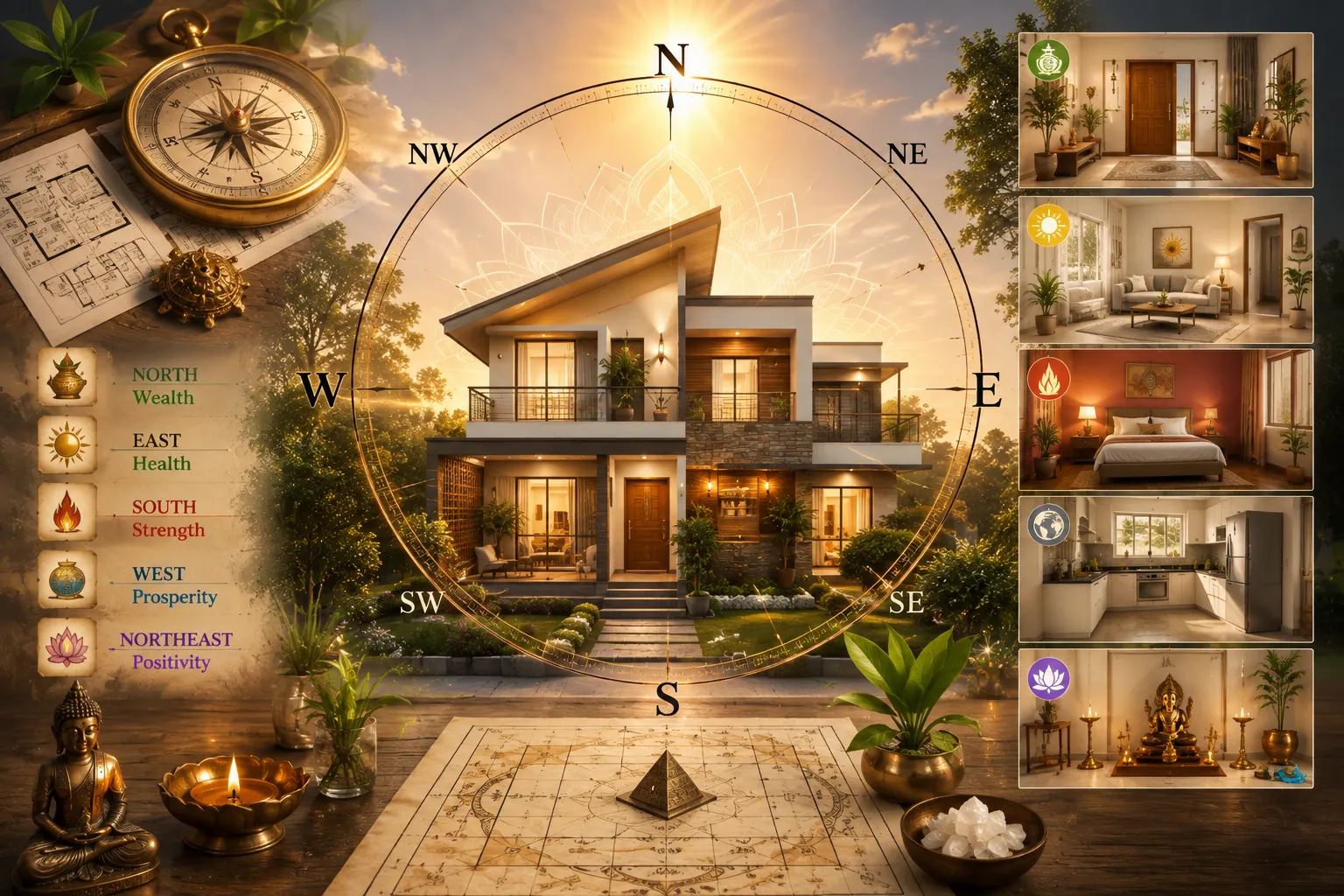
Vastu for Home Explained: Best Directions, Room Placement & Easy Fixes
Complete Vastu guide for home: directions, kitchen, bedroom, entrance & remedies. Improve energy, health & prosperity easily.