Surya Grahan and Chandra Grahan Dosha: Signs, Causes & Solutions
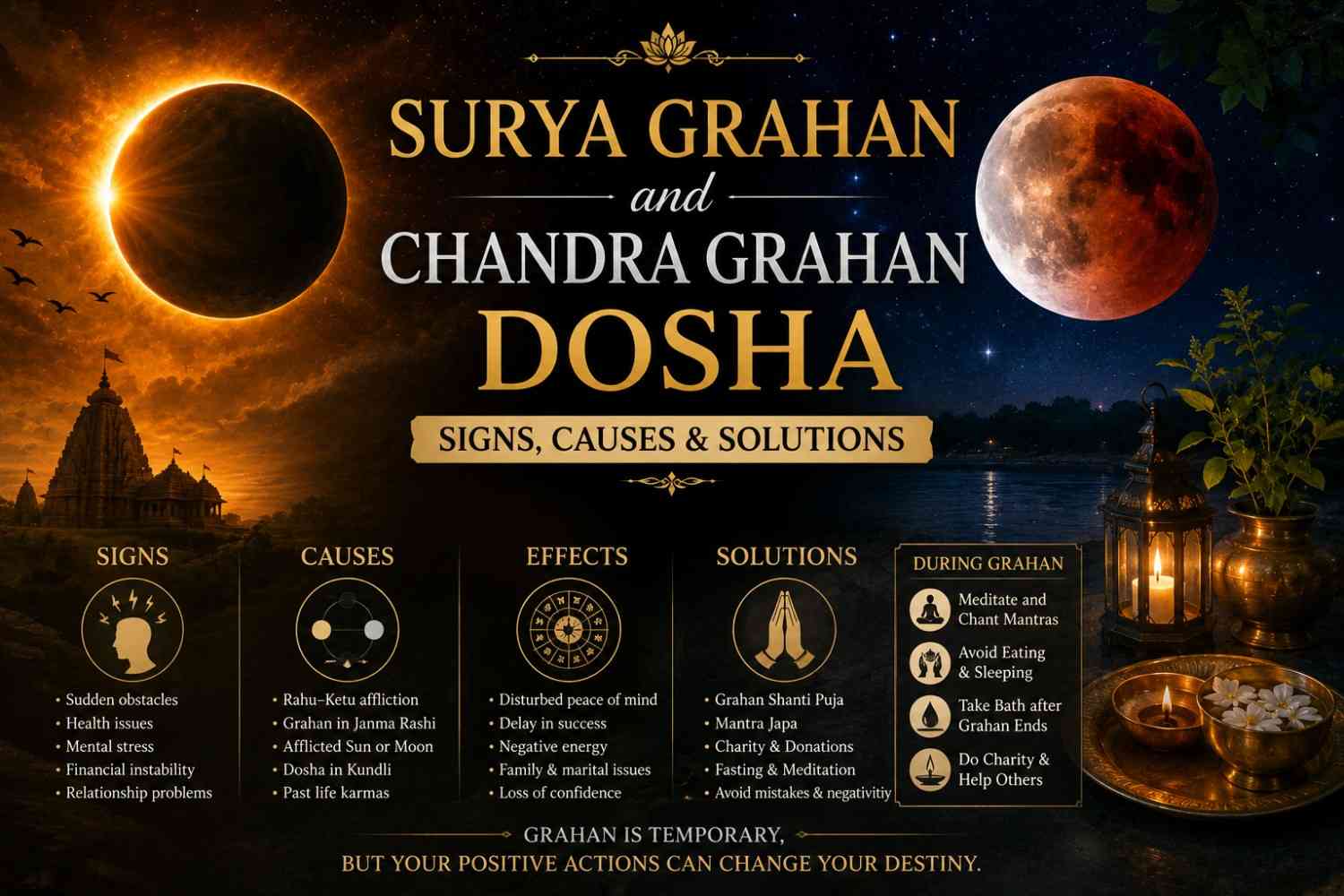
Grahan Dosha forms when the Sun or Moon conjuncts Rahu or Ketu in the natal chart. Named after the Sanskrit word for eclipse, it "obscures" the affected luminary's natural qualities. Severity varies significantly with degree-distance — a tight conjunction within 1-3° is far more intense than a wide one at 8°+.
- ◦What It Means to Have an Eclipse in Your Birth Chart
- ◦The Mythology Behind the Name — Why "Eclipse"?
- ◦Surya Grahan Dosha — When the Sun Meets a Node
- ◦Chandra Grahan Dosha — When the Moon Meets a Node
- ◦What Actually Determines How Severe Grahan Dosha Is
- ◦Classical Remedies for Grahan Dosha
- ◦Grahan Dosha in the Broader Chart Picture
- ◦Important Cautions — What to Know Before Worrying
- ◦Final Thought
What It Means to Have an Eclipse in Your Birth Chart
Most people know what an eclipse looks like from the outside — the sky darkens, the sun or moon disappears, and for a few minutes everything feels slightly otherworldly. But what does it mean when that eclipse energy is frozen into your natal chart from the moment you were born?
That's essentially what Grahan Dosha is. The Sun or Moon — the two most personal planets in your chart, the ones that govern your soul, your mind, your sense of self — sitting right next to Rahu or Ketu, the shadow planets that cause eclipses.
The luminary's light isn't gone. But it's complicated. It's filtered through a nodal lens that makes it express in ways that are less straightforward than usual.
The honest thing to say upfront is this: Grahan Dosha is real and worth understanding — but it's not a catastrophe. Every nodal configuration has a shadow side and a constructive side. This guide covers both, honestly.
Quick Answers: Grahan Dosha at a Glance
- What it is: Sun or Moon conjunct Rahu or Ketu in the natal chart
- Surya Grahan Dosha: Sun conjunct node — affects vitality, father, authority, self
- Chandra Grahan Dosha: Moon conjunct node — affects mind, emotions, mother
- Eclipse connection: Named for eclipses, which occur at exact Sun/Moon-node alignments
- Is it permanent? Yes — a natal feature present from birth
- How severe? Degree-distance is the biggest factor — tight conjunctions are much stronger
- Most active periods: Sun, Moon, Rahu, Ketu mahadashas and antardashas; eclipse transits
The Mythology Behind the Name — Why "Eclipse"?
In Vedic mythology, Rahu and Ketu are the severed head and body of a demon called Svarbhanu. The story goes that he disguised himself among the gods to drink the nectar of immortality — and was cut in two by Lord Vishnu's Sudarshana Chakra before he could swallow it. The head became Rahu; the body became Ketu. And ever since, they periodically take revenge by "swallowing" the Sun and Moon — which is the mythological explanation for eclipses.
This mythology isn't just a story. It explains exactly what Grahan Dosha means in practice. When the Sun or Moon sits conjunct a node in your birth chart, the luminary's natural light is partially obscured — its qualities are complicated, filtered, or distorted by the nodal energy. The closer the conjunction in degrees, the stronger that obscuring effect.
The Sun represents soul, vitality, father, authority, and self-expression. The Moon represents mind, emotions, mother, and inner experience. When either gets eclipsed by a node, the significations of that planet become the ones that require the most conscious work in the native's life.
Surya Grahan Dosha — When the Sun Meets a Node
Surya Grahan Dosha forms when the Sun conjuncts Rahu or Ketu in the natal chart. The solar significations — vitality, father, authority, self, career recognition — are where the eclipse energy plays out.
Sun conjunct Rahu tends to produce:
- Father-relationship complications — distance, complexity, or an unconventional relationship with paternal figures
- Authority and recognition through unconventional paths — success often comes, but rarely through the expected route
- Ego and identity themes that need conscious attention — the sense of self can be amplified in unusual directions by Rahu
- Non-linear career advancement — boundary-crossing rather than conventional ladder-climbing
- Possible health considerations around vitality, heart, or eyes — areas Sun governs
- Constructive expression: unconventional leadership, foreign or cross-cultural success, pioneer capacity
Sun conjunct Ketu tends to produce:
- Detachment from conventional authority and recognition — the native may not chase status the way others do
- Father-relationship themes involving spiritual distance or an otherworldly quality to the paternal connection
- Periods of identity questioning and self-uncertainty — Ketu dissolves where Rahu amplifies
- A natural pull toward spiritual or research-oriented career paths
- Constructive expression: spiritual depth, research capacity, freedom from ego-driven striving
Checking your birth chart for the exact degree of Sun and node conjunction is essential — a 2° conjunction and a 14° conjunction are very different situations, even though both technically qualify as Grahan Dosha.
Chandra Grahan Dosha — When the Moon Meets a Node
Chandra Grahan Dosha forms when the Moon conjuncts Rahu or Ketu. Since the Moon governs the mind and emotional life, this variant tends to be felt more personally and more daily than the Surya version.
Moon conjunct Rahu tends to produce:
- Emotional intensity and mental restlessness — the mind runs fast, sometimes too fast
- Mother-relationship complications — the maternal bond may be complex, intense, or unconventional
- Anxiety patterns or emotional turbulence that benefit enormously from conscious management practices
- A vivid imagination and unconventional emotional patterns — feelings that don't fit neatly into social expectations
- Possible mental health considerations that genuinely benefit from professional support alongside spiritual practice
- Constructive expression: powerful intuition, psychic sensitivity, emotional depth that others can't access
Moon conjunct Ketu tends to produce:
- Emotional detachment and periods of withdrawal — the inner world feels safer than the outer one
- Mother-relationship themes involving distance, spiritual connection, or emotional unavailability
- A strong pull toward introspection and inner-world focus — meditation comes naturally
- Possible difficulty with emotional expression and intimacy — feelings are present but hard to articulate
- Constructive expression: meditative capacity, spiritual sensitivity, emotional independence
It's worth saying clearly: if Chandra Grahan Dosha is producing genuine emotional or mental health difficulties, please seek professional support alongside any spiritual remedies. Astrology supplements — it doesn't replace — mental health care.
For navigating the emotional intensity that Chandra Grahan can bring, Chandra - chandra at Vedaz specializes in emotional intelligence and can offer grounded guidance on working with these patterns consciously.
What Actually Determines How Severe Grahan Dosha Is
This is the most practically important section. Grahan Dosha severity is not fixed — it moves significantly based on supporting factors.
What reduces severity:
- Wide degree-distance — 8°+ between the luminary and node is considerably milder than 1-3°. This single factor matters more than almost anything else
- The luminary strong by sign — Sun in Leo or Aries, Moon in Taurus or Cancer; a strong luminary holds its ground against nodal influence better
- Benefic aspects from Jupiter or Venus to the conjunction — these aspects substantially stabilize the eclipsed luminary
- The conjunction in upachaya houses — 3rd, 6th, 10th, 11th placements produce more constructive outcomes
- Strong overall chart with powerful Raja Yogas elsewhere providing counterbalancing positive energy
What amplifies severity:
- Very tight degree-distance — within 1-3° is where Grahan Dosha produces its strongest effects. This is the situation that deserves serious attention
- The luminary weak by sign — Sun in Libra (debilitation), Moon in Scorpio (debilitation) compounding the nodal affliction
- The conjunction in difficult houses — 1st, 4th, 8th, or 12th house placement intensifies the effect
- No benefic aspects to the conjunction at all — the eclipse energy runs without any moderating influence
- Active Sun, Moon, Rahu, or Ketu mahadasha — these dasha periods are when Grahan Dosha themes activate most visibly
Just as Kaal Sarp Dosha severity depends heavily on which planets provide counterbalancing support in the chart, Grahan Dosha follows the same principle — the configuration alone doesn't tell the full story.
Classical Remedies for Grahan Dosha
Remedies split naturally into three streams — Surya-specific, Chandra-specific, and general nodal practices. Work with whichever stream applies to your chart, plus the general practices.
For Surya Grahan Dosha (Sun affected):
- Chant Sun mantra "Om Suryaya Namah" 108 times on Sundays
- Recite Aditya Hridaya Stotram daily — one of the most powerful classical Sun-strengthening practices
- Offer water (Arghya) to the rising sun every morning — simple, consistent, genuinely effective
- Practice Surya Namaskar as a daily physical and devotional practice
- Honor and serve your father and paternal figures consciously — the relationship work itself is part of the remedy
- Donate wheat, jaggery, copper, or red items on Sundays
For Chandra Grahan Dosha (Moon affected):
- Chant Moon mantra "Om Chandraya Namah" 108 times on Mondays
- Worship Lord Shiva on Mondays — the classical Moon-strengthening practice
- Honor and serve your mother and maternal figures consciously
- Donate white items — milk, rice, sugar, silver — on Mondays
- Spend time near water regularly — rivers, lakes, the sea; Moon energy responds to water
- Maintain emotional regulation practices and seek professional support if mental health concerns are present
General Grahan Dosha remedies for both forms:
- Recite Hanuman Chalisa daily — Hanuman is the primary protective deity for nodal afflictions
- Recite Mahamrityunjaya Mantra regularly for protection and vitality
- Worship Lord Shiva consistently — the deity who governs nodal energy in the classical framework
- Chant Rahu or Ketu mantra on Saturdays as applicable to which node is involved
- During solar and lunar eclipses: maintain mantra practice, fast where appropriate, and avoid beginning major new ventures during the eclipse window
- Donate to causes supporting the disabled or marginalized
- For severe Grahan Dosha: Grahan Dosha Nivaran Pooja at recognized temples
- Maintain ethical conduct — nodal karma responds meaningfully to integrity in daily life
For a structured remedy approach tailored to your specific Grahan Dosha type and chart placement, Atri - atri at Vedaz specializes in astrological remedies and can guide you through the right practice sequence based on your chart.
Grahan Dosha in the Broader Chart Picture
Grahan Dosha rarely sits alone in a chart. When Pitra Dosha indicators are also present — particularly Sun afflicted by Rahu or Ketu in the 9th house — the two configurations overlap directly. In that case,
Surya Grahan Dosha and Pitra Dosha are essentially describing the same planetary configuration from two different analytical frameworks, and the remedy approach needs to address both layers together.
Similarly, when the Nadi Dosha assessment is being done in marriage compatibility and one partner has Chandra Grahan Dosha, experienced astrologers factor the Moon's nodal affliction into how they read the emotional compatibility picture — because the Moon's expression in daily married life is directly affected.
And when evaluating the full dosha picture alongside Manglik Dosha Deep patterns, the combined Sun or Moon affliction with Mars affliction creates a chart that genuinely needs comprehensive, integrated reading rather than single-factor assessment.
Important Cautions — What to Know Before Worrying
- Degree-distance is the single most important factor — always check the actual degrees before concluding severity. A 12° conjunction is very different from a 2° conjunction
- Every nodal configuration has constructive expressions — unconventional leadership, spiritual depth, powerful intuition, research capacity. These are real and should be acknowledged alongside the challenges
- Chandra Grahan Dosha with mental health themes needs professional support — astrology supplements but does not replace mental health care
- The dosha cannot be eliminated — the natal placement is permanent. Remedies strengthen the affected luminary and channel the nodal energy constructively
- Severity assessment requires actual chart reading measuring degree-distance and evaluating all supporting factors
- Be skeptical of expensive "Grahan Dosha removal" packages — sustained simple daily practice produces better results than expensive one-time interventions every time
Final Thought
Having Grahan Dosha in your chart doesn't mean you're living under a permanent eclipse. It means the Sun or Moon — the two most personal planets in Vedic astrology — is expressing through a nodal filter that makes it more complex, more unconventional, and yes, sometimes more difficult than it would otherwise be.
But here's the other side of that: the eclipse also creates depth. The Sun filtered through Rahu produces leaders who see what conventional minds miss. The Moon filtered through Ketu produces meditators and mystics who access inner spaces most people never find. The configuration isn't just a problem — it's a particular quality of light.
The work is to strengthen the affected luminary through consistent, sustained practice — Sun practices for Surya Grahan, Moon practices for Chandra Grahan — and to consciously channel the nodal energy toward its constructive expressions rather than its difficult ones.
The eclipse in your chart is not permanent darkness. It is an invitation to cultivate a different, deeper kind of light.
Raghavendra Kulkarni
Planetary Influences, Karma & Vedic Astrology | 18+ Years
Raghavendra Kulkarni is a Jyotish practitioner and researcher known for his work on planetary combinations, karmic patterns, and astrological remedies. His articles emphasize thoughtful interpretation over superstition, helping readers understand astrology with clarity and context.
Frequently Asked Questions
1. What is Grahan Dosha?
Grahan Dosha is a Vedic astrological configuration formed when the Sun or Moon conjuncts Rahu or Ketu in the natal chart. "Grahan" means eclipse in Sanskrit — and just as eclipses occur when the Sun or Moon aligns with the lunar nodes in the sky, this dosha represents the same eclipse energy frozen into the birth chart. The luminary's natural qualities are partially obscured or complicated by nodal influence, with intensity depending heavily on degree-distance.
2. What is the difference between Surya and Chandra Grahan Dosha?
Surya Grahan Dosha forms when the Sun conjuncts Rahu or Ketu — affecting vitality, father, authority, self-expression, and career. Chandra Grahan Dosha forms when the Moon conjuncts Rahu or Ketu — affecting mind, emotions, mother, inner experience, and mental wellbeing. Each has different effects and somewhat different remedies, though both share the general nodal remedy practices.
3. How serious is Grahan Dosha?
Severity depends more on degree-distance than on the configuration itself. A tight conjunction within 1-3° produces strong effects; a wide conjunction at 8°+ is considerably milder. Sign strength of the luminary, benefic aspects, and house placement also modify the experience significantly. Like all nodal configurations, Grahan Dosha carries constructive expressions — unconventional leadership, spiritual depth, powerful intuition — alongside its challenges.
4. Does Grahan Dosha affect mental health?
Chandra Grahan Dosha — particularly Moon conjunct Rahu in a tight conjunction — can be associated with emotional intensity, anxiety patterns, or mental restlessness. If mental health concerns are present, they should be addressed with professional support alongside spiritual remedies. Astrology supplements but does not replace mental health care. Many natives with Chandra Grahan Dosha also carry powerful intuition and emotional depth as genuine gifts of the configuration.
5. What are the best remedies for Grahan Dosha?
For Surya Grahan: Sun mantra on Sundays, Aditya Hridaya Stotram daily, morning water offering to sun, Surya Namaskar, honoring father. For Chandra Grahan: Moon mantra on Mondays, Lord Shiva worship on Mondays, honoring mother, time near water, emotional regulation practices. For both: daily Hanuman Chalisa, Mahamrityunjaya Mantra, consistent Lord Shiva worship, Rahu or Ketu mantra on Saturdays, and dedicated practice during eclipse periods.
6. Should I avoid activities during eclipses if I have Grahan Dosha?
Classical tradition recommends that everyone — especially those with Grahan Dosha — maintain mantra practice, fasting, and avoid beginning major new ventures during eclipse windows. Eclipses are periods of heightened nodal energy. For those with Grahan Dosha, eclipse periods are best used for remedy practice — mantra, meditation, charity — rather than for important new beginnings or major decisions.
Related Blogs
How Your Ruling Planet Affects You?
The impact of your ruling planet upon yourself and your course of action in life. Find the hidden meaning behind your zodiac sign’s star guide.
How the Moon Phases Impacts Body & Mind
Can the Moon’s phases impact your sleep, mood, and health? Explore the fascinating connection between lunar cycles and wellness and how to harness their energy for personal growth
What Are The Hidden Connection Between Planets and Emotions
Do planets influence your emotions? Explore how astrology connects to mental health, from Mercury retrograde effects to Saturn return life changes—and what science says about it!
Mercury Retrograde Survival Guide: Mental Health Tips for Every Sign
Turn Mercury Retrograde chaos into clarity with actionable mental health hacks for every zodiac sign.