Karva Chauth 2026: Date, Moonrise Time, Rituals and Significance
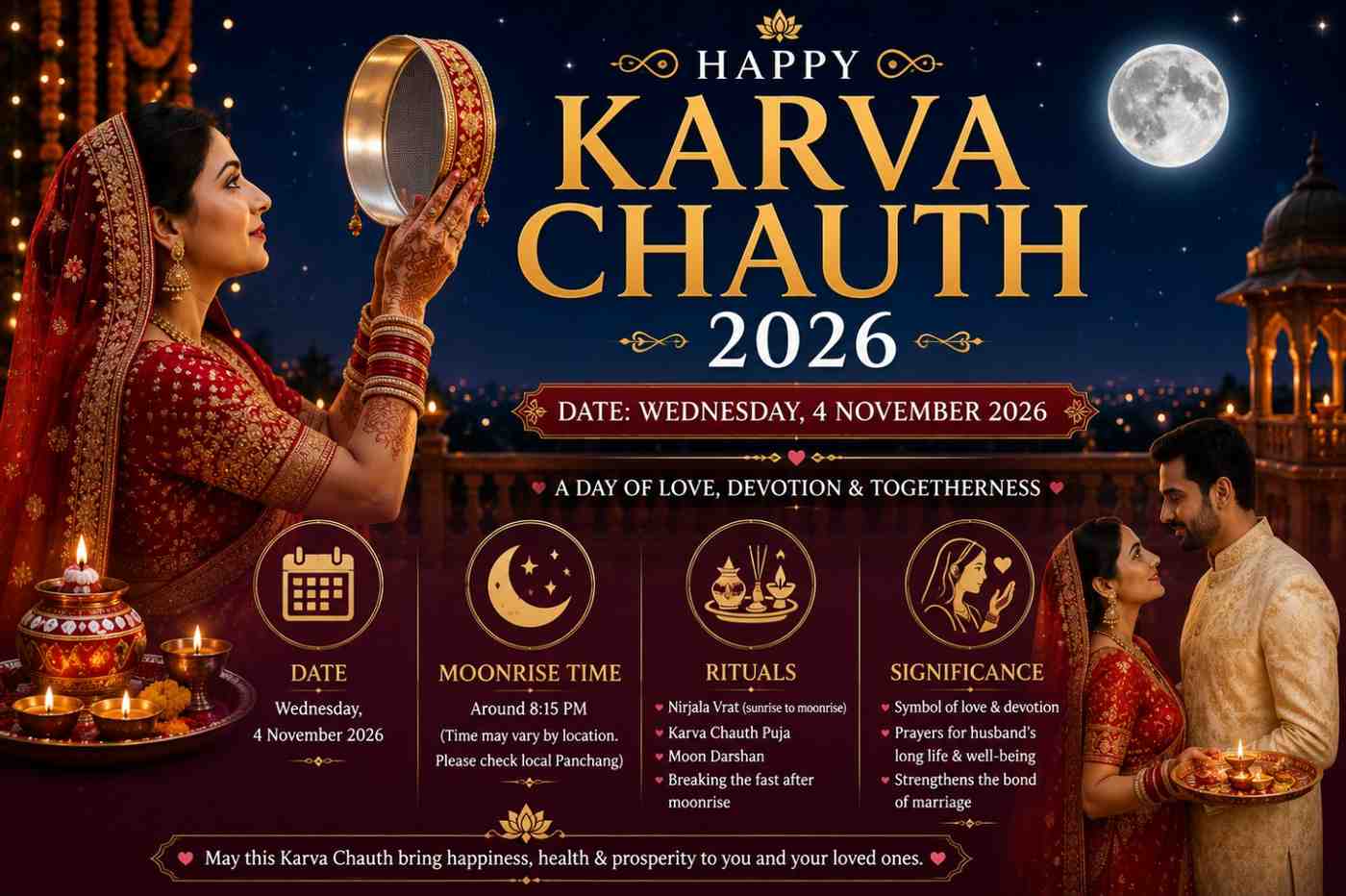
Karva Chauth 2026 falls on Saturday, October 31. The festival involves a complete fast from sunrise to moonrise — traditionally observed by married women for their husbands' long life and wellbeing. The fast is broken only after sighting the moon through a sieve. Moonrise time varies by city — verify locally for your exact time.
If you've grown up in a North Indian household, you know what Karva Chauth feels like. The pre-dawn sargi, the long day of fasting, the women gathering in the evening with their decorated karvas, everyone looking up at the sky waiting for the moon.
There's something genuinely moving about it — the whole day built around one moment of moonrise.
But Karva Chauth has also picked up a lot of cultural noise over the decades — Bollywood glamour, elaborate solah shringar, social media pressure. And somewhere in all of that, the festival's actual roots — its lunar timing, its Ganesha connection, its place in sacred Kartika month — often get lost.
This guide covers all of it. The 2026 date, the traditional observance, the real astrological significance, honest guidance on health and modern practice, and how to approach Karva Chauth in a way that actually means something.
Quick Answers
- Karva Chauth 2026: Saturday, October 31, 2026
- Fast timing: Sunrise to moonrise (approximately 12–14 hours)
- Moonrise: Varies by city — approximately 8–9 PM in most Indian cities; verify locally
- Lunar position: Krishna Paksha Chaturthi of Kartika month
- Primary deities: Goddess Gauri, Lord Shiva, the Moon
- Astrological connections: Moon (emotional life, marriage harmony), Ganesha (Sankashti Chaturthi)
- Geographic scope: Primarily North India — Punjab, Haryana, Delhi, Rajasthan, UP, MP
—
How Is Karva Chauth Traditionally Observed?
The classical observance has a clear structure — and it's worth knowing what each part actually means, not just what to do.
Sargi — The Pre-Dawn Meal
The day begins before sunrise with sargi — a pre-dawn meal prepared by the mother-in-law (or another senior woman in the family) and eaten before the fast begins.
Traditional sargi includes fruits, sweets, mathri, and foods that genuinely sustain energy through the long hours ahead. This isn't optional — eating a good sargi is practical wisdom for a day-long fast.
Fasting Through the Day
From sunrise until moonrise — no food, no water in the nirjala (waterless) form. Typically 12–14 hours depending on your city and the season. This is genuinely demanding, and the health section below addresses who should and shouldn't attempt the full nirjala form.
Evening Karva Chauth Puja
Women gather — often in groups with family or neighbors — to perform the Karva Chauth katha (story recitation). A clay pot (karva) is decorated and filled with water for the worship.
The katha has several regional versions but consistently centers on a devoted woman whose sincerity and dedication to her husband's wellbeing is ultimately rewarded.
The gathering itself is part of the practice — the collective energy of women holding the same intention through a long day carries real weight.
Moon Sighting and Breaking the Fast
This is the moment the whole day has been building toward. The fast is broken only after sighting the moon. The traditional sequence:
- View the moon through a sieve
- View the husband through the same sieve
- Receive water and food from his hands
The sieve creates a filtered, softened view — symbolically, it represents seeing both the moon and the beloved through a lens of devotion rather than ordinary perception. It's a small ritual with genuine symbolic depth.
Why Is Karva Chauth Astrologically Significant?
The Moon's Central Role
The astrological meaning of Karva Chauth isn't just cultural backdrop — it's built into the structure of the observance itself.
The fast is tied directly to lunar visibility. You don't break it at a fixed time — you break it when you can see the moon. That direct engagement with the actual Moon in the sky is what makes this festival genuinely lunar in its design, not just in its symbolism.
In Vedic astrology, the Moon is the karaka (significator) of emotional life, marriage harmony, the mother, and the home.
The traditional framing of Karva Chauth as a wife's observance for her husband draws specifically on this lunar emotional-relational dimension.
The Moon's appearance at the end of a day of sustained intention is, in this reading, not just a timing cue — it's the devotional culmination.
For anyone with a weak or afflicted Moon in their chart — showing up as emotional instability, relationship difficulties, or challenges in the domestic sphere — Karva Chauth is a meaningful annual window for Moon-related practice, regardless of the specific fast format you observe.
Understanding how the Moon sits in your birth chart tells you exactly how significant this annual window is for your emotional and relational life.
The Sankashti Chaturthi — Ganesha Connection
This part is often completely overlooked in Karva Chauth discussions.
Karva Chauth falls on Kartika Sankashti Chaturthi — the fourth lunar day of the dark half of Kartika, which is classically dedicated to Lord Ganesha.
Every Sankashti Chaturthi is a monthly Ganesha observance focused on the removal of obstacles. Karva Chauth, as the Kartika Sankashti Chaturthi, carries this Ganesha-removal-of-obstacles energy running alongside its Moon-worship culmination.
For those with Mercury or Ketu afflictions, or anyone seeking Ganesha's blessing for obstacle removal, adding Ganesha mantra recitation (Om Gam Ganapataye Namah) to the Karva Chauth observance is fully traditional and astrologicaly relevant.
Kartika Month
Kartika is one of the four most sacred months in the Hindu calendar — associated with Vishnu and Shiva worship, spiritual practice, and devotional intensity.
Honest Framing on Modern Karva Chauth
This is worth saying clearly, because Karva Chauth has become one of the more culturally loaded festivals in the Hindu calendar.
Cultural Evolution
The festival's modern prominence — elaborate solah shringar (sixteen adornments), bridal-style dressing, high-visibility celebration — has been substantially amplified by Bollywood and consumer culture over the past few decades.
The classical observance was generally much simpler. Both the traditional sincere version and the contemporary celebratory version exist and are valid — but it's worth knowing which is which, and not confusing recent cultural overlay with ancient tradition.
Health Considerations
Nirjala fasting for 12–14 hours is genuinely demanding — and not appropriate for everyone. Please consult a doctor before observing nirjala Karva Chauth if you have:
- Diabetes or blood sugar regulation issues
- Low blood pressure
- A history of eating disorders
- Pregnancy or nursing
- Any medical condition affected by extended fasting
Many traditions permit non-nirjala forms — water-only fasting, or phalahar (fruits and milk) — for those who cannot sustain the full observance. The tradition does not require harm. A water-only fast observed sincerely is more meaningful than a nirjala fast that damages your health.
Modern Reciprocity
A growing modern variant involves both spouses fasting together, or husbands fasting in solidarity with wives. This is increasingly common and, from a classical-tradition perspective, entirely valid — devotional intention is not gendered. Many couples find the reciprocal form more meaningful as a contemporary marital practice.
For Those Outside the Traditional Structure
The traditional festival is structured around married women fasting for husbands — which creates cultural pressure that can feel exclusionary for single, unmarried, divorced, or widowed women.
Many contemporary women observe Karva Chauth as a general goddess-worship and devotional practice without the husband-specific framing, and this is increasingly accepted.
The tradition's deepest emphasis is on devotion and relational care — these are not exclusively marital qualities. Observe it in whatever form is honest for your situation.
Karva Chauth Practices for Specific Astrological Situations
- Moon afflictions — weak or troubled Moon in the chart, emotional instability, relationship difficulties — Karva Chauth is a meaningful annual Moon-worship window; add Chandra mantra recitation and Lord Shiva mantras alongside the traditional observance. Chandra - chandra at Vedaz specializes in emotional and relational astrology and can help you work with your Moon placement specifically
- Marriage harmony — beyond the fast itself, use the day as a conscious turning of attention toward the marriage; real communication and real care are the deepest practice
- Ganesha-related concerns (Mercury or Ketu afflictions) — as a Sankashti Chaturthi, add Ganesha mantra recitation; the day carries obstacle-removal energy
- Relationship difficulty — observe simply and sincerely, focused on the genuine devotional dimension rather than the social display; sustained marital intention matters more than visible elaborateness
- Health prevents nirjala fasting — observe a non-nirjala form (water-only or phalahar) or a brief evening puja; sincere devotion is the substance, the strict fast is one form of it
For marriage timing and compatibility guidance specific to your chart, Shubha - shubha at Vedaz specializes in marriage astrology — a good resource alongside Karva Chauth if relationship themes are active in your chart.
Practical Notes for Karva Chauth 2026
- Moonrise varies by city — consult a panchang or astrology platform for the exact time in your location. Moonrise on Karva Chauth 2026 typically falls approximately 8–9 PM in most Indian cities, but verify locally
- Puja muhurat is typically the evening period leading up to moonrise — verify the specific auspicious window for your city
- Sargi preparation traditionally happens the previous evening or early morning; plan ahead
- If the moon isn't visible due to weather, the tradition accepts viewing via reflection or breaking the fast at the calculated moonrise time
- Community gatherings are available in many cities for those without a family group nearby — participation is genuinely meaningful
- For first-time nirjala fasting — hydrate well the previous day, eat a substantial sargi, and avoid strenuous activity during the fast
—
How Karva Chauth Fits Into the Vedic Festival Calendar
Karva Chauth sits within the sacred Kartika month — part of a broader cluster of major Vedic festival windows:
- The Diwali 2026 Astrology Guide covers the Kartika Amavasya window that falls just nine days after Karva Chauth — the two festivals are part of the same sustained Kartika arc
- The Akshaya Tritiya Guide covers the spring prosperity window — the other major annual moment for marriage-related beginnings and auspicious undertakings
- The Navratri Guide covers the nine-night Goddess worship arc that immediately precedes Karva Chauth in the autumn calendar
- The Mahashivaratri Guide covers the Great Night of Shiva — particularly relevant for Moon and Saturn remedy work alongside Karva Chauth's lunar emphasis
—
Final Thought
Karva Chauth, at its best, is a day where everything is structured around one moment — the moon coming up, the fast breaking, the relationship consciously honored.
That simplicity is worth protecting. In a festival that has picked up considerable cultural noise — the elaborate dressing, the social media moments, the Bollywood associations — it's easy to lose the thread of what the day is actually about.
Which is, at its core, a conscious turning of attention toward the people you love and the relationship you've chosen.
Observe it in whatever form is honest for you. Traditional nirjala fast if that's meaningful and your health permits. Water-only if that's what you can sustain. A simple evening puja if that's where you are.
Reciprocal fasting with your spouse if that feels right. The festival rewards sincerity over conformity — always has, even before Bollywood got involved.
The moon comes up. You break the fast. The relationship is consciously honored for one full day.
That's enough. That's the whole thing.
Yashodhan Joshi
Vedic Traditions, Festival Significance & Sacred Literature | 16+ Years
Yashodhan Joshi is a researcher and author focused on Vedic traditions, sacred texts, and the spiritual significance of Hindu festivals. He is known for translating complex religious concepts into clear and accessible insights for modern readers.
Frequently Asked Questions
1. What is Karva Chauth?
Karva Chauth is a Hindu festival traditionally observed by married women in North India — a day-long fast from sunrise to moonrise undertaken for the long life and wellbeing of their husbands. It falls on the Krishna Paksha Chaturthi of Kartika month, approximately nine days before Diwali. The fast is broken after sighting the moon and viewing the husband through a sieve.
2. When is Karva Chauth 2026?
Karva Chauth 2026 falls on Saturday, October 31, 2026. Moonrise varies by city — approximately 8–9 PM in most Indian cities, but consult a panchang or astrology platform for your exact local time.
3. What is the astrological significance of Karva Chauth?
Karva Chauth falls on Kartika Sankashti Chaturthi — classically dedicated to Lord Ganesha, carrying obstacle-removal energy. The Moon plays the central role: the fast is tied directly to lunar visibility, and the Moon is the karaka of emotional life and marriage harmony in Vedic astrology. The festival's placement in sacred Kartika month — which also carries Diwali — adds significant spiritual weight.
4. Can someone with health issues fast for Karva Chauth?
Nirjala fasting for 12–14 hours is genuinely demanding and not appropriate for everyone. Those with diabetes, low blood pressure, eating disorder history, pregnancy, nursing, or relevant medical conditions should consult a doctor first. Many traditions permit non-nirjala forms — water-only or phalahar fasting — for those who cannot sustain the full observance. The tradition does not require harm.
5. Can unmarried, divorced, or widowed women observe Karva Chauth?
Yes. Many women observe Karva Chauth as a general goddess-worship and devotional practice without the husband-specific framing, and this is increasingly accepted. The tradition's deepest emphasis is on devotion and relational care — not exclusively marital qualities. Observance shaped to your actual situation, with sincere intention, is valid.
6. Can men or both spouses fast together?
Yes — a growing modern variant involves both spouses fasting together, or husbands fasting in solidarity. This is increasingly common and entirely valid from a classical-tradition perspective. Neither the older one-sided form nor the newer reciprocal form is "wrong" — both are expressions of marital devotion.
Related Blogs
Saraswati Puja: Science Behind Yellow Sweets
Yellow sweets on Saraswati Puja aren't just tradition—they're science, emotion, and energy in one. Find out how colour, food, and devotion come together in this surprising story of wisdom and wellness
Are You Doing Shiv Puja In The Right Way?
Shiv Pooja isn’t about perfection—it’s about presence. Discover the small yet powerful steps you might be skipping, and how they can transform your prayer into a deeper, more personal experience.
Easy Lakshmi Pooja Steps For Inner Peace
You don’t need perfection to feel divine peace. Just a diya, a flower, and a moment of stillness. This gentle Lakshmi Pooja is a soft reminder that grace begins within.
Navgraha Pooja: A Powerful Spiritual Start
Struggling with delays, confusion, or emotional heaviness? Navgraha Pooja might be the spiritual shift you need. Learn how this ancient practice helps you align with cosmic energy and reclaim inner peace.