Makar Sankranti 2027: Date, History, Rituals & Sun Transit
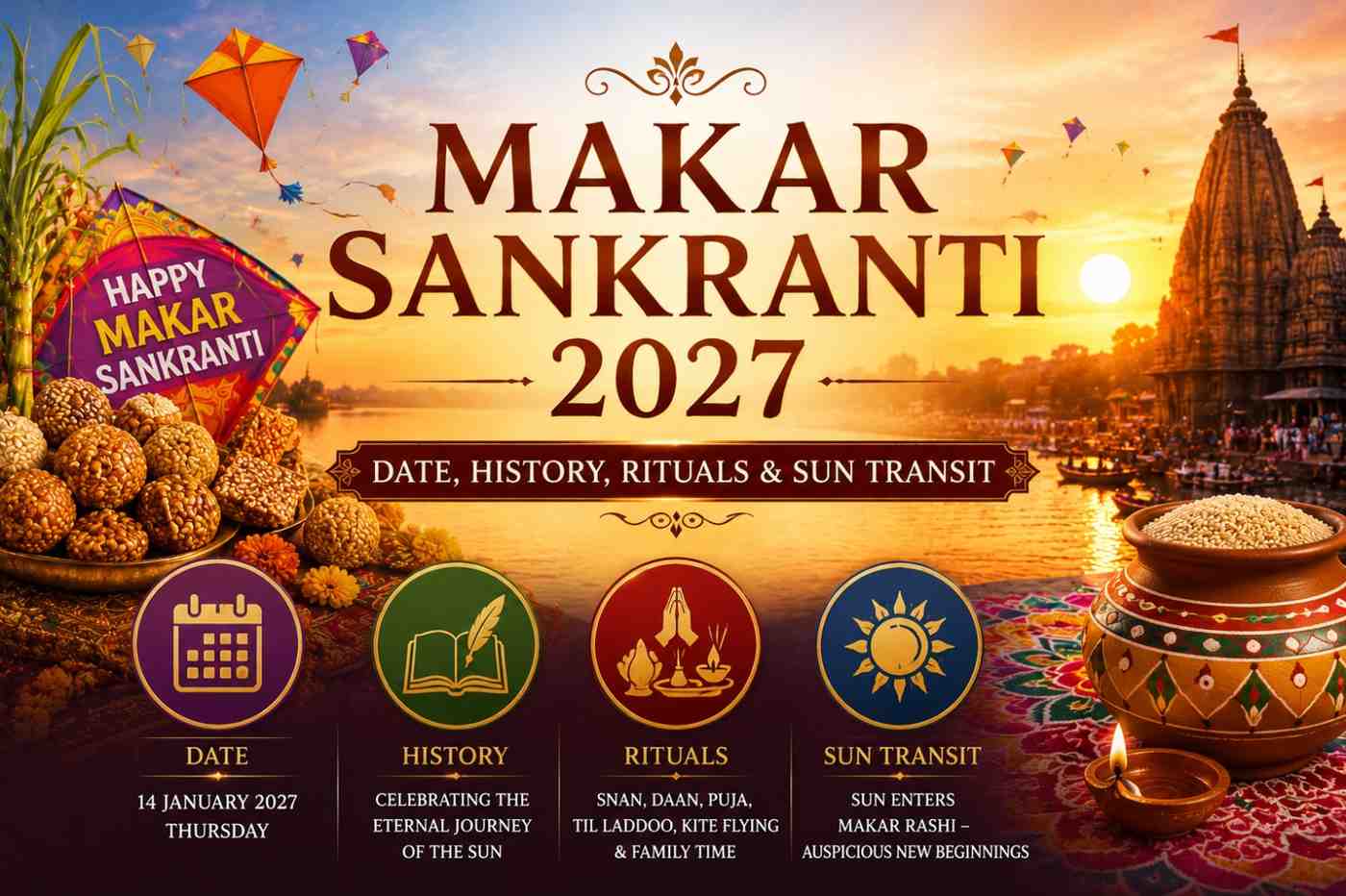
Makar Sankranti marks the Sun's entry into Capricorn (Makara Rashi) and the beginning of Uttarayana — the Sun's six-month northern course. Unlike most Hindu festivals, it falls on essentially the same date every year — January 14 or 15 — because it follows the solar calendar, not the lunar. Makar Sankranti 2027 falls on Thursday, January 14, 2027.
- ◦Makar Sankranti Quick Facts
- ◦What Does "Sankranti" Actually Mean?
- ◦Why Is Uttarayana So Significant?
- ◦The Sun in Capricorn — What It Means Astrologically
- ◦What Are the Traditional Practices of Makar Sankranti?
- ◦Regional Celebrations
- ◦Makar Sankranti Practices for Specific Astrological Situations
- ◦Honest Notes on Makar Sankranti
- ◦How Makar Sankranti Fits Into the Vedic Festival Calendar
- ◦Final Thought
Most Hindu festivals move around the calendar. Navratri shifts. Diwali shifts. Even Ganesh Chaturthi shifts. But Makar Sankranti shows up on January 14 or 15, year after year, like clockwork.
That's because it's not tracking the Moon. It's tracking the Sun — specifically the moment the Sun crosses into Capricorn in the sidereal zodiac. And that makes Makar Sankranti one of the most astrologically grounded festivals in the entire Hindu calendar.
This guide covers what's actually happening astronomically on this day, why Uttarayana matters, what the Sun in Capricorn means for your chart, and how the festival is observed across India's many regional traditions.
Makar Sankranti Quick Facts
| Date in 2026 | Wednesday, January 14, 2026 (has occurred) |
| Date in 2027 | Thursday, January 14, 2027 |
| Sanskrit meaning | Makara (Capricorn) + Sankranti (the Sun's entry into a sign) |
| Astrological event | Sun enters sidereal Capricorn (Makara Rashi) |
| Uttarayana | The Sun's northern course begins — six-month spiritual ascending half-year |
| Regional names | Pongal (Tamil Nadu), Lohri (Punjab), Magh Bihu (Assam), Uttarayan (Gujarat) |
| Distinctive feature | One of the few solar-calendar Hindu festivals — same Gregorian date every year |
What Does "Sankranti" Actually Mean?
Before getting into Makar Sankranti specifically, it helps to understand what sankranti means in Vedic astrology — because it changes how you see the whole festival.
Sankranti simply means the Sun's entry into any zodiac sign. Since the Sun transits through all twelve signs over the course of a year, there are twelve sankrantis annually — one every approximately 30 days.
Each one is astrologically significant. Classical tradition recommends bathing in sacred rivers, donation, and Sun worship at each sankranti moment.
But four sankrantis are considered especially powerful:
- Mesha Sankranti — Sun into Aries (spring; around April 14)
- Karka Sankranti — Sun into Cancer (beginning of Dakshinayana, the southern course; around July 16)
- Tula Sankranti — Sun into Libra (autumnal equinox region; around October 17)
- Makara Sankranti — Sun into Capricorn (beginning of Uttarayana, the northern course; January 14–15)
Of these four, Makara Sankranti is the most widely celebrated — and that's because of what Uttarayana represents.
Why Is Uttarayana So Significant?
Uttarayana literally means "northern course." It refers to the six-month half of the year when the Sun moves progressively northward along the horizon — from the winter solstice region through the summer solstice.
In Vedic tradition, Uttarayana is the ascending, auspicious half-year. It is associated with:
- Increasing light and spiritual ascent
- Major spiritual undertakings, mantra anushthana, and scriptural study
- Weddings — Uttarayana is the preferred half-year for marriage muhurat
- Important beginnings and dharmic action
- The half-year when the divine is considered more accessible
The corresponding Dakshinayana (southern course, summer to winter solstice) is associated with introspection, ancestral observance, and the half-year when Pitru Loka (the realm of ancestors) is considered closer. Pitru Paksha falls in Dakshinayana for exactly this reason.
So Makar Sankranti isn't just a festival — it's the annual opening of the half-year the tradition has always preferred for everything important.
One honest nuance worth knowing: Sidereal Makar Sankranti now falls about three weeks after the actual astronomical winter solstice due to the precession of the equinoxes.
The actual northward movement of the Sun begins around December 21 in tropical reckoning. This gap is real and is acknowledged in classical astrological discussion — it's one of the few places where the Vedic sidereal calendar and actual astronomical timing have drifted apart.
The Sun in Capricorn — What It Means Astrologically
When the Sun enters Capricorn on Makar Sankranti, something interesting happens astrologically: the Sun moves into Saturn's own sign.
Saturn rules Capricorn. And in classical Vedic planetary relationships, the Sun and Saturn are famously difficult with each other — a father-son mythology that runs through the entire tradition. The Sun entering Saturn's sign is therefore not a comfortable transit — it requires conscious navigation.
What this means practically:
- The 30-day post-Sankranti window (Sun in Capricorn through approximately mid-February) is productive for Saturn-related work — career, institutional matters, disciplined undertakings, long-term planning
- It requires conscious attention to ego and authority dynamics — the Sun-Saturn friction tends to surface tensions around fathers, bosses, and structures
- For natives whose Moon sign places Capricorn in a significant house, this transit activates those themes directly
Understanding which house Capricorn occupies from your birth chart tells you exactly which area of life the Makar Sankranti transit activates for you personally — and how to best use the 30-day window that follows.
What Are the Traditional Practices of Makar Sankranti?
Across India's many regional variations, certain core practices are widely shared:
Ritual Bathing
Bathing in sacred rivers — the Ganga, Yamuna, Godavari — or simply at home with conscious intention of purification at the sankranti moment.
The Kumbh Mela bathing at Prayagraj traditionally falls in this window when held. Even a simple home bath with the intention of marking the Sun's transition carries the practice's classical meaning.
Sun Worship
- Surya Arghya — offering water to the rising sun, facing east, typically with cupped hands
- Aditya Hridaya Stotram recitation — one of the most powerful Sun-related texts
- Surya Namaskar practice — the sun salutation sequence as a physical act of solar worship
- Surya mantras — Om Suryaya Namah, Om Hraam Hreem Hraum Sah Suryaya Namah
Sesame and Jaggery
Til (sesame) and gur (jaggery) are the emblematic offerings of this festival — and the association isn't random.
Sesame is classically associated with Saturn, the planet ruling Capricorn which the Sun is entering. Jaggery represents warmth and sweetness appropriate to the season of ascending light.
The traditional greeting shared during Makar Sankranti — "til-gud ghya, god god bola" (take sesame and jaggery, speak sweetly) — is one of the most genuinely warm ritual exchanges in the Hindu festival calendar.
Donation (Daan)
Donation on Makar Sankranti is held in classical tradition to carry amplified karmic merit. Traditional donations for this day:
- Sesame seeds and jaggery
- Blankets and warm clothing — the festival falls in winter, and clothing donation to those in need is particularly emphasized
- Food and khichdi
- Any genuine donation undertaken with sincere intention
Kite Flying
Particularly in Gujarat (Uttarayan), Rajasthan, and Telangana — one of the largest kite-flying celebrations in the world.
The practice is symbolically connected to greeting the rising Sun and moving upward toward the divine. Practically: choose safer string — sharp manjha causes serious injuries to people and significant harm to birds. Many cities now regulate its use.
Bonfires
Lohri — the preceding evening in Punjab — features large communal bonfires with singing, dancing, and offerings of sesame, jaggery, and other items into the fire. It's one of the most communally joyful festivals in the North Indian calendar.
Special Foods
- Pongal (Tamil Nadu) — sweet rice and lentil dish; gives the festival its Tamil name
- Khichdi — rice and lentil dish; widely offered and consumed in North India
- Til ladoo and til chikki — sesame seed sweets
- Gur-papdi — jaggery-wheat sweet
Regional Celebrations
- Pongal (Tamil Nadu) — the four-day Tamil harvest festival; the second day (Surya Pongal) corresponds to Makar Sankranti and is dedicated to Sun worship
- Lohri (Punjab) — the preceding evening, communal bonfires and harvest celebration
- Magh Bihu (Assam) — also called Bhogali Bihu; harvest festival with communal feasts and bonfires
- Uttarayan (Gujarat) — among the largest kite-flying festivals in the world; the sky over Ahmedabad fills with thousands of kites on this day
- Maghi (Haryana, Himachal) — harvest celebration with ritual bathing
- Suggi (Karnataka) — harvest festival with sesame and jaggery customs
The regional diversity is striking — but the core practices (Sun worship, sesame-jaggery, donation, ritual bathing) run through all of them. You don't need to participate in a specific regional form to observe the day meaningfully.
Makar Sankranti Practices for Specific Astrological Situations
- Sun-related concerns — weak Sun in the chart, Leo-related difficulties, father relationship issues — Makar Sankranti is the most powerful annual window for Sun-strengthening remedies; Surya Arghya, Aditya Hridaya Stotram, Surya Namaskar, and donation of red items combine effectively. Ayush - ayush at Vedaz can guide you on Sun-vitality practices specific to your chart configuration
- Saturn-related concerns — Sade Sati, Shani Dosha, Saturn Mahadasha — the Sun's movement into Saturn-ruled Capricorn makes this a natural combined Sun-Saturn observance window; pair Sun worship with conscious Shani acknowledgment
- Pitra Dosha and ancestral observance — sankranti days are classically associated with Tarpan; Makar Sankranti particularly so as one of the four major sankrantis of the year
- Beginning sustained spiritual practice — Uttarayana's opening is the traditional auspicious launch point for mantra anushthana, scriptural study, or any committed practice
- Sesame-jaggery donation — this is the day's emblematic remedy; the combined daan-and-Sun-worship is the classical formula
- The 30-day post-Sankranti window — Sun's transit through Capricorn is favorable for Saturn-related work and disciplined, structured undertakings
For personalized guidance on how the Sun's transit through Capricorn affects your specific chart, Kuber - kuber at Vedaz specializes in wealth and prosperity astrology — particularly relevant if Capricorn activates your 2nd, 10th, or 11th house themes.
Honest Notes on Makar Sankranti
The date is genuinely stable. January 14 or 15 nearly every year — because it tracks the sidereal Sun, not the Moon. This is one of the simplest and most reliable dates in the Hindu festival calendar.
The Uttarayana nuance is real. Sidereal Makar Sankranti falls about three weeks after the actual astronomical winter solstice due to precession. This is acknowledged in classical astrological discussion — not a secret or an error, just a known feature of the sidereal system.
Kite flying has real safety considerations. Sharp manjha injures people and kills birds every year. Choosing safer string and being attentive to surroundings is part of conscious observance — the tradition doesn't require harm.
The core practices work across all regional forms. Sun worship, donation, sesame-jaggery sharing, and ritual bathing are the heart of the observance. You don't need any specific regional tradition to observe Makar Sankranti meaningfully.
For those new to formal Sun worship, Surya Namaskar combined with sincere mantra recitation is a fully accessible entry point. Elaborate ritual is not required.
How Makar Sankranti Fits Into the Vedic Festival Calendar
Makar Sankranti is the year's solar pivot point — and it connects to a broader pattern of major Vedic festival windows:
- The Diwali 2026 Astrology Guide covers the Kartika Amavasya window at the other end of the year — together, Makar Sankranti and Diwali mark the two biggest annual turning points in the Vedic solar-lunar calendar
- The Akshaya Tritiya Guide covers the spring prosperity window — falling within Uttarayana, the ascending half-year that Makar Sankranti opens
- The Navratri Guide covers the nine-night Goddess worship arc — also falling within Uttarayana and carrying the ascending half-year's energy
- The Mahashivaratri Guide covers the Great Night of Shiva — also falling within Uttarayana, making it one of the most powerful Shiva windows of the ascending half-year
Final Thought
Makar Sankranti is the year's pivot toward light.
The Sun crosses into Capricorn. Uttarayana opens. The six months the tradition has always favored — for important beginnings, for spiritual practice, for weddings, for sustained dharmic action — begin right here.
That's worth marking consciously. Not just with til ladoo and kite flying (though both are wonderful), but with actual intention: What practice will you launch with Uttarayana's opening? What important undertaking will you begin in the ascending half-year?
The bathers at Prayag and the kite-flyers in Ahmedabad are participating in the same thing at heart — a conscious greeting of the Sun's return northward, a recognition that the light is ascending again, and a turning toward the half-year that the tradition has always said is the better one for becoming more of who you're trying to be.
Observe it with that in mind. The sunrise is worth getting up for.
Tanirika Sen
Festival History, Mythology & Cultural Heritage | 8+ Years
Tanirika Sen specializes in the historical and mythological foundations of Hindu festivals. Through detailed research and engaging storytelling, she helps readers discover the deeper significance behind traditional celebrations and sacred observances.
Frequently Asked Questions
1. What is Makar Sankranti?
Makar Sankranti is the Hindu festival marking the Sun's entry into Capricorn (Makara Rashi) and the beginning of Uttarayana — the Sun's six-month northern course. It is one of the few Hindu festivals based on the solar calendar, falling on essentially the same date every year — January 14 or 15. It is observed across India under regional names including Pongal, Lohri, Magh Bihu, and Uttarayan.
2. When is Makar Sankranti 2027?
Makar Sankranti 2027 falls on Thursday, January 14, 2027. Makar Sankranti 2026 was Wednesday, January 14, 2026 (already occurred). The date is stable because it tracks the Sun's entry into sidereal Capricorn — a fixed annual astronomical event by the sidereal calendar.
3. What is Uttarayana?
Uttarayana — literally "northern course" — is the six-month half of the year when the Sun moves northward along the horizon. In Vedic tradition, this period is associated with increasing light, spiritual ascent, and auspiciousness — the preferred half-year for major spiritual undertakings, weddings, and important beginnings. The corresponding Dakshinayana (southern course) is associated with introspection and ancestral observance.
4. Why is sesame and jaggery the emblematic food of Makar Sankranti?
Sesame (til) is classically associated with Saturn — the planet ruling Capricorn, which the Sun is entering. Jaggery (gur) represents the warmth and sweetness appropriate to the festival of ascending light. Donation of sesame and jaggery is the classical Makar Sankranti remedy, and the greeting "til-gud ghya, god god bola" (take sesame and jaggery, speak sweetly) is one of the most genuinely warm ritual exchanges in the festival calendar.
5. What is the difference between Makar Sankranti and the winter solstice?
Related but distinct. The astronomical winter solstice falls around December 21 in tropical reckoning — the actual shortest day of the year. Sidereal Makar Sankranti falls about three weeks later, on January 14–15, due to the precession of the equinoxes. Classical tradition treats Makar Sankranti as the beginning of Uttarayana even though the actual astronomical northward movement begins at the solstice — an acknowledged feature of the sidereal system.
6. What are the best Makar Sankranti practices?
Ritual bathing (sacred river or at home with intention), Sun worship (Surya Arghya, Aditya Hridaya Stotram, Surya Namaskar), donation of sesame seeds, jaggery, blankets, and warm clothing, sharing til-gud sweets, Tarpan (ancestral water offering — sankranti days carry this significance), and beginning a sustained spiritual practice using Uttarayana's opening as the launch point.
Related Blogs
Saraswati Puja: Science Behind Yellow Sweets
Yellow sweets on Saraswati Puja aren't just tradition—they're science, emotion, and energy in one. Find out how colour, food, and devotion come together in this surprising story of wisdom and wellness
Are You Doing Shiv Puja In The Right Way?
Shiv Pooja isn’t about perfection—it’s about presence. Discover the small yet powerful steps you might be skipping, and how they can transform your prayer into a deeper, more personal experience.
Easy Lakshmi Pooja Steps For Inner Peace
You don’t need perfection to feel divine peace. Just a diya, a flower, and a moment of stillness. This gentle Lakshmi Pooja is a soft reminder that grace begins within.
Navgraha Pooja: A Powerful Spiritual Start
Struggling with delays, confusion, or emotional heaviness? Navgraha Pooja might be the spiritual shift you need. Learn how this ancient practice helps you align with cosmic energy and reclaim inner peace.