Onam and King Mahabali: Story, Significance and Celebrations
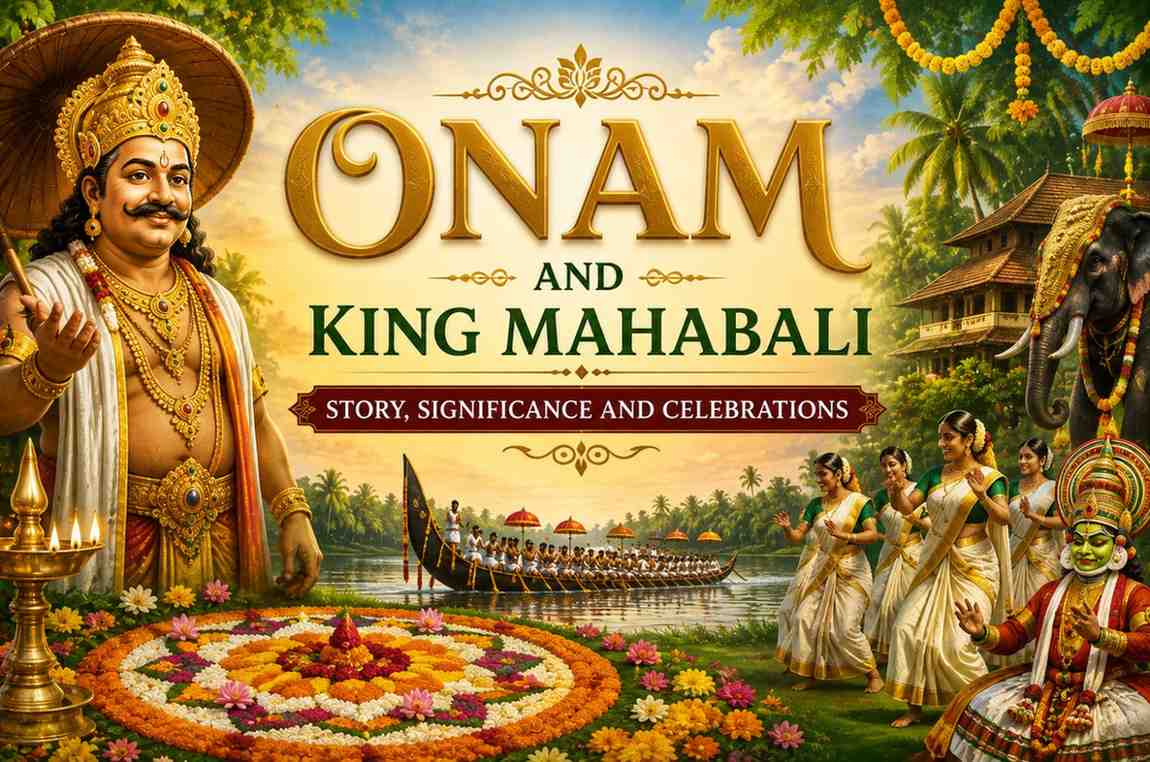
Onam is Kerala's most important festival — a 10-day celebration culminating on Thiruvonam, the day the Moon transits Shravana nakshatra in the Malayalam month of Chingam. Thiruvonam 2026 falls approximately on Wednesday, August 26, 2026. The festival commemorates the annual return of the beloved King Mahabali to visit his people.
- ◦Onam Quick Facts
- ◦Who Was King Mahabali — and Why Does It Matter?
- ◦The 10 Days of Onam — What Each Day Means
- ◦Why Is Onam Astrologically Significant? The Shravana Nakshatra Connection
- ◦Traditional Onam Practices
- ◦Onam Practices for Specific Astrological Situations
- ◦Honest Notes on Onam Observance
- ◦How Onam Fits Into the Vedic Festival Calendar
- ◦Final Thought
Most festivals celebrate a deity. Onam celebrates a king.
Not a god, not an avatar — a king. King Mahabali, who ruled Kerala in what classical tradition calls a golden age: no poverty, no dishonesty, no discrimination, prosperity for everyone. A king so beloved that even after Lord Vishnu pressed him into the netherworld, the people never stopped waiting for him to come back.
And Onam is that return. Every year, for 10 days, Kerala welcomes him home.
That mythology alone makes Onam one of the most distinctive festivals in the entire Indian calendar. Add the Shravana nakshatra connection, the Onasadya feast, the Pookalam floral carpets, and the Vallam Kali boat races — and you have a festival that's unlike anything else. This guide covers all of it.
Onam Quick Facts
| Thiruvonam 2026 | Approximately Wednesday, August 26, 2026 |
| Malayalam month | Chingam (August–September) — first month of the Malayalam calendar |
| Meaning | Onam derives from "Sravanam" — the Shravana nakshatra |
| Astrological foundation | Thiruvonam = Moon transiting Shravana nakshatra in Chingam month |
| Duration | 10 days, beginning with Atham and culminating in Thiruvonam |
| Central mythology | The annual return of King Mahabali to visit his people |
| Geographic scope | Kerala and the global Malayali diaspora |
Who Was King Mahabali — and Why Does It Matter?
Before getting into the festival's structure, the Mahabali story deserves real attention — because how you understand the story determines how you understand Onam.
Mahabali was an Asura king — but the tradition is careful about what that means here. He was also one of the most just, generous, and beloved rulers in classical narrative.
Under his rule, Kerala is held to have experienced a genuine golden age: no poverty, no dishonesty, no discrimination, abundant prosperity for all. He was so respected that even the gods weren't envied the way Mahabali was loved.
His power grew to the point that the gods feared he would overtake the heavens. Lord Vishnu took his fifth avatar — Vamana, the dwarf Brahmin — and approached Mahabali during a yagna (fire ceremony), asking for three paces of land. Despite warnings from his guru, Mahabali agreed — he couldn't refuse. He was that kind of king.
Vamana then grew to cosmic size. First step: the earth. Second step: the heavens. Where to place the third? Mahabali, honoring his word, offered his own head. Vamana pressed him into the netherworld (Patala) — but recognizing Mahabali's righteousness, granted him one boon: he could return to visit his people once every year.
Onam is that annual visit.
Now — this story is sometimes read as "a demon king gets defeated." But that's not how Kerala reads it, and that's not what Onam reflects. The dominant Kerala framing is the welcoming of a beloved king back home.
The entire festival's energy is celebratory, not triumphant. You don't lay an elaborate Pookalam and cook 30 dishes to celebrate someone's defeat. You do it to welcome someone you love.
The deeper reading: Mahabali's generosity — his inability to refuse even a cosmic trick — was simultaneously his greatest virtue and the thing that cost him his throne.
His "fall" was through his own dharma, not through a failure of it. And the tradition honors that. The annual return signifies that the deepest dharmic values — generosity, justice, the prosperity of all — persist beyond political circumstance.
That's what makes Onam genuinely moving. It's a festival built on the memory of what good governance feels like, and on the refusal to let that memory go.
The 10 Days of Onam — What Each Day Means
Onam isn't one long celebration with repeated practices. Each day has its own distinct meaning and energy — and the 10 days form a complete arc building toward Thiruvonam.
Day 1 — Atham
The festival begins. The first layer of the Pookalam — the elaborate floral carpet laid at the home entrance — is placed. This first layer is simple; it will grow over the next nine days into something extraordinary. Atham is the planting of the seed.
Day 2 — Chithira
The Pookalam grows a new ring of flowers. Preparations for the festival intensify — more flowers, more cooking, more anticipation.
Day 3 — Chodi
Shopping for new clothes and household items is traditional on this day. The market energy of Chodi mirrors the practical preparation that precedes any major homecoming.
Day 4 — Vishakam
Cultural competitions begin — dance performances, music, arts. The festival's cultural dimension starts to come alive alongside the devotional one.
Day 5 — Anizham
Major preparations for the climactic days. Vallam Kali — the famous Kerala snake-boat races — often peak in this period. The Pamba River fills with the sound of rowing songs and the surge of Chundan Vallam boats.
Day 6 — Thriketta
Family gatherings intensify. Ancestral homes begin welcoming returning relatives — those who have come from other cities, other states, other countries, to be home for Onam.
Day 7 — Moolam
Sadya preparations begin in earnest. Specific dishes are made in advance; the scale of the Onasadya feast requires days of preparation. The kitchen becomes the heart of the house.
Day 8 — Pooradam
Symbolic clay or wooden images of Mahabali are placed at home entrances. The king's presence is formally welcomed. The Pookalam is now approaching its full, elaborate form.
Day 9 — Uthradam
Called "First Onam" — the day before Thiruvonam. Major shopping is completed. The Onasadya preparations are largely finished. Families are gathered. Everything is ready.
Day 10 — Thiruvonam
The main day. Mahabali is welcomed. The Onasadya is served. The family eats together on banana leaves, surrounded by everything the 10 days have built toward. This is the day the Moon transits Shravana nakshatra — the astrological heart of the festival.
Why Is Onam Astrologically Significant? The Shravana Nakshatra Connection
"Onam" itself derives from "Sravanam" — the Malayalam-Tamil form of Shravana nakshatra. The festival's name is its astrological foundation.
Shravana is the 22nd nakshatra in the Vedic sequence, spanning 10°–23°20' of sidereal Capricorn. Its ruling deity is Lord Vishnu — and this is where the astrological symbolism of Onam locks into place perfectly.
Vishnu rules Shravana. Vishnu's avatar Vamana is central to the Mahabali story. The festival falls when the Moon transits Vishnu's own nakshatra. The astrological and mythological layers are not separate — they're the same story told in two languages.
Shravana's name means "ear" or "listening" — and the nakshatra is associated with devotional learning, the receiving of sacred teaching, and listening as a spiritual practice.
This quality gives Thiruvonam a contemplative dimension that sits beautifully alongside the feast and celebration: the invitation to genuinely listen — to the story of Mahabali, to the tradition's teaching about dharmic generosity, to what righteous living actually requires.
For natives whose Moon is in Shravana nakshatra natally, Thiruvonam is the annual day when the transiting Moon returns to its natal nakshatra — a personally significant astrological moment beyond the festival's broader cultural meaning.
Understanding how Shravana sits in your birth chart — its house, its aspects, its relationship to your Moon — tells you exactly how this annual transit lands for you.
The Saturn dimension: Shravana falls in Capricorn, which is Saturn-ruled. So the nakshatra carries a Saturn-Vishnu combined quality — devotion (Vishnu) paired with discipline and structure (Saturn).
For those in Saturn periods who are working on sustained spiritual practice, Onam's Shravana energy offers a meaningful alignment.
Traditional Onam Practices
Pookalam — The Floral Carpet
The Pookalam is Onam's most distinctive visual expression — an elaborate floral carpet laid at the home entrance, built in concentric rings of fresh flowers over the 10 days. What begins as a simple circle on Atham becomes, by Thiruvonam, something genuinely stunning.
The Pookalam is not decoration. It is the formal welcome mat for Mahabali's return — a living artwork that grows more elaborate as the king's arrival approaches. Different regions of Kerala have distinct Pookalam traditions; competitions are held for the most elaborate designs.
Onasadya — The Grand Feast
The Onasadya is one of the most celebrated regional feast traditions in India — a fully vegetarian meal served on a banana leaf, typically including 20–30 dishes: sambar, rasam, avial, thoran, pachadi, inji puli, olan, erissery, multiple types of payasam, banana chips, pappadam, and many more, arranged in specific positions on the leaf.
The scale is intentional. Mahabali's reign was one of abundance for all — and the Sadya enacts that abundance at the family table. Serving it on a banana leaf (not a plate) connects the feast to its agricultural and natural roots.
Preparing the full traditional Sadya is a major undertaking. Many families share preparation across the extended family or order from established Sadya specialists. Simplified home versions are entirely valid — the intention of abundance and welcome is what matters.
Vallam Kali — The Snake-Boat Races
Among the largest team-sport spectacles in India. The snake-boat races (Chundan Vallam) on the Pamba River and other Kerala waterways are extraordinary — boats over 100 feet long, rowed by over 100 oarsmen, moving to the rhythm of Vanchipattu (boat songs).
If you've never seen Vallam Kali, it's worth understanding that the scale is genuinely unlike anything else in the festival calendar.
Other Practices
- Pulikali — performers in Thrissur paint themselves as tigers and dance through the streets; one of the most visually striking folk traditions in Kerala
- Onapudava — gifting of new clothes within the family, particularly to younger members and household staff
- Thiruvathirakali and Kummattikali — traditional dance forms performed during the festival
- Family gatherings — Onam is the major annual family-reunion festival in Kerala; many Malayalis return from abroad specifically for Thiruvonam
Onam Practices for Specific Astrological Situations
- Shravana nakshatra natives — Thiruvonam is the annual lunar return to your natal nakshatra; this is a particularly significant day for spiritual practice, devotional study, and conscious intention-setting. Moksha - moksha at Vedaz specializes in spiritual and devotional astrology — especially worth consulting around Thiruvonam if Shravana is your birth nakshatra
- Vishnu-related worship — the festival's Vishnu foundation (Vamana, Shravana nakshatra) makes Onam relevant for sustained Vishnu mantra practice: Vishnu Sahasranama, Vishnu Ashtottara, or simply the Dwadasha Nama Stotram
- Dharmic and ethical reflection — the Mahabali story is a meditation on righteous leadership and the conflict between unbounded generosity and cosmic order; the festival genuinely invites reflection on what dharmic life looks like in your own circumstances
- Saturn-period natives — Shravana falls in Saturn-ruled Capricorn; for those in Sade Sati or Saturn Mahadasha who are working on sustained devotional practice, Onam's Saturn-Vishnu combined energy offers a meaningful alignment
- Non-Malayali practitioners — a simple Vishnu puja on Thiruvonam, preparing an Onasadya-style meal, or reading the Mahabali story with family is accessible and genuinely meaningful
Honest Notes on Onam Observance
Onam is one of the more secularly-observed festivals in India. Christian, Muslim, and Hindu Malayalis often celebrate the cultural aspects of Onam together — Pookalam, Sadya, Vallam Kali — making it a festival of regional identity as much as religious observance.
This inclusive dimension is genuine and worth honoring rather than narrowing.
The Mahabali story has multiple valid readings. The "Vamana defeats Mahabali" framing and the "Mahabali is welcomed back" framing both have textual support.
Kerala has consistently emphasized the second — and Onam reflects that choice fully. Both readings are worth knowing; the Kerala emphasis on welcoming Mahabali back reflects a deep regional commitment to his values.
Onasadya at full scale is a significant undertaking — 20–30 dishes, specific preparation sequences, traditional serving arrangements.
Many families now share the preparation or order from Sadya specialists. Simplified home versions are entirely valid. The intention of abundance and welcome is what the feast is for.
For non-Malayali practitioners — reading the Mahabali story, preparing or sharing in a Sadya-style meal, and observing Thiruvonam with simple Vishnu puja is genuinely accessible. The festival's welcome is broad.
The deeper invitation of Onam is universal. What does righteous leadership look like? What does generosity unbounded by self-protection cost and create? What does it mean to welcome back what political circumstance has displaced? These questions belong to no single region.
How Onam Fits Into the Vedic Festival Calendar
Onam is the year's most powerful Vishnu-devotional and nakshatra-based festival window — and it sits within the broader pattern of major Vedic festival dates:
- The Diwali 2026 Astrology Guide covers the Kartika Amavasya window — the year's most powerful Lakshmi and planetary remedy night, sitting in the same second half of the year as Onam
- The Akshaya Tritiya Guide covers the spring prosperity window — also carrying strong Vishnu associations through its Parashurama Jayanti connection
- The Navratri Guide covers the nine-night Goddess worship arc that follows Onam in the same autumn festival cluster
- The Mahashivaratri Guide covers the Great Night of Shiva — the complementary annual window to Onam's Vishnu-devotional energy
Final Thought
Onam is the festival of the returning king — and that image is worth sitting with.
Every year, Kerala lays out the Pookalam, cooks the Sadya, and waits. Not for a god, not for a cosmic force, but for a king whose generosity cost him everything and whose people never stopped loving him for it.
There's something deeply human about that. The refusal to let a beloved thing be simply gone. The annual renewal of the welcome.
The Mahabali story asks a genuinely hard question: what does it cost to be that generous? He couldn't refuse Vamana. His virtue and his downfall were the same act. And the tradition doesn't resolve that tension — it honors it, year after year, by welcoming him back.
If you observe Onam — whether in the full Kerala tradition or in simpler personal observance — lay the Pookalam with care. Serve the Sadya with abundance. Listen on Thiruvonam, which is what Shravana is always asking for. And let the question the festival carries follow you beyond the 10 days:
What kind of person, when they return, would their people welcome back like this?
That's the invitation. That's the whole festival.
Samyukta Vaidyanathan
Festival Rituals, Fasting Traditions & Hindu Customs | 12+ Years
Samyukta Vaidyanathan writes extensively about Hindu festival rituals, fasting practices, and traditional observances. Her content combines scriptural references with practical guidance to help devotees celebrate festivals with confidence and understanding.
Frequently Asked Questions
1. What is Onam?
Onam is Kerala's most important festival — a 10-day celebration combining harvest gratitude, devotional remembrance, and cultural pride. It commemorates the legendary King Mahabali, whose just and generous rule is held as the model of righteous kingship, and whose annual return to visit his people is what Onam marks. The main day, Thiruvonam, falls when the Moon transits Shravana nakshatra in the Malayalam month of Chingam.
2. When is Onam 2026?
Thiruvonam 2026 falls approximately on Wednesday, August 26, 2026. The exact date depends on when the Moon transits Shravana nakshatra in Chingam — consult a Malayalam panchang for precise timing. The 10-day festival begins with Atham approximately 10 days before Thiruvonam, around August 17, 2026.
3. Who was King Mahabali?
Mahabali was a legendary Asura king celebrated as one of the most just, generous, and beloved rulers in classical narrative. Under his rule, Kerala is held to have experienced a golden age with no poverty or dishonesty. When Lord Vishnu took the Vamana avatar and pressed him into the netherworld, Mahabali was granted the boon of annual return to visit his people. Onam is that annual return — celebrated as a homecoming, not a defeat.
4. What is the astrological foundation of Onam?
Onam centers on Shravana nakshatra — the festival's name derives from "Sravanam." The main day (Thiruvonam) falls when the Moon transits Shravana nakshatra in Chingam month. Shravana spans 10°–23°20' of sidereal Capricorn and is ruled by Lord Vishnu — connecting astrologically to the Vamana avatar of the Mahabali story. The nakshatra's name means "listening," associated with devotional learning and receiving sacred teaching.
5. What is Onasadya?
Onasadya is the festival's emblematic vegetarian feast served on a banana leaf, traditionally including 20–30 dishes — sambar, rasam, avial, thoran, pachadi, multiple payasams, and many others. It is one of the most celebrated regional feast traditions in India, served on Thiruvonam and representing the abundance of Mahabali's golden age brought to the family table.
6. Can non-Malayalis observe Onam?
Yes — Onam is one of the most inclusively-observed festivals in India, celebrated across religious communities. The most accessible entry for non-Malayali practitioners is reading the Mahabali story, preparing or sharing in a Sadya-style meal, observing Thiruvonam with simple Vishnu puja, and reflecting on the festival's themes of righteous leadership and devotional return. The festival's cultural welcome makes participation broadly accessible.
Related Blogs
Saraswati Puja: Science Behind Yellow Sweets
Yellow sweets on Saraswati Puja aren't just tradition—they're science, emotion, and energy in one. Find out how colour, food, and devotion come together in this surprising story of wisdom and wellness
Are You Doing Shiv Puja In The Right Way?
Shiv Pooja isn’t about perfection—it’s about presence. Discover the small yet powerful steps you might be skipping, and how they can transform your prayer into a deeper, more personal experience.
Easy Lakshmi Pooja Steps For Inner Peace
You don’t need perfection to feel divine peace. Just a diya, a flower, and a moment of stillness. This gentle Lakshmi Pooja is a soft reminder that grace begins within.
Navgraha Pooja: A Powerful Spiritual Start
Struggling with delays, confusion, or emotional heaviness? Navgraha Pooja might be the spiritual shift you need. Learn how this ancient practice helps you align with cosmic energy and reclaim inner peace.