Pitru Paksha 2026 Guide: Dates, Rituals & Remedies
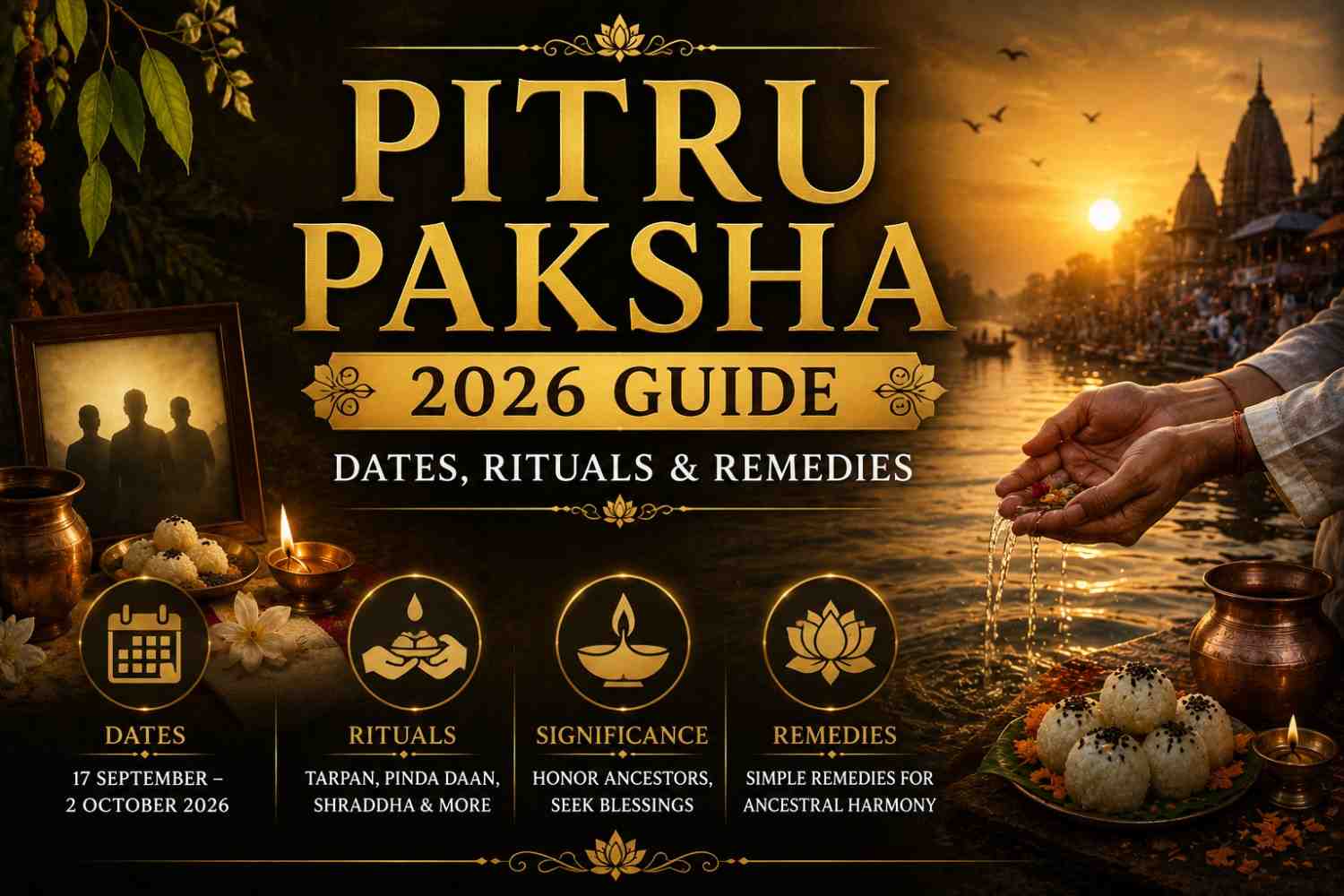
Pitru Paksha 2026 runs September 27 to October 10 — the 16-day dark fortnight of Bhadrapada month dedicated to ancestral observance. It concludes on Mahalaya Amavasya (October 10), the single most powerful ancestral day of the year. For natives with Pitra Dosha, this is the most important remedy window of the entire calendar.
- ◦Pitru Paksha 2026 Quick Facts
- ◦What Is Pitru Paksha and Why Does It Matter?
- ◦Pitru Paksha 2026 — The Window in Detail
- ◦What Are the Traditional Practices of Pitru Paksha?
- ◦Pitru Paksha and Pitra Dosha — The Astrological Connection
- ◦What to Avoid During Pitru Paksha
- ◦Honest Guidance on Pitru Paksha Observance
- ◦How Pitru Paksha Fits Into the Vedic Festival Calendar
- ◦Final Thought
Most festivals ask you to celebrate. Pitru Paksha asks you to remember.
For 16 days every year, the Hindu calendar pauses new beginnings, weddings, and celebrations — and turns its full attention to the ancestors. The people who came before you. The lineage you carry. The unfinished work that may still be moving through your family, your chart, your life.
It's one of the more quietly powerful observances in the Vedic tradition — and one of the most misunderstood. This guide covers what Pitru Paksha actually is, why this specific window matters astrologically, what the practices involve, the 2026 dates in detail, and honest guidance on Pitra Dosha remedies.
Pitru Paksha 2026 Quick Facts
| Pitru Paksha 2026 | September 27 – October 10, 2026 (Mahalaya Amavasya) |
| Sanskrit meaning | Pitru (ancestors) + Paksha (fortnight) — "ancestral fortnight" |
| Lunar position | Krishna Paksha (dark half) of Bhadrapada — Purnima to Amavasya |
| Concluding day | Mahalaya Amavasya — the most powerful single day, immediately before Navratri |
| Duration | 15–16 days (varies by year and lunar calendar) |
| Primary practice | Shraddha — ancestral rites performed for departed family members |
| Astrological role | The most powerful annual window for Pitra Dosha remedies |
What Is Pitru Paksha and Why Does It Matter?
In classical Hindu understanding, the relationship between living descendants and departed ancestors isn't just emotional or sentimental — it's karmically active. Ancestors continue to influence the lives of descendants through the lineage they belong to. You carry their gifts and their unfinished business both.
Pitru Paksha is the annual window where this relationship is consciously honored — the 16 days when classical tradition holds that Pitru Loka (the realm of the ancestors) is most accessible to the realm of the living.
It's not about fear or obligation. It's about acknowledgment — recognizing that you stand on a long line of people whose lives shaped the ground you're standing on right now.
The lunar timing isn't arbitrary. The dark half of Bhadrapada falls just after the autumnal equinox, when the Sun moves into Virgo (sidereal) and begins its southerly course.
This astronomical transition has been associated since ancient times with the ancestral realm. And the fortnight falls as a natural pause before Sharad Navratri — symbolically, the ancestors are honored first, and then the year's spiritual intensification begins with the Goddess.
Pitru Paksha 2026 — The Window in Detail
Pitru Paksha 2026 runs September 27 to October 10, 2026, concluding on Mahalaya Amavasya and giving way to Sharad Navratri on October 11.
Within the fortnight, each lunar day (tithi) carries its own significance — because Shraddha for a specific ancestor is traditionally performed on the tithi that corresponds to the day of their passing.
So if your father passed on the Panchami tithi, his Shraddha falls on the Panchami of Pitru Paksha. This is why knowing the death tithi of close ancestors matters in this tradition.
The standout day is Mahalaya Amavasya — the concluding new moon of the fortnight. This is the single most powerful ancestral observance day of the entire year.
Even if you can't maintain practice for all 16 days, observing Mahalaya Amavasya alone is the traditional minimum. It's also the day for Shraddha when an ancestor's death tithi is unknown — Mahalaya Amavasya covers all ancestors.
For precise tithi-by-tithi dates for your city, consult a panchang or astrology platform — exact timing depends on the lunar calendar and your geographic location.
What Are the Traditional Practices of Pitru Paksha?
Tarpan — Daily Water Offerings
Tarpan is the simplest and most accessible practice — and for most people, it's the foundation of the entire fortnight.
It involves offering water mixed with black sesame seeds and barley to ancestors, performed in the morning after bathing, using cupped hands, while reciting the names of departed family members.
It can be done at home, at a river or sacred water source, or at a temple. The act of conscious offering with intention is what the tradition emphasizes — the location is secondary.
If you do only one thing during Pitru Paksha, daily Tarpan is it.
Shraddha — The Formal Ancestral Rite
Shraddha is the more elaborate formal observance, traditionally performed on the tithi corresponding to an ancestor's day of passing — or on Mahalaya Amavasya if the tithi is unknown.
It typically involves:
- Preparation of specific foods for the ancestral offering
- Formal invocation and offering to ancestors
- Feeding of Brahmins or qualified priests on behalf of ancestors
- Donations to those in need — Daan (charity) performed with ancestral intention is one of the most karmically emphasized practices of the entire fortnight
- The full ceremony is traditionally performed by the eldest son, though this varies by region and family
Shraddha can be performed at home with a qualified priest, or at recognized pilgrimage sites — most notably Gaya.
Anna Daan — Food Donation
Feeding those in need on behalf of ancestors is among the most emphasized practices of Pitru Paksha. The traditional understanding is that food offered with genuine ancestral intention reaches them through the act of feeding the living.
This includes feeding Brahmins in the formal Shraddha tradition but also extends to feeding the hungry, supporting community kitchens, and any sincere act of food charity done with ancestral intention.
You don't need an elaborate ceremony for this. A meal given to someone who needs it, with your ancestors in mind, carries the same classical weight.
Pilgrimage to Gaya
Gaya in Bihar is the classical pilgrimage destination for ancestral observance. The Vishnupad Temple and the Phalgu River are held in tradition as the most powerful sites for Pind Daan — the offering of pinda (cooked rice balls) for ancestors.
Classical tradition holds that Pind Daan at Gaya during Pitru Paksha grants moksha (liberation) to ancestors and resolves unresolved ancestral karma.
For severe Pitra Dosha, this pilgrimage is the most traditional recommendation. Trimbakeshwar in Maharashtra is the secondary classical destination — particularly for Tripindi Shraddha and Narayan Nagbali rituals.
Other Practices
- Lighting lamps at dawn and dusk throughout the fortnight
- Reciting Pitra Stotram, Pitra Sukta, or Pitra Gayatri Mantra
- Feeding crows, dogs, and cows — particularly crows, which classical tradition identifies as messengers between this world and the ancestral realm
- Maintaining a sattvic diet through the fortnight in many traditions
- Avoiding new beginnings — weddings, house warmings, major purchases, new ventures — during this period (more on this below)
Pitru Paksha and Pitra Dosha — The Astrological Connection
For natives with Pitra Dosha in their natal chart — particularly the Sun afflicted by Rahu or Ketu, especially in the 9th house — Pitru Paksha is the most powerful annual remedy window of the entire year. No other window comes close.
Understanding exactly how Pitra Dosha shows up in your birth chart is the starting point — the specific configuration determines which practices are most relevant for your situation.
Practical approach by priority:
- Daily Tarpan throughout the fortnight — the non-negotiable foundation
- Shraddha on the death tithi of known ancestors — wherever possible
- Mahalaya Amavasya — maximum emphasis on the concluding day regardless of what else you observe
- Pilgrimage to Gaya for Pind Daan — the most classical recommendation for severe Pitra Dosha; worth planning if feasible
- Tripindi Shraddha at Trimbakeshwar — strong alternative or supplementary practice
- Sustained anna daan throughout the fortnight — food charity with ancestral intention
- Conscious work on unresolved family relationships — Pitra Dosha is partly about lineage patterns, not ritual alone; the inner work matters as much as the outer practice
For those who cannot perform extensive observance — even single-day Mahalaya Amavasya practice with sincere intention carries full traditional weight.
For personalized guidance on which specific practices your chart needs during this window, Maitreyi - maitreyi at Vedaz specializes in past life and ancestral astrology — exactly the right place to start if Pitra Dosha is active in your chart.
What to Avoid During Pitru Paksha
Pitru Paksha is one of the few periods in the Hindu calendar treated as inauspicious for new beginnings — and it's worth understanding why, because it's not a negative thing.
The fortnight's energy is dedicated to ancestral honoring. Major new undertakings simply belong in different windows. Traditional avoidances include:
- Weddings and engagement ceremonies — resumed after Mahalaya Amavasya
- House warmings and entry into new homes
- Starting major new businesses or ventures
- Major purchases — vehicles, gold, jewelry (small daily purchases are unaffected)
- Festive celebrations of birthdays or anniversaries
Honest Guidance on Pitru Paksha Observance
A few things worth saying directly:
You don't need an elaborate ceremony. Daily Tarpan, sincere anna daan, and Mahalaya Amavasya observance are a complete foundation. Elaborate Shraddha ceremonies have their place — but they are not the only valid practice, and sincerity matters far more than elaborateness.
This tradition is open to anyone in the lineage. For those whose family doesn't traditionally observe Pitru Paksha, taking up Tarpan and Mahalaya Amavasya practice personally is entirely valid. The tradition is for the lineage — not gated by ritual exclusivity.
Be cautious of expensive packaged tours. There are many commercial operators selling "Pitra Dosha Nivaran" pilgrimage packages — some guaranteeing complete dosha removal.
Pilgrimage to Gaya undertaken sincerely through standard temple priests is the classical approach. Expensive packages and aggressive sales tactics are commercial overlay, not the tradition.
The deepest meaning is not transactional. Pitru Paksha is about conscious acknowledgment — the recognition that you stand on a long lineage of ancestors, that you carry both their gifts and their unfinished work, and that honoring them consciously is part of becoming a complete adult in the dharmic sense.
For difficult family histories. Pitru Paksha can be a hard window for those carrying trauma or estrangement. The tradition doesn't ask you to honor ancestors uncritically — but it does invite a deeper relationship with lineage than dismissal or avoidance. Approach it with whatever practice is honest for your actual situation.
How Pitru Paksha Fits Into the Vedic Festival Calendar
Pitru Paksha is the most important ancestral window of the year — and it sits within a broader pattern of major Vedic festival dates worth understanding together:
- The Diwali 2026 Astrology Guide covers the Kartika Amavasya window — Amavasya nights throughout the year carry ancestral significance, and Diwali's Amavasya is the most powerful of all
- The Akshaya Tritiya Guide covers the spring prosperity window — one of the best annual dates to resume auspicious undertakings after Pitru Paksha ends
- The Navratri Guide covers Sharad Navratri, which begins immediately after Pitru Paksha — the transition from ancestral observance into Goddess worship is one of the most powerful sequences in the Vedic calendar
- The Mahashivaratri Guide covers the Shiva-Saturn window — relevant for Pitra Dosha natives since Saturn and Shiva both connect to ancestral and karmic themes
Final Thought
Pitru Paksha isn't a festival in the usual sense. There's no celebration, no color, no fireworks. Just 16 days of remembering.
And there's something quietly profound about that. In a calendar full of auspicious beginnings and goddess worship and lamp-lighting, the tradition carved out an entire fortnight to say: before all of that — remember where you came from.
The water you pour in Tarpan, the food you give in anna daan, the Shraddha you perform on the right tithi — none of it is meant to be transactional. It's meant to be a real acknowledgement.
That you didn't arrive here alone. That the people who came before you — with all their gifts and all their unfinished work — are part of what made you.
If you observe Pitru Paksha 2026, observe it simply and sincerely. Daily Tarpan as the foundation. Mahalaya Amavasya with full attention. Anna daan whenever you can. And beneath all the ritual — the genuine recognition that honoring your ancestors is part of how you become whole.
That's what the 16 days are for.
Neel Madhavan
Religious Celebrations, Temple Festivals & Spiritual Culture | 10+ Years
Neel Madhavan is a spiritual culture researcher with expertise in temple festivals, religious celebrations, and devotional practices across India. His articles explore how faith, community, and tradition come together during major Hindu festivals.
Frequently Asked Questions
1. What is Pitru Paksha?
Pitru Paksha (also called Mahalaya Paksha or Shraddha Paksha) is the 16-day dark fortnight of Bhadrapada month — the most important annual window in the Hindu calendar for ancestral observance. Classical tradition holds that ancestors are particularly accessible during this period to receive offerings and prayers from descendants. The fortnight concludes on Mahalaya Amavasya, immediately preceding Sharad Navratri.
2. When is Pitru Paksha 2026?
Pitru Paksha 2026 runs September 27 to October 10, 2026, concluding on Mahalaya Amavasya on October 10. Sharad Navratri begins the following day, October 11. Exact tithi-by-tithi dates depend on the lunar calendar and your location — consult a panchang for your city.
3. What is the difference between Tarpan and Shraddha?
Tarpan is the simpler daily practice — offering water mixed with black sesame seeds and barley to ancestors, while reciting their names. It can be performed at home or at a sacred water source. Shraddha is the more elaborate formal ceremony, traditionally performed on the tithi of an ancestor's passing, involving food preparation, formal invocation, feeding of priests, and donations. Tarpan is the accessible daily foundation; Shraddha is the formal observance.
4. What is Mahalaya Amavasya?
Mahalaya Amavasya — also called Sarvapitri Amavasya — is the new moon day concluding Pitru Paksha (October 10, 2026). It is the single most powerful ancestral observance day of the entire year. Even for those who cannot maintain the full fortnight, observing this day alone is the traditional minimum. It is particularly the day for Shraddha when an ancestor's death tithi is unknown.
5. Why is Gaya considered important for Pitru Paksha?
Gaya in Bihar is the classical pilgrimage destination for ancestral observance. The Vishnupad Temple and the Phalgu River are considered the most powerful sites for Pind Daan — the offering of cooked rice balls for ancestors. Classical tradition holds that Pind Daan at Gaya during Pitru Paksha grants moksha (liberation) to ancestors and resolves unresolved ancestral karma. For severe Pitra Dosha, this pilgrimage is the most traditional recommendation.
6. Why is Pitru Paksha considered inauspicious for new beginnings?
Pitru Paksha is not "negative" — it is simply dedicated to ancestral honoring rather than new undertakings. Weddings, house warmings, new businesses, major purchases, and festive celebrations are traditionally avoided because the fortnight's energy is for those who have gone before. Major new beginnings benefit from being placed in dedicated auspicious windows like Akshaya Tritiya, Diwali, or other muhurats throughout the year.
Related Blogs
Saraswati Puja: Science Behind Yellow Sweets
Yellow sweets on Saraswati Puja aren't just tradition—they're science, emotion, and energy in one. Find out how colour, food, and devotion come together in this surprising story of wisdom and wellness

Are You Doing Shiv Puja In The Right Way?
Shiv Pooja isn’t about perfection—it’s about presence. Discover the small yet powerful steps you might be skipping, and how they can transform your prayer into a deeper, more personal experience.
Easy Lakshmi Pooja Steps For Inner Peace
You don’t need perfection to feel divine peace. Just a diya, a flower, and a moment of stillness. This gentle Lakshmi Pooja is a soft reminder that grace begins within.
Navgraha Pooja: A Powerful Spiritual Start
Struggling with delays, confusion, or emotional heaviness? Navgraha Pooja might be the spiritual shift you need. Learn how this ancient practice helps you align with cosmic energy and reclaim inner peace.