Planetary Puja and Havan Guide: Vedic Remedies, Benefits and Common Mistakes
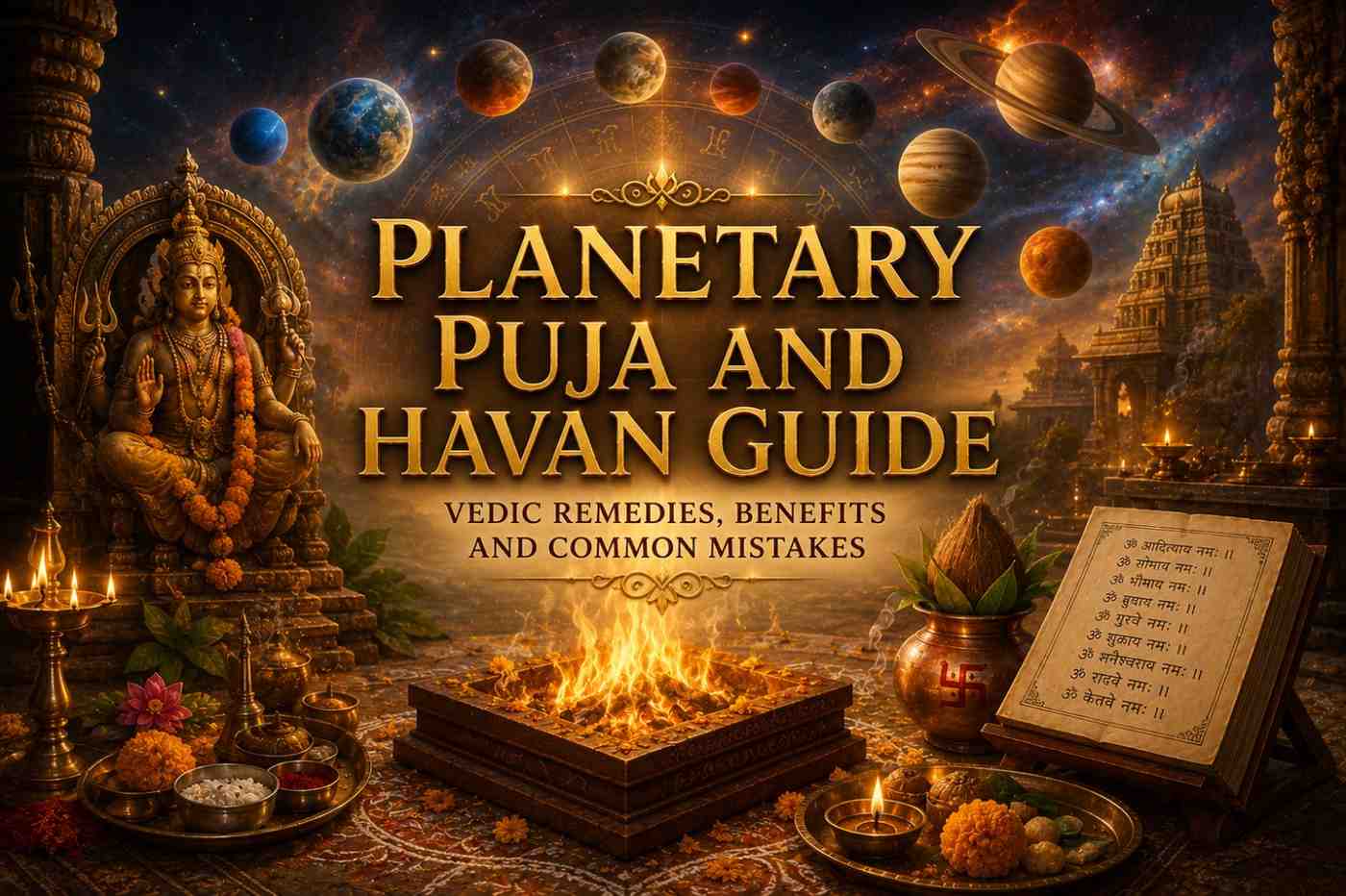
Planetary puja and havan are formal Vedic worship ceremonies used to pacify a difficult planet or strengthen a weak one. A puja combines offerings, mantras, and ritual; a havan adds a sacred fire ceremony. They are the most structured remedy category — and also the most commercially exploited. Personal sincerity matters more than ceremony scale.
- ◦Planetary Puja and Havan: Quick Reference
- ◦What Planetary Puja and Havan Actually Are
- ◦The Major Graha Puja Ceremonies
- ◦How a Planetary Puja Is Structured
- ◦Doing Puja Yourself vs. Having It Performed by Priests
- ◦The Commercial Exploitation Problem — Read This Carefully
- ◦How to Use Planetary Puja Sensibly
- ◦A Final Word
Here's something worth knowing before you read anything else in this guide: planetary puja is the one remedy category where people get exploited the most. Scary dosha diagnoses, expensive packages, remote ceremonies with "guaranteed" results — it's a real problem, and it's widespread.
So yes, this guide covers everything about planetary pujas and havans — what they are, how they work, the major ceremonies, when they're genuinely worth doing. But it's also going to be honest about the commercial side, because that honesty is arguably the most useful thing this guide can offer.
The good news? The classical tradition itself is clear: your own intention and devotion are essential to any puja's effect. Which means the remedy was never something you could simply buy. That's worth holding onto.
Planetary Puja and Havan: Quick Reference
| Detail | Information |
|---|---|
| Puja | Formal structured worship — offerings, mantras, ritual |
| Havan / Homa / Yagna | Fire ceremony — offerings into consecrated fire with mantras |
| Navagraha Puja | Worship of all nine planets together |
| Graha Shanti | Puja specifically to pacify a difficult planet |
| Who performs it | Often trained priests; simpler pujas can be done personally |
| Key caution | Most commercially exploited remedy category — caution essential |
What Planetary Puja and Havan Actually Are
A puja is a formal act of worship structured according to traditional procedure. Direct it toward a specific graha and you have a planetary puja — an organized ceremony that typically includes invoking the planet and its presiding deity, making offerings, reciting the planet's mantras a specified number of times, and often culminating in a havan.
The havan — also called homa or yagna — is where things get especially interesting. Fire (Agni) holds a sacred place in the Vedic tradition as the carrier and purifier of offerings.
When you make offerings into a consecrated fire while reciting mantras, those offerings are understood to reach the planetary and divine energies directly. A full planetary havan can involve reciting the planet's mantra 11,000, 18,000 times or more — sometimes across multiple days.
What makes puja work, according to the tradition, isn't just the ritual mechanics. It's the combination of precise procedure, powerful mantras recited in volume, the lineage carried by trained priests — and, crucially, the conscious devotional intention of the person for whom the puja is performed.
That last part is what makes the commercial exploitation of puja so contrary to the tradition's own understanding.
The Major Graha Puja Ceremonies
Navagraha Puja and Navagraha Shanti
Worship of all nine planets together — for general planetary balance and the pacification of multiple afflictions at once. This is often performed at the start of major life undertakings: a new home, a new business, a marriage. When several planets in a chart need attention simultaneously, the Navagraha Puja is the classical comprehensive approach.
Individual Graha Shanti Pujas
Each planet has its own dedicated puja and shanti ceremony:
- Surya Puja / Aditya Havan — Sun: vitality, authority, father-relationship, government matters
- Chandra Puja — Moon: emotional stability, mental peace, mother-relationship
- Mangal Puja / Mangal Shanti — Mars: Manglik Dosha, courage, protection
- Budh Puja — Mercury: intelligence, communication, commerce
- Guru Puja / Brihaspati Havan — Jupiter: wisdom, prosperity, education, dharma
- Shukra Puja — Venus: relationships, harmony, comfort
- Shani Puja / Shani Shanti Havan — Saturn: Sade Sati, Shani Dosha, Saturn Mahadasha relief
- Rahu Puja / Rahu Shanti — Rahu afflictions and confusion
- Ketu Puja / Ketu Shanti — Ketu afflictions and sudden losses
Dosha-Specific Pujas
These are the ceremonies most often targeted by commercial exploitation — and also the ones with the most genuine classical support when performed properly:
- Kaal Sarp Dosha Nivaran Puja — performed especially at Trimbakeshwar and Kalahasti; pairs naturally with the Navagraha Mantras Guide practice for Rahu-Ketu
- Mangal Dosha / Manglik Nivaran Puja — for Manglik Dosha, sometimes including Kumbh Vivah
- Pitra Dosha Nivaran Puja / Narayan Nagbali — for ancestral karmic patterns, especially at Gaya and Trimbakeshwar
- Nadi Dosha Nivaran Puja — performed before marriage when Nadi Dosha is present and uncancelled
- Mahamrityunjaya Havan — for health, longevity, and protection; the fire ceremony form of the Mahamrityunjaya Mantra Guide practice
- Graha Shanti — for a specific afflicted planet identified through chart analysis
How a Planetary Puja Is Structured
The details vary by tradition and region, but here's the general shape of a planetary puja:
- Sankalpa — the formal statement of intention: naming the person, the purpose, the planet being addressed. This is where your conscious intention enters the ceremony — and why it matters that you're present for it
- Invocation — calling the planet, its presiding deity, and often Ganesha (for an auspicious beginning) into the worship
- Offerings — flowers, the planet's associated items, food offerings, light, and incense presented with mantras
- Mantra japa — recitation of the planet's mantra a specified number of times (traditionally fixed per planet)
- Havan — if included, offerings into the consecrated fire with mantras; often the central and most powerful portion
- Concluding rites — final offerings, aarti, prasad distribution, and dakshina (offering to the priests)
Doing Puja Yourself vs. Having It Performed by Priests
This is a genuinely important question and the tradition has a clear answer: both are valid, for different scales and purposes.
For personal home practice — a simple planetary puja at your home altar on the planet's day is entirely valid and traditionally encouraged. Invocation, offerings, and mantra recitation. No priest required. In fact, personal worship carries the significant advantage of your own direct devotion and intention — which the tradition considers essential regardless of who else is involved.
For ongoing planetary support, sincere simple personal puja combined with mantra practice is genuinely effective. Reading your birth chart well enough to know which planet you're working with is really all you need to start.
For elaborate havans — this is where trained priests add genuine value. Tens of thousands of mantra repetitions, precise Vedic procedure, fire ceremony — this requires the correct pronunciation, procedural knowledge, and capacity that a trained lineage carries. For major dosha-specific pujas at pilgrimage temples, the temple's own priests are the right officiants.
But here's what never changes: even when priests perform the puja, the person for whom it is performed should be present, engaged, and holding genuine intention. The moment it becomes an outsourced transaction — just a name on a list and a payment made — it has drifted from what the tradition actually describes.
If you want to understand what your chart genuinely needs before deciding on any ceremony, Gargi, Vedaz's AI astrologer specializing in personality and personal growth can help you understand your chart's actual configuration and which remedies genuinely fit your situation.
The Commercial Exploitation Problem — Read This Carefully
This is the most important section in this guide. Planetary puja, more than any other remedy category, has been heavily commercialized — and the patterns are consistent enough that knowing them protects you.
Online "puja services" with guaranteed results are the most exploitative corner of the astrology industry. A genuine puja carries no guarantee — it is devotional practice, not a purchased outcome. Any service promising guaranteed dosha removal through a remote ceremony is misrepresenting both the remedy and the tradition.
Fear-based selling is the clearest warning sign. An astrologer who emphasizes how catastrophic your dosha is — and then offers an expensive puja as the only solution — is using fear as a sales tool. The classical tradition does not support this framing. A genuine practitioner gives you an honest assessment and starts with accessible remedies.
The escalating cost pattern is a red flag. Genuine temple pujas have set, often quite modest costs. When quotes run into very large sums for "powerful" ceremonies, or when pressure mounts to perform increasingly expensive rituals, that is commercial exploitation — not classical remedy.
The free reading → alarming diagnosis → expensive package pattern is perhaps the most widespread exploitation in the entire astrology industry. Recognize it. Walk away from it.
A remote puja you merely pay for — without presence, engagement, or intention — misunderstands what puja fundamentally is. The tradition is explicit: the person's own devotion and intention are essential to the ceremony's effect.
How to Use Planetary Puja Sensibly
Here's a practical framework:
- Start with the foundation — mantra, fasting, daan, simple personal puja. This addresses most planetary support needs and is genuinely effective. The Hanuman Chalisa Benefits Guide and Vedic Gemstones Complete guide both cover accessible remedy options that should come before expensive ceremonies
- Reserve elaborate havans for genuine occasions — major life undertakings, or serious afflictions confirmed by thorough chart analysis
- Be present and engaged when having a puja performed — your intention is not optional
- Use genuine temples and their own priests for dosha-specific pujas — Trimbakeshwar for Kaal Sarp, Gaya for Pitra Dosha
- Verify the diagnosis first — never perform an expensive dosha puja without confirming the dosha is genuinely present and uncancelled
- Combine puja with ongoing practice — a puja anchors a remedy; it doesn't replace sustained daily work
- Refuse fear-based pressure — if the framing is "your dosha is catastrophic and only this expensive puja can fix it," that is a sales tactic, not the classical tradition
A Final Word
Planetary puja occupies a real and meaningful place in the Vedic remedy tradition. A genuine ceremony, performed with devotion and conscious intention, for a real occasion or a serious confirmed affliction — that's what the tradition describes and what genuinely has value.
But the honest picture is this: the foundation of planetary remedy is not the expensive ceremony. It's the sustained personal practice of mantra, fasting, daan, and simple personal worship — which is genuinely effective, costs nothing, and is available to everyone, right now.
If you're ever in a conversation where a free reading leads to an alarming dosha diagnosis leads to an expensive puja package as the only solution — recognize that pattern for what it is. A commercial tactic. Not the classical tradition.
The tradition itself tells you that your own intention and devotion are essential to any puja's effect. Which means the remedy was never something that could simply be bought.
Start with the foundation. Reserve elaborate ceremonies for genuine occasions. And let any puja you do undertake be what the tradition actually intends: a structured act of genuine devotion. Not an outsourced transaction.
For those wanting to explore where spiritual practice and personal growth intersect in your chart, Moksha, Vedaz's AI astrologer specializing in spiritual guidance and mental peace can help you understand which practices genuinely align with where you are on your path right now.
Saanvika Iyengar
Vedic Remedies, Planetary Worship & Ritual Practices | 11+ Years
Saanvika Iyengar specializes in traditional Vedic remedies, planetary worship practices, and ritual observances. Her articles help readers understand the significance of planetary pujas and their place within broader Hindu devotional traditions.
Frequently Asked Questions
1. What is a planetary puja?
A planetary puja is a formal structured worship ceremony directed toward a specific graha or all nine planets together. It typically includes invocation of the planet and its deity, offerings, recitation of the planet's mantras a specified number of times, and often a havan (fire ceremony). It is the most elaborate category of Vedic astrological remedy, used to pacify a difficult planet or strengthen a weak one.
2. What is the difference between a puja and a havan?
A puja is a formal worship ceremony of offerings, mantras, and ritual. A havan (also called homa or yagna) is specifically a fire ceremony — offerings made into a consecrated fire while mantras are recited. Fire (Agni) is regarded in the Vedic tradition as the carrier and purifier of offerings, making havan especially potent. The havan is often the central portion of a larger puja.
3. Can I do a planetary puja myself, or do I need a priest?
Both are valid for different scales. A simple personal planetary puja at a home altar on the planet's day is entirely valid — invocation, offerings, mantra recitation — and carries the significant advantage of your own direct devotion. For large havans involving tens of thousands of mantra repetitions and precise Vedic procedure, trained priests carry genuine value. Even then, the person for whom the puja is performed should be present and genuinely engaged.
4. Are expensive online dosha removal pujas legitimate?
Be very skeptical. Online puja services promising guaranteed results through remote ceremonies are the most exploitative corner of the astrology industry. A genuine puja carries no guarantee — it is devotional practice, not a purchased outcome. The clearest warning signs are fear-based selling, escalating costs, and the pattern of a free reading followed by an alarming diagnosis followed by an expensive package. The tradition is explicit: your own intention and devotion are essential to any puja's effect.
5. When is an elaborate havan actually worth doing?
Elaborate priest-performed havans have a genuine place for major life undertakings — a new home, business, or marriage — and for serious, well-identified afflictions confirmed by thorough chart analysis. They should be performed at genuine temples by genuine priests, with the person present and engaged, at honest cost. They should never be the first remedy reached for. Sincere personal practice is the foundation.
6. How do I avoid being exploited by puja services?
Verify the diagnosis first — never perform an expensive dosha puja without confirming the dosha is genuinely present and uncancelled. Refuse fear-based sales pressure. Recognize the free reading → alarming diagnosis → expensive package pattern. Use genuine temples and their own priests for dosha-specific ceremonies. And remember: sincere personal practice is the effective foundation, and elaborate havans are for genuine occasions at honest cost, with your real engagement.
Related Blogs

Saraswati Puja: Science Behind Yellow Sweets
Yellow sweets on Saraswati Puja aren't just tradition—they're science, emotion, and energy in one. Find out how colour, food, and devotion come together in this surprising story of wisdom and wellness

Are You Doing Shiv Puja In The Right Way?
Shiv Pooja isn’t about perfection—it’s about presence. Discover the small yet powerful steps you might be skipping, and how they can transform your prayer into a deeper, more personal experience.
Easy Lakshmi Pooja Steps For Inner Peace
You don’t need perfection to feel divine peace. Just a diya, a flower, and a moment of stillness. This gentle Lakshmi Pooja is a soft reminder that grace begins within.
Navgraha Pooja: A Powerful Spiritual Start
Struggling with delays, confusion, or emotional heaviness? Navgraha Pooja might be the spiritual shift you need. Learn how this ancient practice helps you align with cosmic energy and reclaim inner peace.