Yantras in Vedic Astrology: Meaning, Types, Benefits and Proper Use
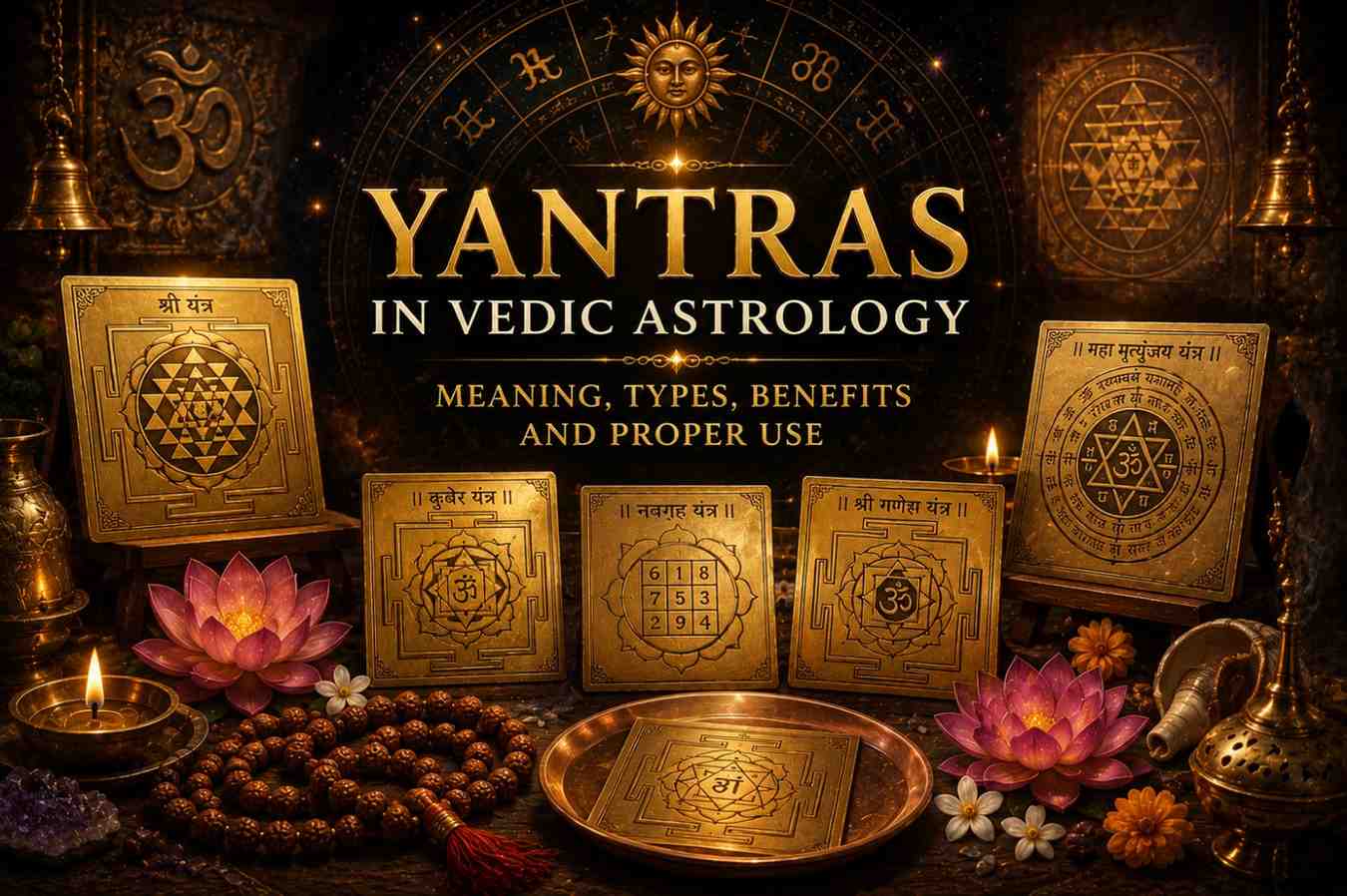
Yantras are sacred geometric diagrams used in Vedic astrology as instruments for meditation, focus, and planetary remedy. Each of the nine planets has an associated yantra. Lower-risk than gemstones, yantras work as focusing tools rather than amplifiers. They must be energized through mantra before use and work best when paired with the matching planetary mantra.
Most people have seen a yantra without fully knowing what they were looking at. That intricate geometric diagram in a temple, on an altar, or hanging in someone's home — layers of triangles, lotus petals, a square border, and a single dot at the center. It looks like art. But in the Vedic tradition, it is something more precise than that.
A yantra is an instrument. Not a decoration, not a charm, not a magical object you own and benefit from passively. An instrument — meaning it does something, but only when you actually use it.
This guide covers what yantras are, how they work within the classical remedy system, all nine planetary yantras, the key deity yantras, and how to choose, energize, and use them properly.
What Yantras Are and How They Work
A yantra is a precise geometric composition — built from interlocking triangles, circles, lotus petals, squares, and a central point called the bindu — arranged according to strict traditional specifications. Each yantra is understood to be a visual representation of a specific cosmic energy: a planet, a deity, or a principle.
The key word there is precise. The geometry isn't decorative — it is functional. The specific arrangement of forms is held to resonate with the energy it represents, the same way a specific mantra's sound is held to resonate with the energy it invokes. Yantra and mantra are, in this sense, two dimensions of the same thing — one visual, one sonic.
In practice, yantras work primarily as instruments of focus and meditation. Gazing at a yantra, meditating before it, or placing it in a worship space gives you a tangible focal point for directing attention toward the planetary or divine energy you are working with.
This is also what makes yantras lower-risk than gemstones. In the Vedic Gemstones Complete guide, gemstones are described as amplifiers — they strengthen a planet's energy, for better or worse. Yantras don't amplify in the same way. They focus and orient. That's a meaningfully different mode of action, and a gentler one.
The Nine Planetary Yantras (Navagraha Yantras)
Each graha has an associated yantra, used to support that planet's energy when it is weak but benefic in the chart — or to bring steadiness during a difficult planetary period.
Surya Yantra (Sun) For vitality, authority, confidence, father-relationship, and government connection. Energized on Sundays. Pairs with the Sun's Naam or Beej mantra.
Chandra Yantra (Moon) For emotional stability, mental peace, intuition, and mother-relationship. Energized on Mondays. Particularly useful for a weak or heavily afflicted Moon.
Mangal Yantra (Mars) For courage, energy, and protection from enemies. Used specifically for Manglik Dosha support. Energized on Tuesdays. Pairs naturally with the Hanuman Chalisa Benefits Guide practice for Mars afflictions.
Budh Yantra (Mercury) For intelligence, communication, commerce, and learning. Energized on Wednesdays. Useful when Mercury is weak and affecting intellectual or communicative capacity.
Guru / Brihaspati Yantra (Jupiter) For wisdom, prosperity, education, and dharma. Energized on Thursdays. One of the more broadly auspicious planetary yantras given Jupiter's natural benefic nature.
Shukra Yantra (Venus) For relationships, harmony, comfort, and artistic capacity. Energized on Fridays. Useful when Venus is weak and affecting relationships or material wellbeing.
Shani Yantra (Saturn) For discipline, career stability, and relief during Sade Sati and other Saturn periods. Energized on Saturdays. One of the most commonly used planetary yantras given how frequently Saturn-related periods affect people.
Rahu Yantra For protection from Rahu-related confusion, handling unconventional situations, and foreign success. Energized on Saturdays. Requires chart confirmation before use.
Ketu Yantra For spiritual insight, protection from sudden losses, and clarity during Ketu-dominated periods. Energized on Saturdays. Also requires chart confirmation.
The Navagraha Yantra — a combined yantra incorporating all nine planetary energies — is widely used for general planetary balance and is a practical choice when a single planetary focus isn't clear.
The Most Important Deity Yantras
Sri Yantra (Sri Chakra)
The most revered yantra in the entire tradition. The Sri Yantra is composed of nine interlocking triangles radiating from a central bindu, forming 43 smaller triangles, surrounded by lotus petals and a square enclosure with four gates. It is associated with the goddess Lalita Tripura Sundari — and with abundance, prosperity, and spiritual completeness.
It is used both as a deep meditation instrument and as a placement in homes and businesses for prosperity. If there is one yantra that has earned its near-universal recommendation across traditions, it is this one.
Other Widely-Used Deity Yantras
- Ganesh Yantra — removal of obstacles, auspicious beginnings
- Lakshmi Yantra — wealth, prosperity, financial stability
- Kuber Yantra — wealth accumulation and financial growth
- Durga Yantra — protection, courage, removal of negative influences
- Hanuman Yantra — courage, strength, protection; pairs naturally with Hanuman Chalisa Benefits Guide practice
- Saraswati Yantra — knowledge, learning, education, creative and intellectual work
- Maha Mrityunjaya Yantra — health, longevity, protection; pairs with the Mahamrityunjaya Mantra Guide practice
- Vastu Yantra — harmonizing the energy of a home or building
How Yantras Are Energized and Used
Energizing (Prana Pratishtha)
A yantra must be energized before use through a process called prana pratishtha — the invocation of life-energy into the object. This is done through recitation of the appropriate mantra for the yantra's planet or deity, performed a specified number of times, ideally during an auspicious time.
Some practitioners have yantras energized by qualified priests. Others energize them personally through dedicated mantra practice — which the tradition considers entirely valid. What matters is sincerity and correct practice, not ritual grandeur.
An un-energized yantra is traditionally considered an inert diagram rather than a functional instrument. This point matters practically: buying a yantra and placing it on a shelf without energizing it is not the same as using a yantra.
Placement and Use
- In a home worship space (puja room or altar) — facing east or north, kept clean and respected
- As a meditation focal point — gazing at the central bindu and the surrounding geometry to concentrate the mind
- In trataka practice — steady, concentrated gazing at the yantra as a formal meditation discipline
- In a business or workspace — particularly Sri Yantra, Lakshmi Yantra, or Kuber Yantra for prosperity
- As a pendant or small carried yantra — energized planetary yantras worn for ongoing support
- Combined with the matching mantra — yantra and mantra together is the traditional pairing, and the most effective one. See the Navagraha Mantras Guide for the full planetary mantra reference
Care
- Keep the yantra clean and in a respected place — not on the floor or in cluttered areas
- Metal yantras (copper, silver, gold) are traditional and durable; paper yantras should be protected from moisture and damage
- Periodically re-energize through mantra practice
- Treat it as a sacred instrument, not a decorative object
How to Choose Which Yantra to Use
Like planetary mantras, yantras are most effective when chosen based on what your chart actually needs. Here's how to identify that:
- The yantra of your Lagna lord — for overall vitality and life direction support
- The yantra of a weak but functionally benefic planet — to directly support that planet
- The yantra of your current Mahadasha ruler — for navigating that period with greater steadiness
- The yantra of a dosha-causing planet — Mangal Yantra for Manglik, Shani Yantra for Shani Dosha
- A deity yantra aligned with a specific life goal — Lakshmi or Kuber for finances, Saraswati for education, Durga for protection
- Sri Yantra or Navagraha Yantra — for general support when a single planetary focus isn't clear
As with mantras, supporting a functionally malefic planet can be counterproductive — but since yantras are focusing instruments rather than amplifiers, the risk is lower than with gemstones.
For the most precise selection, understanding your birth chart well enough to identify which planet genuinely needs support is the right starting point.
If you'd like personalized guidance on which yantra suits your current planetary configuration, you can speak with Atri, Vedaz's AI astrologer specializing in astrological remedies — who can assess your chart's specific remedy needs across yantras, mantras, and other classical practices.
Honest Guidance on Yantras
A few things worth saying plainly:
- Yantras are lower-risk than gemstones — focusing instruments, not amplifiers. The risk of harm from a suboptimal choice is genuinely lower
- A yantra works through the focus and meditation it supports — it is most effective when actually used, not merely owned or displayed
- Energizing matters — an un-energized yantra is traditionally an inert diagram. Sincere personal energizing through mantra practice is valid and meaningful
- Yantra and matching mantra together is the traditional and most effective pairing — one without the other misses the point
- Be cautious of expensive "pre-energized" yantras from unverified sellers — personal energizing through genuine practice carries as much validity as any priest's ritual
- Geometric precision matters in traditional yantra construction — a poorly-drawn or mass-produced yantra of low quality is considered less effective. Source from reputable makers
- A yantra placed in a drawer is an inert diagram. A yantra used daily is what the tradition intends
A Final Word
Yantras occupy a gentle and accessible place in the remedy tradition. Focusing instruments rather than amplifying objects. Lower-risk than gemstones. Genuinely useful as supports for meditation and worship when they are actually used as such.
That last part is everything. A yantra placed in a drawer is an inert diagram. A yantra used daily is what the tradition intends — an instrument for the conscious cultivation of the energies you are working to strengthen.
Choose the yantra your chart actually needs. Energize it sincerely through mantra practice. Pair it with the matching mantra. And use it — as a meditation focal point, as a worship anchor, as a daily turning of attention toward what you are genuinely working to strengthen.
The benefit comes through use. That is the whole point of calling it an instrument.
For those building a complete remedy practice, Moksha, Vedaz's AI astrologer specializing in spiritual guidance and mental peace can help you understand how yantra practice fits into your broader spiritual path — and which practices are most suited to where you are right now.
Meenakshi Venkatesan
Sacred Geometry, Yantra Traditions & Ritual Symbolism | 10+ Years
Meenakshi Venkatesan specializes in sacred geometry, yantric traditions, and symbolic aspects of Hindu spiritual practices. Her articles aim to explain complex concepts in a clear and respectful manner.
Frequently Asked Questions
1. What is a yantra?
A yantra is a sacred geometric diagram used in the Vedic tradition as an instrument for meditation, focus, and planetary remedy. The word combines "yam" (to control or sustain) and "tra" (instrument). Each yantra is a precise composition of triangles, circles, lotus petals, and a central point (bindu), understood to represent and resonate with a particular planetary or divine energy.
2. What are the nine planetary yantras?
The Navagraha yantras are: Surya Yantra (Sun), Chandra Yantra (Moon), Mangal Yantra (Mars), Budh Yantra (Mercury), Guru/Brihaspati Yantra (Jupiter), Shukra Yantra (Venus), Shani Yantra (Saturn), Rahu Yantra, and Ketu Yantra. Each supports its planet's energy when that planet is weak but benefic, or helps bring steadiness during a difficult planetary period. A combined Navagraha Yantra incorporates all nine.
3. What is the Sri Yantra?
The Sri Yantra (or Sri Chakra) is the most revered yantra in the Vedic tradition — composed of nine interlocking triangles radiating from a central bindu, forming 43 smaller triangles, surrounded by lotus petals and a square enclosure with four gates. It is associated with the goddess and with abundance, prosperity, and spiritual completeness. It is used both as a meditation instrument and as a placement in homes and businesses.
4. How do I use a yantra?
A yantra is traditionally energized first through prana pratishtha — mantra recitation invoking the planet or deity. Then it can be placed in a home worship space facing east or north, used as a meditation focal point, used in trataka gazing practice, placed in a business for prosperity, or worn as an energized pendant. The traditional and most effective approach pairs the yantra with its matching mantra.
5. Are yantras safer than gemstones?
Generally yes. Gemstones amplify a planet — so the wrong gemstone can amplify a malefic planet and cause harm. Yantras are focusing and meditation instruments rather than amplifiers, making them lower-risk. That said, for precise selection of a planetary yantra, chart consultation is worthwhile, since supporting a functionally malefic planet can still be counterproductive.
6. Do I need to energize a yantra before using it?
Yes, in the traditional understanding. A yantra is energized through prana pratishtha — recitation of the appropriate planetary or deity mantra a specified number of times, ideally during an auspicious time. An un-energized yantra is traditionally considered an inert diagram. You can have it energized by a qualified priest or energize it personally through dedicated mantra practice — both are valid.
Related Blogs
Boost Your Health with Astrology
Boost your health with astrology using zodiac-based habits, wellness tips, and simple routines for better physical and mental balance.

The Socking Truth Behind Wearing A Black Thread
Uncover the mystery behind the black thread. From protection to spiritual energy—here’s why everyone’s suddenly wearing one.

Hidden Messages In Your Moles
What if that little mole on your cheek is more than just a mark? Explore the fascinating meanings behind mole placements and what they reveal about your future.
Who Is Your Ishta Devata?
Explore the concept of your personal God in Hinduism. Learn how to discover, connect with, and build a relationship with your Ishta Devata for inner peace and spiritual growth.